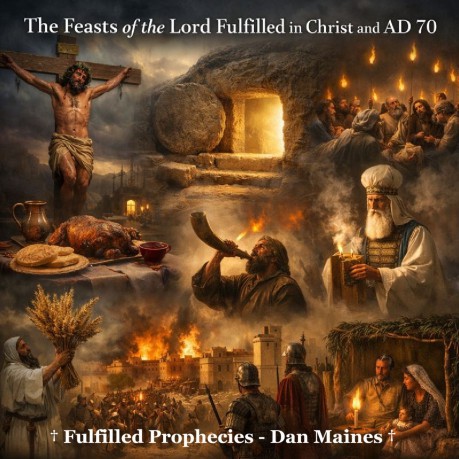
The Feasts of the Lord
Fulfilled in Christ and AD 70 Introduction † This message is not about Jewish ritual, it
is about Christ fulfilling what God established from the beginning. Leviticus 23:1-2 † The feasts are called the Lord's appointed
times, not Israel's traditions. 1 Corinthians 5:7 † Passover was fulfilled at the cross when
Christ was sacrificed. John 19:30 † Redemption language confirms Passover
fulfillment. Romans 6:6 † Unleavened Bread was fulfilled at the cross
through Christ's sinless body and burial. Hebrews 4:15 † Christ's sinlessness fulfills the requirement
of unleavened bread. 1 Corinthians 15:20 † Firstfruits was fulfilled in the resurrection
of Christ. Acts 2:1-4 † Pentecost was fulfilled with the outpouring
of the Spirit. † These four feasts are the spring feasts. Matthew 24:31-34 † Trumpets pointed to warning and gathering
before judgment. Hebrews 9:26 † The Day of Atonement pointed to final
covenantal cleansing. Hebrews 10:9 † Day of Atonement themes are fulfilled by the
removal of the first covenant. Revelation 21:1-3 † Tabernacles pointed to God dwelling fully
with His people. † All seven feasts find fulfillment in Christ
and His completed work. Historical References † Josephus records the destruction of the
temple in AD 70, confirming the end of sacrificial worship. How It Applies To Us Today † We do not live waiting for unfinished
feasts. Q and A Appendix † Question: Why were some feasts fulfilled at
the cross and others in AD 70. † Question: How do we know Passover was
fulfilled at the cross. † Question: Where is Unleavened Bread fulfilled
if it is not named directly. † Question: Why is Firstfruits tied to the
resurrection and not AD 70. † Question: Why is Pentecost considered
fulfilled and not ongoing. † Question: Why are Trumpets, Atonement, and
Tabernacles placed in AD 70. † Question: Does this mean AD 70 completed
Christ's work. † Question: Is any feast still awaiting future
fulfillment. † Question: Why is this important for believers
today. Futurist Objection Refuter † The futurist claim that the feasts await
future fulfillment fails because Scripture explicitly identifies
Christ as the fulfillment of the spring feasts and places the fall
feast fulfillment within that generation spoken of by Jesus. † This is the fulfilled perspective we proclaim at
Fulfilled Prophecies † Source Index † Leviticus 23:1-2; 1 Corinthians 5:7; John
19:30; Romans 6:6; Hebrews 4:15; 1 Corinthians 15:20; Acts 2:1-4;
Matthew 24:31-34; Hebrews 9:26; Hebrews 10:9; Revelation 21:1-3
By Dan Maines
†
God gave seven appointed feasts as prophetic markers pointing to
redemption, covenant transition, and completion.
†
The seven feasts are Passover, Unleavened Bread, Firstfruits,
Pentecost, Trumpets, the Day of Atonement, and Tabernacles.
†
Scripture itself shows that these feasts were not all fulfilled at
the same moment.
† From the fulfilled
perspective, the feasts fall into two fulfillment points, the cross
and AD 70.
† This distinction honors both
Christ's finished redemptive work and the historical removal of the
old covenant system.
† The spring feasts
point to redemption accomplished in Christ and the formation of the
new covenant people.
† The fall feasts point
to judgment, cleansing, and the completion of covenant transition.
†
Scripture consistently places the fulfillment of the fall feasts
within that generation.
The Lord spoke again to
Moses, saying,
Speak to the sons of Israel and say to them, The
Lord's appointed times which you shall proclaim as holy convocations,
My appointed times are these.
† Appointed
times indicate fixed moments in God's redemptive plan.
†
Fulfillment must be determined by Scripture, not assumptions of
future delay.
Clean out the old leaven
so that you may be a new lump, just as you are in fact unleavened.
For Christ our Passover also has been sacrificed.
† His death
accomplished redemption and ended the need for the Passover lamb.
†
Scripture explicitly identifies Christ as our Passover.
Therefore when Jesus had received
the sour wine, He said, It is finished. And He bowed His head and
gave up His spirit.
† Nothing related to sin
offering remained unfinished.
† The cross
closed the sacrificial system.
knowing this, that our old self
was crucified with Him, in order that our body of sin might be done
away with, so that we would no longer be slaves to sin.
†
The removal of leaven pictures the removal of sin through His
death.
† The crucifixion of the old self
corresponds to the putting away of the old life under the law.
For we do not have a high
priest who cannot sympathize with our weaknesses, but One who has
been tempted in all things as we are, yet without sin.
† His body contained no
corruption, no leaven.
† This establishes
Unleavened Bread as fulfilled in Him, not awaiting future completion.
But now Christ has been
raised from the dead, the first fruits of those who are asleep.
† He rose as the representative
head of the new creation.
† This guaranteed
the covenantal harvest that followed.
When the day of Pentecost had
come, they were all together in one place.
And suddenly there
came from heaven a noise like a violent rushing wind, and it filled
the whole house where they were sitting.
And there appeared to
them tongues as of fire distributing themselves, and they rested on
each one of them.
And they were all filled with the Holy Spirit
and began to speak with other tongues, as the Spirit was giving them
utterance.
† This marked the birth of the
new covenant people.
† The harvest age began,
not a waiting period for future fulfillment.
†
They were fulfilled in Christ and the early church.
†
No spring feast is left unfulfilled.
And He will send forth His
angels with a great trumpet and they will gather together His elect
from the four winds, from one end of the sky to the other.
Truly
I say to you, this generation will not pass away until all these
things take place.
† Jesus explicitly places
this event within that generation.
† This was
a covenantal gathering, not a future global relocation.
Otherwise, He would have needed
to suffer often since the foundation of the world, but now once at
the consummation of the ages He has been manifested to put away sin
by the sacrifice of Himself.
† The consummation of
the ages is singular, not ongoing.
† Sin
removal is connected to the end of the old age.
Then He said, Behold, I have
come to do Your will. He takes away the first in order to establish
the second.
†
Establishment of the second covenant required the first to end.
†
This process culminated historically in AD 70.
Then I saw a new heaven
and a new earth, for the first heaven and the first earth passed
away, and there is no longer any sea.
And I saw the holy city,
new Jerusalem, coming down out of heaven from God, made ready as a
bride adorned for her husband.
And I heard a loud voice from the
throne, saying, Behold, the tabernacle of God is among men, and He
will dwell among them, and they shall be His people, and God Himself
will be among them.
† The dwelling is people,
not stone.
† With the old covenant house
removed in AD 70, the new covenant dwelling stood complete.
† None remain
awaiting future fulfillment.
† The law's
shadows have given way to covenant reality.
†
Eusebius identifies the fall of Jerusalem as divine judgment and
covenantal transition.
† Irenaeus speaks of
Christ fulfilling the law and prophets, not postponing them.
† We live in the reality of fulfilled
redemption.
† Our worship is rooted in
Christ, not shadows.
† Answer:
Scripture shows two fulfillment moments, redemption accomplished at
the cross and covenant judgment completed in AD 70.
†
The Bible never teaches that all feasts must be fulfilled at the same
time.
† Answer: Scripture
explicitly states that Christ is our Passover who was sacrificed.
†
The sacrificial death of Christ ended the need for the feast it
fulfilled.
† Answer:
Unleavened Bread is fulfilled in Christ's sinless body and burial.
†
The removal of leaven pictures the removal of sin through His death.
† Answer:
Firstfruits required a representative resurrection, not a judgment
event.
† Christ rose first, guaranteeing the
covenantal harvest that followed.
† Answer:
Pentecost was fulfilled when the Spirit was given in Acts 2.
†
The feast marked the beginning of the harvest age, not an unfulfilled
promise.
† Answer: Jesus
places the trumpet gathering within that generation.
†
Hebrews connects atonement language to the removal of the old
covenant.
† Revelation presents God dwelling
with His people after the old system passed away.
† Answer: No. Christ's
redemptive work was finished at the cross.
†
AD 70 completed the covenantal transition and removed the old
covenant house.
† Answer: No. Scripture presents
all seven feasts as fulfilled.
† What remains
is living in the reality of what Christ has already completed.
† Answer: Because fulfilled feasts
mean we live in fulfillment, not expectation.
†
We are not waiting for shadows, we are walking in substance.
†
Futurism separates what Scripture joins by denying the cross as
fulfillment and ignoring covenantal time statements.
†
The Bible presents the feasts as shadows fulfilled in Christ and
completed through the removal of the old covenant system in AD 70.
© Fulfilled Prophecies - Dan
Maines.
†
Josephus, Wars of the Jews; Eusebius, Ecclesiastical History;
Irenaeus, Against Heresies
Links