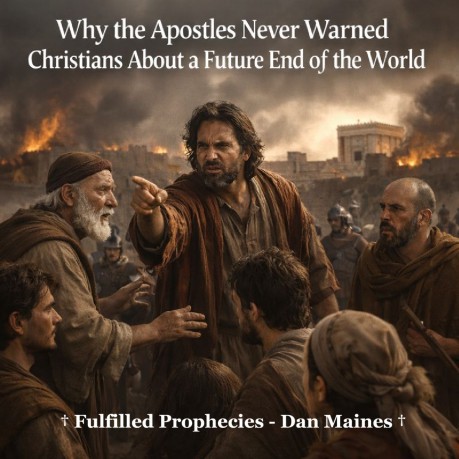
Why the Apostles Never Warned
Christians About a Future End of the World Introduction † This message isn't built on speculation about
what the apostles might've believed, it's built on what they actually
wrote. 1 John 2:18 † John didn't warn them about a distant end of
the world, he identified their present time as the last hour. 1 Corinthians 7:29-31 † Paul described the time as shortened, not
extended into thousands of years. Galatians 1:6-7 † Paul's alarm wasn't about missing the end of
the world, it was about abandoning Christ. 2 Thessalonians 2:7 † Lawlessness wasn't future speculation, it was
already active. Hebrews 1:1-2 † Hebrews locates the last days in the
apostolic era itself. Hebrews 8:13 † Something was already obsolete and nearing
disappearance. Hebrews 10:25 † The day was visible and approaching, not
hidden centuries away. 1 Peter 4:7 † Peter didn't soften his language or redefine
near. Historical References † Early Christian writers consistently tied the
apostles' warnings to the events leading up to Jerusalem's
destruction. How It Applies To Us Today † We aren't called to live in fear of missing a
future apocalypse. Q and A Appendix † Question: If the apostles believed in a
future end of the world, why didn't they warn believers about missing
it? † Question: Didn't the apostles talk about the
end? † Question: Why didn't they explain signs of a
future global apocalypse? † Question: Could the apostles have been
mistaken about timing? † Question: Why does modern Christianity warn
about what the apostles never did? † This is the fulfilled perspective we proclaim at
Fulfilled Prophecies † Source Index † 1 John 2:18; 1 Corinthians 7:29-31; Galatians
1:6-7; 2 Thessalonians 2:7; Hebrews 1:1-2; Hebrews 8:13; Hebrews
10:25; 1 Peter 4:7; James 5:8-9; Romans 13:11-12; Acts 20:29-30;
Colossians 2:8; Matthew 24:34; Hebrews 12:26-28
By Dan Maines
† If a future global end of the world
was central to apostolic teaching, we should expect repeated, urgent
warnings across the epistles.
† Instead, what
we find is silence on that idea, and silence can be just as loud as
spoken words.
† The apostles were not
careless men, they warned constantly, and what they warned about
tells us everything.
Children, it is the last hour;
and just as you heard that antichrist is coming, even now many
antichrists have appeared; from this we know that it is the last
hour.
†
The evidence wasn't future signs, it was what was already happening
among them.
† The apostolic concern was
immediate covenant crisis, not a postponed cosmic finale.
But this I say,
brethren, the time has been shortened, so that from now on those who
have wives should be as though they had none; and those who weep, as
though they did not weep; and those who rejoice, as though they did
not rejoice; and those who buy, as though they did not possess; and
those who use the world, as though they did not make full use of it;
for the form of this world is passing away.
† The world
passing away was already in motion, not waiting on modern events.
†
He warned them how to live through transition, not how to survive a
future apocalypse.
I am amazed that you are so
quickly deserting Him who called you by the grace of Christ, for a
different gospel; which is really not another; only there are some
who are disturbing you and want to distort the gospel of Christ.
†
False gospels were the danger, not future disasters.
†
Apostolic urgency focused on covenant faithfulness, not end times
escape.
For the mystery of
lawlessness is already at work; only he who now restrains will do so
until he is taken out of the way.
† The apostles framed the end
in present tense realities.
† This fits
covenant collapse language, not a delayed global catastrophe.
God, after He spoke long ago
to the fathers in the prophets in many portions and in many ways, in
these last days has spoken to us in His Son, whom He appointed heir
of all things, through whom also He made the world.
† These weren't the
last days of the planet, but the last days of the former covenant
order.
† The writer assumed his audience was
already living in them.
When He said, A new covenant,
He has made the first obsolete. But whatever is becoming obsolete and
growing old is ready to disappear.
† This language only makes
sense before AD 70, not after it.
† The
warning wasn't about the end of creation, but the removal of the Old
Covenant system.
not forsaking our own
assembling together, as is the habit of some, but encouraging one
another; and all the more as you see the day drawing near.
† Believers could see
it drawing near in their lifetime.
† Again,
there's urgency without a single warning about the end of the planet.
The end of all things is near;
therefore, be of sound judgment and sober spirit for the purpose of
prayer.
† The end he spoke of demanded
immediate spiritual readiness.
† A near end
fits covenant judgment, not a postponed global destruction.
† Josephus documented the
internal lawlessness, false prophets, and societal collapse exactly
as the apostles described.
† Eusebius
explicitly connected Jesus' and the apostles' warnings to AD 70, not
to a future end of the world.
† Clement of
Alexandria and Lactantius spoke of the apostolic age as the closing
of an era, not the countdown to the end of history.
† We're called to remain
faithful to Christ, just as the apostles urged their original
audiences to do.
† When we read the epistles
honestly, we learn what actually mattered to them.
†
Understanding apostolic silence protects us from importing modern
fears into ancient texts.
† Answer: Because their warnings were
directed at immediate covenant dangers, not a distant global event.
They warned about false teachers, law pushers, persecution, and
falling away from Christ, all framed as present threats (Galatians
1:6-9; Colossians 2:8; Acts 20:29-30).
† Answer: Yes, but when they did, they
consistently described it as near, approaching, or already at work.
They never described it as thousands of years away (1 John 2:18;
Hebrews 10:25; 1 Peter 4:7).
† Answer: Because
their audiences were facing the end of the Old Covenant order, not
the end of the planet. Their writings assume an imminent transition
already unfolding in their time (Hebrews 8:13; 2 Thessalonians 2:7).
† Answer: Scripture
never corrects them or reframes their language. Instead, later New
Testament writers repeat and intensify the same nearness language,
showing agreement, not confusion (James 5:8-9; Romans 13:11-12).
† Answer:
Because later theology shifted the focus from covenant fulfillment to
speculative futurism. The apostolic writings themselves set the
boundaries for what believers were meant to fear and prepare for
(Matthew 24:34; Hebrews 12:26-28).
© Fulfilled Prophecies - Dan
Maines.
†
Josephus, Wars of the Jews; Eusebius, Ecclesiastical History; Clement
of Alexandria; Lactantius
Links