The
Song of Moses and the Song of the Lamb Introduction: Deuteronomy 32, known as the Song
of Moses, is one of the most prophetic and judgment-centered
passages in the Old Testament. It is not simply a historical
lament. Moses, under the Spirit of God, spoke of the future of
Israel, especially the judgment that would come in their latter
days. That judgment was fulfilled in the first century, just as
Jesus warned the generation standing before Him. Main Message 1. The Song Was a Witness Against Israel Deuteronomy 31:29:
"For
I know that after my death you will act corruptly, and you will
turn from the way that I have commanded you, and evil will happen
to you in the latter days, because you will do what is evil in the
sight of the Lord, provoking Him to anger with the work of your
hands." These latter days were Israel's future at that
time, not ours. Jesus confirmed they applied to the generation He
confronted. 2. A Corrupt Generation Identified Deuteronomy 32:5:
"They
have acted corruptly against Him, they are not His children,
because of their defect; but are a perverse and crooked
generation." Deuteronomy 32:20:
"Then
He said, 'I will hide My face from them, I will see what their end
will be; for they are a perverse generation, sons in whom there is
no faithfulness.'" Jesus echoed this judgment: Matthew 17:17: "You
unbelieving and perverse generation..." Luke 9:41: "You unbelieving
and perverse generation..." Matthew 23:33-36: "You snakes... all these things will
come upon this generation." 3. Days of Vengeance Fulfilled Deuteronomy 32:41-43:
"I
will return vengeance on My adversaries... Rejoice, you nations,
with His people... He will avenge the blood of His servants..." Revelation fulfills this: Revelation 18:20: "God has
pronounced judgment for you against her." Revelation 18:24: "In her
was found the blood of prophets and saints..." Revelation 19:2: "He has avenged the blood of His
bond-servants on her." 4. The Apostolic Confirmation 1 Thessalonians 2:14-16:
"They
both killed the Lord Jesus and the prophets... The wrath has come
upon them to the utmost." Paul was witnessing the fulfillment of what Moses prophesied
in the Song. Judgment was already underway. 5. The Song of the Lamb Revelation 15:3-4:
"And
they sang the song of Moses, the bond-servant of God, and the song
of the Lamb..." These songs are not in conflict: The Song of Moses = Judgment on
Old Covenant Israel The Song of the Lamb =
Redemption through the Messiah Together they mark the
transition: From the Old Covenant to the New From judgment to victory The Song of the Lamb is sung by the redeemed in the New
Jerusalem. It is a present reality, not future. Conclusion: God's Word is consistent. The
judgment promised in Deuteronomy 32 came just as Jesus said it
would. The generation that rejected Him
bore the full weight of that wrath. The Song of Moses is not waiting
to be fulfilled. It was fulfilled in the first century as
a divine witness to God's justice. How can futurism stand when
Deuteronomy, Revelation, and Jesus Himself confirm fulfillment? The Song of Moses stands
fulfilled. The Song of the Lamb is now sung by the redeemed who
live in the New Jerusalem - the true people of God in the New
Covenant. Let us rejoice that we now live in the fulfilled kingdom,
under the reign of the risen Lamb. The Song of the Lamb
(Revelation 15:3-4 NASB):
"Great and marvelous
are Your works, Lord God, the Almighty;
Righteous and true are
Your ways, King of the nations!
Who will not fear You, Lord,
and glorify Your name?
For You alone are holy;
For all the
nations will come and worship before You,
For Your righteous
acts have been revealed." Key Points: Sung alongside the Song of Moses,
linking judgment on Israel to victory in Christ. The Song of Moses focuses on
judgment (Deuteronomy 32). The Song of the Lamb emphasizes
righteousness, worship, and victory. It is the New Covenant anthem of the redeemed - not future,
but fulfilled. Fulfilled Perspective: In the fulfilled view, the Song
of the Lamb is sung by the church - the New Jerusalem - after
judgment on apostate Israel. It celebrates: God's justice fulfilled Christ's kingdom established The gospel going out to all
nations post-70 AD It completes the transition: From the Song of Moses
(judgment) To the Song of the Lamb (victory) Together They Declare:
Justice
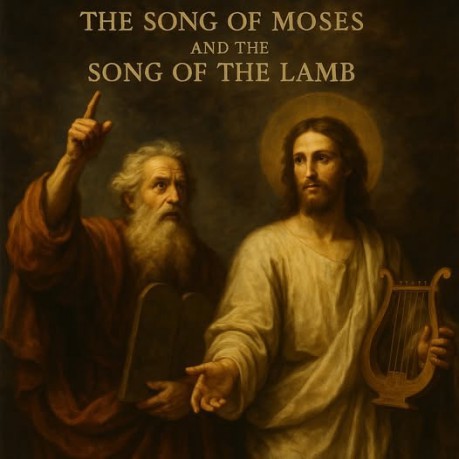
has been served, and Christ reigns forever. Visual Imagery: Moses holds a stone
tablet = The Law and the covenant of judgment (Deuteronomy
32). Jesus holds a lyre
= The song of redemption and praise (Revelation 15:3). This symbolizes the powerful transition from law to grace,
from judgment to salvation, from the Song of Moses to the Song of
the Lamb.
By Dan Maines
Links