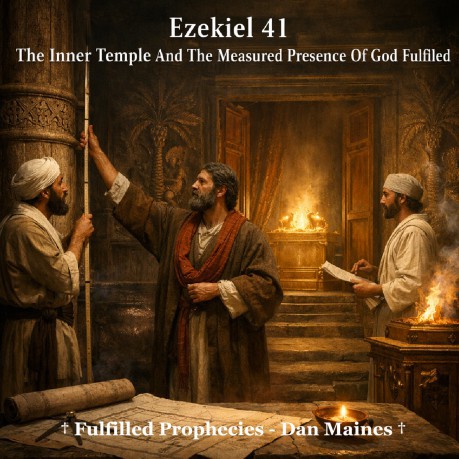
Ezekiel 41 The Inner Temple
And The Measured Presence Of God Fulfilled Introduction † Ezekiel 41 continues the detailed vision of
the temple, showing the inner structure, the Most Holy Place, and the
precise measurements of God's dwelling. † This vision is not about a future physical
building, it points to the perfected dwelling of God with His people,
fulfilled in Christ and completed in the judgment of the old system
in AD 70 (John 2:19-21). † The measurements show order, completion, and
divine design, revealing that God's presence is no longer tied to a
physical temple made with hands (Acts 7:48). Ezekiel 41:1-4 † The Most Holy Place represents the direct
presence of God, which under the old covenant was restricted and
inaccessible to the people (Hebrews 9:7). † In Christ, access is opened fully, the veil
was torn, showing that the true Most Holy Place is now entered
spiritually, not physically (Matthew 27:51). † The perfect measurements show completeness,
meaning God's dwelling is now fully established in His people, not in
a physical structure (Ephesians 2:21-22). Ezekiel 41:5-11 † The expanding structure shows growth and
increase, pointing to the expanding kingdom of God through the gospel
(Isaiah 9:7). † The chambers surrounding the temple reflect
the people of God being built into His dwelling, each connected but
distinct (1 Peter 2:5). † This structure grows upward, showing
spiritual maturity and fullness in Christ, fulfilled in the body of
believers (Colossians 2:19). Ezekiel 41:12-14 † The symmetry and precision show divine order,
God's dwelling is not random but perfectly established (1 Corinthians
14:33). † The repeated measurements emphasize
completion, pointing to the finished work of Christ and the end of
the old covenant system (Hebrews 8:13). † The fullness of the structure reflects the
fullness of God's presence now dwelling among His people permanently
(Revelation 21:3). Ezekiel 41:15-20 † The cherubim represent God's presence and
guardianship, just like in Eden, showing restored access to God
(Genesis 3:24). † The palm trees symbolize victory and life,
pointing to the restored blessing and eternal life in Christ (John
12:13). † This imagery shows that what was lost in Eden
is restored in Christ, access to God's presence is no longer blocked
(Revelation 22:14). Ezekiel 41:21-26 † The wooden altar shows a shift from sacrifice
to fellowship, pointing to the table of the Lord fulfilled in Christ
(1 Corinthians 10:21). † The repeated imagery of cherubim and palm
trees reinforces restored access and victory, showing that God's
presence is now open and life-giving. † The temple is no longer about animal
sacrifice, it is about communion with God through Christ, fulfilled
before the destruction of Jerusalem (Hebrews 10:12-14). Historical References † Josephus records the destruction of the
temple in AD 70, showing the end of the physical temple system. † Eusebius explains that believers understood
Christ as the true temple after Jerusalem fell. † Tertullian taught that God now dwells in His
people, not in buildings made with hands. How It Applies To Us Today † God's presence isn't found in buildings, it's
found in His people, we are the temple now (1 Corinthians 3:16). † Access to God is open, we don't need priests,
rituals, or physical temples, Christ has already fulfilled it
(Hebrews 4:16). † The order and structure remind us that our
lives should reflect God's design, built up and growing in Him
(Ephesians 4:15-16). † The imagery of life and access shows that
we're living in the restored reality, what was lost has been
fulfilled and given back through Christ. Q & A Appendix Q When was Ezekiel 41 fulfilled? Q Is this talking about a future physical
temple? Q What is the Most Holy Place now? Q Why all the measurements? Q What do the cherubim and palm trees mean? † This is the fulfilled perspective we proclaim at
Fulfilled Prophecies † Source Index † Ezekiel 41 † Josephus, Wars of the Jews; Eusebius,
Ecclesiastical History; Tertullian, Against Marcion
By Dan Maines
Then he brought me into the
nave and measured the side pillars, six cubits on each side was the
width of the side pillar. The width of the entrance was ten cubits,
and the sides of the entrance were five cubits on each side. He
measured its length, forty cubits, and the width, twenty cubits. Then
he went inside and measured each side pillar of the entrance, two
cubits, and the entrance, six cubits high, and the width of the
entrance, seven cubits. He measured its length, twenty cubits, and
the width, twenty cubits, before the nave, and he said to me, This is
the Most Holy Place.
Then he measured the wall of
the house, six cubits, and the width of each side chamber, four
cubits, around the house on every side. The side chambers were in
three stories, one over another, and thirty in each story, and they
entered the wall which belonged to the house for the side chambers
all around, so that they might have a hold, but they did not have a
hold in the wall of the house. The side chambers became broader as
they went around the house, because the structure of the house went
up all around the house. Therefore the width of the house continued
upward, and so one went up from the lowest story to the highest by
way of the second story. I also saw that the house had a raised
platform all around, the foundations of the side chambers were a full
rod of six long cubits. The thickness of the outer wall of the side
chambers was five cubits, and the open area that was left was the
place of the side chambers. Between the chambers there was a width of
twenty cubits all around the house on every side. The doorways of the
side chambers were toward the open area, one doorway toward the
north, and another doorway toward the south, and the width of the
open area was five cubits all around.
The building that was in
front of the separate area at the side toward the west was seventy
cubits wide, and the wall of the building was five cubits thick all
around, and its length was ninety cubits. Then he measured the house,
one hundred cubits long, and the separate area with the building and
its walls, also one hundred cubits long. Also the width of the front
of the house and of the separate areas along the east was one hundred
cubits.
He measured the length of
the building in front of the separate area behind it, with its
galleries on each side, one hundred cubits, and the inner nave and
the porches of the court. The thresholds, the beveled window frames,
and the galleries all around their three stories opposite the
threshold were paneled with wood all around, and from the floor to
the windows, now the windows were covered, to the space above the
door, even to the inner room, and on the outside, and on all the wall
all around inside and outside, by measurement. It was carved with
cherubim and palm trees, and a palm tree was between cherub and
cherub, and each cherub had two faces, so that the face of a man was
toward the palm tree on one side, and the face of a young lion toward
the palm tree on the other side, they were carved on all the house
all around. From the ground to above the door cherubim and palm trees
were carved, as well as on the wall of the nave.
The doorposts of the nave
were squared, as for the front of the sanctuary, the appearance was
similar. The altar was of wood, three cubits high and its length two
cubits, its corners, its base, and its sides were of wood, and he
said to me, This is the table that is before the Lord. The nave and
the sanctuary each had a double door. The doors had two leaves each,
two turning leaves, two leaves for the one door and two leaves for
the other. There were carved on them, on the doors of the nave,
cherubim and palm trees, like those carved on the walls, and there
was a threshold of wood on the front of the porch outside. There were
beveled window frames and palm trees on one side and on the other, on
the sides of the porch, thus were the side chambers of the house and
the thresholds.
A
It was fulfilled in Christ establishing the true temple and completed
with the destruction of the physical temple in AD 70 (John 2:19-21;
Hebrews 8:13).
A No, God does not dwell in temples
made with hands, this is fulfilled spiritually in Christ and His
people (Acts 7:48; Ephesians 2:21-22).
A
It is the presence of God accessed through Christ, not a physical
room (Hebrews 10:19-20).
A
They show completeness and perfection, pointing to God's finished
work in Christ (Colossians 2:10).
A
They represent restored access to God and victory, showing Eden
restored through Christ (Genesis 3:24; Revelation 22:14).
© Fulfilled Prophecies - Dan
Maines.
Links