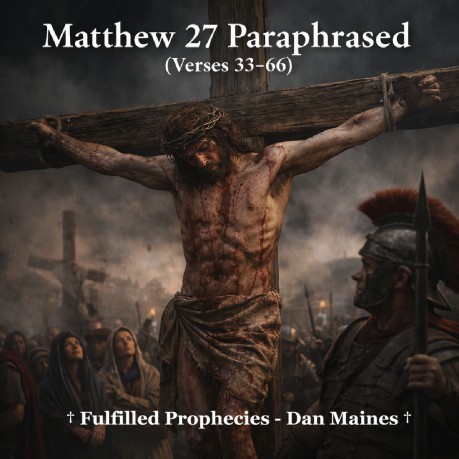
Matthew 27 Paraphrased
(Verses 33-66) Introduction † Matthew continues the account with the
crucifixion itself, the moment where the rejection of the Messiah by
the leaders of that generation reached its peak. The Roman execution
was brutal, public, and humiliating, yet it unfolded exactly as the
scriptures had foretold. † These events were not random acts of
violence. They fulfilled the prophetic descriptions of the suffering
Messiah and demonstrated that Jesus willingly laid down His life as
part of God's redemptive plan. † Even the smallest details surrounding the
crucifixion, from the dividing of His garments to the mocking of the
crowds, occurred in ways the prophets had already described centuries
earlier. Matthew 27:33 And when they came to a place called Golgotha, which means Place
of a Skull, † Golgotha was the location outside the city
where Roman executions were carried out. † The name likely came from the shape of the
hill or from the association with death and execution. † Roman law required crucifixions to occur
publicly outside the city walls. Matthew 27:34 They gave Him wine to drink mixed with gall, and after tasting it,
He was unwilling to drink it. † The drink was sometimes offered as a mild
pain reliever to those being crucified. † Jesus refused it, choosing to face the
suffering fully conscious. † This moment fulfilled the prophetic imagery
of the suffering servant (Psalm 69:21). Matthew 27:35 And when they had crucified Him, they divided His garments among
themselves by casting lots. † Roman soldiers commonly took the clothing of
the condemned. † This fulfilled Psalm 22:18 which predicted
the dividing of the Messiah's garments. † Even the actions of the soldiers unknowingly
fulfilled prophecy. Matthew 27:36 And sitting down, they began to keep watch over Him there. † Roman guards remained present to prevent
anyone from interfering with the execution. † Crucifixions could last many hours and
sometimes days. † The soldiers' watch ensured the sentence
would be carried out fully. Matthew 27:37 And above His head they put up the charge against Him which read,
THIS IS JESUS THE KING OF THE JEWS. † Roman executions included a written charge
explaining the crime. † The accusation reflected the political claim
brought before Pilate. † Ironically, the sign declared the truth about
Jesus' identity. Matthew 27:38 At that time two rebels were crucified with Him, one on the right
and one on the left. † Jesus was executed among criminals. † This fulfilled the prophecy that the Messiah
would be numbered with transgressors (Isaiah 53:12). † The placement further emphasized the
humiliation intended by the Romans. Matthew 27:39 And those passing by were hurling abuse at Him, shaking their
heads † The crucifixion took place along a public
road. † People passing by joined in mocking the
condemned. † The shaking of heads fulfilled Psalm 22:7. Matthew 27:40 And saying, You who are going to destroy the temple and rebuild it
in three days, save Yourself. If You are the Son of God, come down
from the cross. † The crowd misunderstood Jesus' earlier
statements about the temple (John 2:19). † They mocked the idea of His power while He
remained on the cross. † Their words reflected their disbelief in His
identity. Matthew 27:41 In the same way the chief priests also, along with the scribes and
elders, were mocking Him and saying, † The religious leaders who condemned Jesus
continued their ridicule at the cross. † Their actions demonstrated the complete
rejection of their Messiah. † They believed the crucifixion proved Jesus
was not the Christ. Matthew 27:42 He saved others, He cannot save Himself. He is the King of Israel,
let Him now come down from the cross, and we will believe in Him. † The leaders mocked the miracles Jesus had
performed. † They misunderstood that remaining on the
cross was part of the mission. † Their demand for a sign ignored the many
signs already given. Matthew 27:43 He trusts in God, let God rescue Him now, if He delights in Him,
for He said, I am the Son of God. † This mockery echoed the words predicted in
Psalm 22:8. † The leaders used Jesus' own claims against
Him. † They believed the crucifixion disproved His
relationship with God. Matthew 27:44 The rebels who had been crucified with Him were also insulting Him
in the same way. † Even those suffering beside Him initially
joined the mocking. † The humiliation surrounding the crucifixion
was complete. † Luke records that one of the criminals later
changed his response (Luke 23:39-43). Matthew 27:45 Now from the sixth hour darkness fell upon all the land until the
ninth hour. † The darkness lasted approximately three
hours. † Such darkness symbolized divine judgment in
scripture (Amos 8:9). † The event marked the solemn moment
surrounding the death of Jesus. Matthew 27:46 And about the ninth hour Jesus cried out with a loud voice,
saying, ELI, ELI, LAMA SABACHTHANI? that is, MY GOD, MY GOD, WHY HAVE
YOU FORSAKEN ME? † Jesus quoted Psalm 22:1, identifying Himself
with the suffering described in that psalm. † The cry expressed the depth of the suffering
He endured. † Psalm 22 ultimately ends in vindication and
victory. Matthew 27:47 And some of those who were standing there, when they heard it,
began saying, This man is calling for Elijah. † The bystanders misunderstood the words spoken
by Jesus. † Elijah was often associated with deliverance
in Jewish expectation. † The misunderstanding continued the mocking
atmosphere. Matthew 27:48 Immediately one of them ran, and taking a sponge, he filled it
with sour wine and put it on a reed, and gave Him a drink. † Sour wine was a common drink among soldiers. † The sponge allowed the drink to be lifted to
the crucified victim. † This fulfilled the imagery of Psalm 69:21. Matthew 27:49 But the rest of them said, Let us see whether Elijah will come to
save Him. † The crowd continued mocking the situation. † They expected some dramatic rescue. † Their words reflected continued disbelief. Matthew 27:50 And Jesus cried out again with a loud voice, and yielded up His
spirit. † Jesus willingly gave up His life. † His death was not forced but surrendered
according to His mission (John 10:18). † This moment completed the sacrifice. Matthew 27:51 And behold, the veil of the temple was torn in two from top to
bottom, and the earth shook and the rocks were split. † The tearing of the veil symbolized the end of
the temple system's separation. † The tearing from top to bottom showed it was
an act of God. † The earthquake emphasized the significance of
the moment. Matthew 27:52 And the tombs were opened, and many bodies of the saints who had
fallen asleep were raised; † This event demonstrated the power associated
with the death of Christ. † The opening of the tombs symbolized victory
over death. † The resurrection language reflected the hope
connected with the Messiah. Matthew 27:53 And coming out of the tombs after His resurrection they entered
the holy city and appeared to many. † These appearances occurred after Jesus'
resurrection. † The event served as testimony to the power of
God. † It reinforced the reality of what had taken
place. Matthew 27:54 The Roman centurion and the soldiers guarding Jesus witnessed the
earthquake and everything happening around them, and they were filled
with fear and said that this truly was the Son of God. † The centurion was the Roman officer
responsible for overseeing the execution. † The supernatural events surrounding the
crucifixion caused even hardened soldiers to recognize that something
extraordinary had happened. † The statement shows that even Gentiles began
to recognize the identity of Jesus while Israel's leadership rejected
Him. Matthew 27:55 Many women were also watching from a distance. These women had
followed Jesus from Galilee and had supported His ministry. † The male disciples had largely scattered, but
these women remained faithful witnesses. † They had followed Jesus for a long time and
helped support the ministry. † Their presence also establishes eyewitness
testimony to the crucifixion. Matthew 27:56 Among them were Mary Magdalene, Mary the mother of James and
Joseph, and the mother of the sons of Zebedee. † These women appear repeatedly in the Gospel
accounts as witnesses to the crucifixion and resurrection. † Mary Magdalene in particular is mentioned in
all four Gospel accounts. † Their presence further confirms the
reliability of the testimony surrounding these events. Matthew 27:57 When evening arrived, a rich man from Arimathea named Joseph came
forward, and he also had become a disciple of Jesus. † Joseph of Arimathea was a respected member of
the council according to other Gospel accounts. † His willingness to step forward shows courage
since Jesus had just been executed. † His actions fulfilled prophecy concerning the
burial of the Messiah (Isaiah 53:9). Matthew 27:58 Joseph went to Pilate and requested the body of Jesus. Pilate then
ordered that the body be given to him. † Roman practice normally left crucified bodies
exposed, but permission could be granted for burial. † Joseph used his position and influence to
ensure Jesus received a proper burial. † This fulfilled the prophetic expectation that
the Messiah would be buried with the rich (Isaiah 53:9). Matthew 27:59 Joseph took the body and wrapped it in a clean linen cloth. † Linen burial cloths were typical for Jewish
burials. † The care shown in the burial reflects honor
toward Jesus. † The burial preparation would also become
important evidence for the resurrection. Matthew 27:60 He placed the body in his own new tomb which had been cut into the
rock, and after rolling a large stone across the entrance he
departed. † Rock tombs were commonly used by wealthy
families. † The stone sealed the tomb entrance. † This ensured the burial location was clearly
known. Matthew 27:61 Mary Magdalene and the other Mary were sitting there opposite the
tomb. † These women carefully observed where Jesus
was buried. † Their presence removes any possibility of
confusion about the tomb location. † They would later return to the same place on
the first day of the week. Matthew 27:62 On the next day, which was the day after the preparation, the
chief priests and Pharisees gathered together with Pilate. † The religious leaders remained concerned even
after the crucifixion. † They feared Jesus' followers might create a
claim about resurrection. † Their actions ironically set up additional
proof of what would happen. Matthew 27:63 They said, Sir, we remember that while He was still alive that
deceiver said that after three days He would rise again. † Even Jesus' enemies remembered His prophecy
about rising after three days. † The leaders referred to Jesus as a deceiver,
showing their continued hostility. † Their memory of His words led them to take
preventative action. Matthew 27:64 Therefore give orders for the tomb to be secured until the third
day, otherwise His disciples might come and steal the body and say to
the people that He has risen from the dead. † The leaders feared the disciples would claim
resurrection. † They sought to prevent any possible movement
of the body. † Ironically this security would later
strengthen the evidence for the resurrection. Matthew 27:65 Pilate told them they had a guard available and instructed them to
secure the tomb as carefully as they could. † Pilate allowed the religious leaders to take
whatever precautions they believed necessary. † Roman guards were trained soldiers assigned
to ensure security. † The presence of guards removed the
possibility of a secret removal by the disciples. Matthew 27:66 So they went and secured the tomb by sealing the stone and setting
a guard. † The seal likely involved a Roman cord and
official mark placed across the stone. † Breaking such a seal would have been a
serious offense. † Instead of preventing the resurrection
message, these precautions ultimately provided stronger testimony to
the events that followed. Historical References † Josephus records that Pontius Pilate governed
Judea under the Roman emperor Tiberius and frequently dealt with
unrest during the Passover festivals in Jerusalem. † Tacitus confirms that crucifixion was a
common Roman punishment used for those considered enemies of the
state or threats to Roman authority. † Justin Martyr wrote in the second century
that the suffering and crucifixion of Jesus fulfilled the prophetic
writings of the Hebrew scriptures. † Irenaeus testified that the death and burial
of Christ occurred exactly as foretold by the prophets and were
publicly known events witnessed by many. † Tertullian referenced the Roman records
surrounding the crucifixion and pointed to the testimony of the
soldiers and the governor involved in the execution. How It Applies To Us Today † The crucifixion reminds us that Jesus
willingly endured suffering in order to accomplish the work of
redemption. † The rejection of Jesus by the religious
leadership warns us that religious systems can become blind to truth
when tradition and authority become more important than scripture. † The faithful presence of the women at the
cross reminds us that loyalty to Christ does not disappear when
circumstances become difficult. † The confession of the Roman centurion shows
that the truth about Jesus reached beyond Israel and began to be
recognized by the nations. † The sealing of the tomb by the authorities
shows that even the enemies of Jesus unknowingly helped establish the
evidence surrounding the events that followed. Q & A Appendix Q Why did the Roman centurion declare that Jesus
was the Son of God? A The centurion witnessed the earthquake and the
extraordinary events surrounding the crucifixion and recognized that
Jesus was not an ordinary man (Matthew 27:54). Q Why was Jesus buried in a rich man's tomb? A The burial fulfilled the prophecy that the
Messiah would be associated with the rich in His death (Isaiah 53:9). Q Why did the chief priests ask for the tomb to
be guarded? A They remembered that Jesus had predicted He
would rise after three days and feared His disciples might claim that
He had risen (Matthew 27:63-64). Q Why is the sealed tomb important? A The guard and seal made it impossible for the
disciples to secretly remove the body, strengthening the historical
testimony of what occurred afterward (Matthew 27:65-66). Q What does the crucifixion show about God's
plan? A The events surrounding the death of Jesus
fulfilled the scriptures and demonstrated that His death was part of
God's predetermined purpose (Acts 2:23). † This is the fulfilled perspective we proclaim at
Fulfilled Prophecies † Source Index † Matthew 27:33-66; Isaiah 53:9; Psalm 22:1,
7-8, 18; Psalm 69:21; Luke 23:39-43; John 10:18; Acts 2:23 † Josephus, Antiquities of the Jews; Tacitus,
Annals; Justin Martyr, First Apology; Irenaeus, Against Heresies;
Tertullian, Apology.
By Dan Maines
© Fulfilled Prophecies - Dan
Maines.
Links