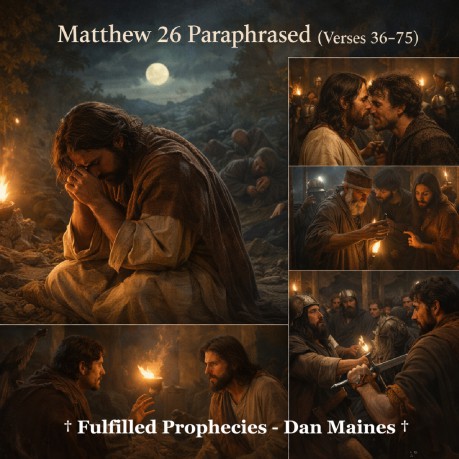
Matthew 26 Paraphrased
(Verses 36-75) Introduction † The second half of Matthew 26 records the
most intense night in the earthly life of Jesus. After the Passover
meal, Jesus entered Gethsemane where the weight of what was about to
happen pressed heavily upon Him. (Luke 22:44) † These events show both the weakness of the
disciples and the determination of Jesus to complete the mission
given to Him by the Father. What follows is not a sudden tragedy but
the fulfillment of what Jesus had been predicting throughout His
ministry. (Matthew 16:21) † The arrest, trial, and denial recorded here
demonstrate how the leaders of Israel rejected their Messiah,
fulfilling the warnings Jesus had already given about that
generation. (Matthew 23:37-38) Matthew 26:36 Then Jesus came with them to a place called Gethsemane, and said
to His disciples, Sit here while I go over there and pray. † Gethsemane was a garden area on the Mount of
Olives where Jesus often went with His disciples. (John 18:2) † Jesus withdrew to pray, showing His constant
dependence on the Father even at the most difficult moment. (Luke
6:12) Matthew 26:37 And He took with Him Peter and the two sons of Zebedee, and began
to be grieved and distressed. † Peter, James, and John were often present
during the most significant moments of Jesus' ministry. (Matthew
17:1) † The grief and distress reveal the human
reality of what Jesus was about to endure. (Hebrews 5:7) Matthew 26:38 Then He said to them, My soul is deeply grieved, to the point of
death, remain here and keep watch with Me. † Jesus expressed the overwhelming burden He
felt as the crucifixion approached. (Isaiah 53:4) † He asked His closest disciples to remain
alert in prayer during this critical moment. (Luke 22:40) Matthew 26:39 And He went a little beyond them, and fell on His face and prayed,
saying, My Father, if it is possible, let this cup pass from Me, yet
not as I will, but as You will. † The cup represented the suffering and
judgment that Jesus would bear. (Isaiah 51:17) † Even while expressing the weight of the
moment, Jesus fully submitted to the Father's will. (John 6:38) Matthew 26:40 And He came to the disciples and found them sleeping, and said to
Peter, So, you men could not keep watch with Me for one hour? † The disciples had promised loyalty but
quickly failed in their watchfulness. (Matthew 26:35) † This moment revealed how unprepared they were
for the coming events. (Mark 14:37) Matthew 26:41 Keep watching and praying, so that you do not come into
temptation, the spirit is willing, but the flesh is weak. † Jesus warned that spiritual alertness is
necessary to avoid falling into temptation. (1 Corinthians 10:12) † The statement acknowledges that good
intentions alone are not enough. (Romans 7:18) Matthew 26:42 He went away again a second time and prayed, saying, My Father, if
this cannot pass away unless I drink it, Your will be done. † Jesus again demonstrated full submission to
the Father's plan. (Philippians 2:8) † The mission of redemption would continue
exactly as planned. (John 12:27) Matthew 26:43 Again He came and found them sleeping, for their eyes were heavy. † The disciples struggled to stay awake despite
the seriousness of the moment. (Luke 22:45) † Their weakness contrasts with Jesus'
steadfast commitment. (Hebrews 12:2) Matthew 26:44 And He left them again, and went away and prayed a third time,
saying the same thing once more. † The repeated prayer shows the intensity of
Jesus' struggle before the crucifixion. (Luke 22:44) † Yet every prayer ended with submission to the
Father's will. (John 18:11) Matthew 26:45 Then He came to the disciples and said to them, Are you still
sleeping and resting? Behold, the hour is at hand and the Son of Man
is being betrayed into the hands of sinners. † The moment Jesus had been predicting had now
arrived. (Matthew 20:18) † The phrase the hour is at hand appears
throughout the Gospel as the appointed time of His sacrifice. (John
12:23) Matthew 26:46 Get up, let us be going, behold, the one who betrays Me is at
hand. † Jesus did not run or hide. He walked forward
to face the moment He had already accepted. (John 18:4) † This demonstrates that His arrest happened
voluntarily within God's plan. (John 10:18) Matthew 26:47 While He was still speaking, Judas, one of the twelve, came up
accompanied by a large crowd with swords and clubs, who came from the
chief priests and elders of the people. † The religious leaders used force to arrest
Jesus even though He had taught openly in the temple. (Matthew 21:23) † Judas led the group, fulfilling the prophecy
about betrayal by a companion. (Psalm 41:9) Matthew 26:48 Now he who was betraying Him gave them a sign, saying, Whomever I
kiss, He is the one, seize Him. † The kiss was normally a greeting of respect,
making the betrayal even more striking. (Luke 7:45) † Judas used a sign of friendship to identify
Jesus. (Luke 22:48) Matthew 26:49 Immediately Judas went to Jesus and said, Greetings, Rabbi, and
kissed Him. † Judas addressed Jesus respectfully while
carrying out betrayal. (Mark 14:45) † This moment reveals the depth of the
deception. (Psalm 55:21) Matthew 26:50 And Jesus said to him, Friend, do what you have come for. Then
they came and laid hands on Jesus and seized Him. † Jesus did not resist arrest because He
understood the events must unfold this way. (John 18:11) † His calm response shows complete control of
the situation. (Isaiah 53:7) Matthew 26:51 And behold, one of those who were with Jesus reached and drew his
sword, and struck the slave of the high priest and cut off his ear. † The Gospel of John identifies this disciple
as Peter. (John 18:10) † Peter attempted to defend Jesus by force,
misunderstanding the nature of Jesus' mission. (Matthew 16:22) Matthew 26:52 Then Jesus said to him, Put your sword back into its place, for
all those who take up the sword shall perish by the sword. † Jesus rejected violent resistance to
accomplish God's purpose. (Romans 12:19) † His kingdom would not be advanced by physical
warfare. (John 18:36) Matthew 26:53 Or do you think that I cannot appeal to My Father, and He will at
once put at My disposal more than twelve legions of angels? † Jesus had access to overwhelming divine power
but chose not to use it. (2 Kings 6:17) † This demonstrates that His arrest was
voluntary. (John 10:18) Matthew 26:54 How then will the Scriptures be fulfilled, which say that it must
happen this way? † The crucifixion fulfilled numerous prophecies
about the suffering Messiah. (Isaiah 53:5) † Jesus consistently pointed to scripture as
the explanation for these events. (Luke 24:44) Matthew 26:55 At that time Jesus said to the crowds, Have you come out with
swords and clubs to arrest Me as you would against a robber? Every
day I used to sit in the temple teaching and you did not seize Me. † Jesus exposed the hypocrisy of arresting Him
secretly at night. (John 18:20) † The leaders avoided public confrontation
because they feared the people. (Matthew 21:46) Matthew 26:56 But all this has taken place so that the Scriptures of the
prophets will be fulfilled. Then all the disciples left Him and fled. † The scattering of the disciples fulfilled
prophecy about the shepherd being struck. (Zechariah 13:7) † Fear caused the disciples to abandon Jesus in
that moment. (Mark 14:50) Matthew 26:57 Those who had seized Jesus led Him away to Caiaphas the high
priest, where the scribes and elders were gathered together. † The religious authorities had already
gathered to conduct a trial against Jesus. (John 18:24) † This trial was conducted in secrecy and
violated normal legal procedures. (Luke 22:54) Matthew 26:58 But Peter was following Him at a distance as far as the courtyard
of the high priest, and entered in, and sat down with the officers to
see the outcome. † Peter followed but remained cautious and
fearful. (John 18:15) † This distance symbolized the uncertainty he
was experiencing. (Mark 14:54) Matthew 26:69 Now Peter was sitting outside in the courtyard, and a servant girl
came to him and said, You too were with Jesus the Galilean. † Peter's denial began with a simple question
from a servant girl. (Mark 14:66) † Fear of association with Jesus now controlled
his response. (Luke 22:56) Matthew 26:70 But he denied it before them all, saying, I do not know what you
are talking about. † Peter's first denial happened quickly under
pressure. (Luke 22:57) † This fulfilled the warning Jesus had given
earlier that night. (Matthew 26:34) Matthew 26:71 When he had gone out to the gateway, another servant girl saw him
and said to those who were there, This man was with Jesus of
Nazareth. † Peter attempted to move away but was
recognized again. (Mark 14:68) † The situation continued to build toward his
second denial. (Luke 22:58) Matthew 26:72 And again he denied it with an oath, I do not know the man. † The second denial became stronger and more
forceful. (Mark 14:70) † Peter now attempted to distance himself
completely from Jesus. (Luke 22:58) Matthew 26:73 A little later the bystanders came up and said to Peter, Certainly
you too are one of them, for even the way you talk gives you away. † Peter's Galilean accent exposed him. (Mark
14:70) † The pressure intensified as the crowd
continued questioning him. (Luke 22:59) Matthew 26:74 Then he began to curse and swear, I do not know the man. And
immediately a rooster crowed. † The third denial fulfilled Jesus' prediction
exactly. (Matthew 26:34) † Peter's fear had completely overcome his
earlier confidence. (Luke 22:60) Matthew 26:75 And Peter remembered the statement which Jesus had made, Before a
rooster crows, you will deny Me three times. And he went out and wept
bitterly. † Peter immediately realized what had happened
and was overwhelmed with sorrow. (Luke 22:61) † His bitter weeping showed genuine repentance
after failure. (John 21:15) Historical References † Josephus recorded that the high priestly
families often used political influence and force to maintain
authority in Jerusalem. † Eusebius wrote that early Christians saw the
events of this night as the fulfillment of the prophets concerning
the suffering Messiah. † Tertullian noted that Peter's denial
demonstrated human weakness but also became an example of restoration
and grace. How It Applies To Us Today † Jesus' submission in Gethsemane shows the
importance of trusting God's will even during the most difficult
moments. (Luke 22:42) † The failure of the disciples reminds
believers that human strength alone is not enough to remain faithful.
(John 15:5) † Peter's repentance shows that failure does
not have to be the end of a believer's story. Restoration is always
possible through Christ. (John 21:15-17) Q & A Appendix Q: Why did Jesus pray for the cup to pass? Q: Why did the disciples flee when Jesus was
arrested? Q: Did Peter's denial end his role as a
disciple? † This is the fulfilled perspective we proclaim at
Fulfilled Prophecies † Source Index † Matthew 26:36-75; Matthew 16:21; Matthew
20:18; Matthew 23:37-38; Matthew 26:34; Mark 14:37-72; Luke 22:40-62;
John 10:18; John 15:5; John 18:1-27; Acts 2:23; Isaiah 51:17; Isaiah
53:4-7; Zechariah 13:7; Hebrews 5:7; Hebrews 12:2; Philippians 2:8;
Romans 7:18; Romans 12:19; 1 Corinthians 10:12 † Josephus, Antiquities of the Jews; Eusebius,
Ecclesiastical History; Tertullian, Apology. Matthew 26 Paraphrased (Verses
1-35) https://fulfilledprophecies.com/topics/990.html
Matthew 26a Paraphrased (Verses 36-75) https://fulfilledprophecies.com/topics/991.html
By Dan Maines
A:
The cup represented the suffering and judgment He would endure, yet
He submitted completely to the Father's will. (Luke 22:42)
A: Fear overtook them, fulfilling the
prophecy that the shepherd would be struck and the sheep scattered.
(Zechariah 13:7)
A: No. After the resurrection Jesus
restored Peter and continued to use him powerfully. (John 21:15-17)
© Fulfilled Prophecies - Dan
Maines.
Links