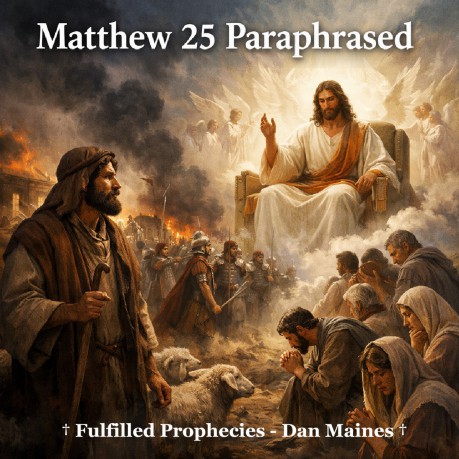
Matthew 25
Paraphrased
By Dan Maines
Introduction
† Matthew 25 continues
the same conversation Jesus began in Matthew 24 on the Mount of
Olives. The disciples asked about the destruction of the temple and
the end of that age (Matthew 24:3). Everything in this chapter
continues that same discussion.
† Jesus had
just declared that the judgment He described would come upon that
generation (Matthew 23:36; Matthew 24:34). The illustrations in this
chapter explain readiness, faithfulness, and the separation that
would occur when that judgment arrived.
†
These parables were given to warn Israel that the kingdom was
arriving and accountability was near. Some would be ready and
faithful, others would ignore the warnings.
†
Early Christian writers confirm that believers took these warnings
seriously. Eusebius records that Christians fled Jerusalem before the
Roman armies surrounded the city because they recognized the signs
Jesus gave (Luke 21:20-22; Eusebius, Ecclesiastical History 3.5).
The
Parable Of The Ten Virgins
Matthew 25:1
Then
the kingdom of heaven will be comparable to ten virgins, who took
their lamps and went out to meet the groom.
†
Jesus uses a wedding illustration familiar to first century
listeners. Nighttime wedding processions required lamps to greet the
groom.
† The focus is readiness. Some were
prepared for the arrival, others were not.
†
This mirrors Jesus' earlier warnings about watching carefully for the
approaching judgment (Matthew 24:42-44).
Matthew
25:2
Five of them were foolish, and five were
prudent.
† The difference was not appearance
but preparation.
† Jesus often divided people
this way, those who listened and obeyed and those who ignored the
warning (Matthew 7:24-27).
† This division
also reflects Israel in that generation, believers and rejecters of
the Messiah.
Matthew 25:3
For when the
foolish took their lamps, they did not take extra oil with them.
†
The foolish assumed the wait would be short and made no
preparation.
† Many in Israel assumed their
religious identity guaranteed safety while ignoring Christ's
warnings.
† Outward religion without faith
left them unprepared (Matthew 23:27-28).
Matthew
25:4
But the prudent ones took oil in flasks with their
lamps.
† The wise expected delay and prepared
accordingly.
† Faithful disciples listened
carefully to Jesus' warnings about Jerusalem's coming destruction
(Luke 21:20-22).
† Because they were
attentive, they were able to respond when the signs appeared.
Matthew
25:5
Now while the groom was delaying, they all became
drowsy and began to sleep.
† The delay
represents the time between Christ's ascension and the coming
judgment.
† Believers continued daily life
while remaining watchful.
† Peter later
addressed those who mocked the delay, explaining that judgment would
still come (2 Peter 3:3-10).
Matthew 25:6
But
at midnight there finally was a shout: Behold, the groom! Come out to
meet him.
† The sudden announcement
illustrates how quickly the events surrounding Jerusalem unfolded.
†
When the Roman armies surrounded the city, the warnings of Jesus
became unmistakable (Luke 21:20).
† Josephus
recorded the rapid escalation of the siege once the armies
arrived.
Matthew 25:7
Then all those
virgins got up and trimmed their lamps.
†
Everyone suddenly realized the moment had arrived.
†
The warnings Jesus gave were no longer theoretical once the siege
began.
† Those who prepared could respond,
those who had not were suddenly unready.
Matthew
25:8
The foolish said to the prudent ones, Give us some
of your oil, because our lamps are going out.
†
Spiritual readiness cannot be borrowed.
†
Each person had to respond personally to Christ.
†
Many relied on tradition instead of faith (Romans 9:31-32).
Matthew
25:9
But the prudent ones answered, No, there most
certainly would not be enough for us and you too, go instead to the
merchants and buy some for yourselves.
†
Preparation had to occur before the crisis arrived.
†
When the siege began there was no time left to prepare.
†
Jesus had spent years warning that generation.
Matthew
25:10
And while they were going away to make the
purchase, the groom came, and those who were ready went in with him
to the wedding feast, and the door was shut.
†
The shutting of the door represents the closing of opportunity.
†
When the temple system ended in AD 70 the old covenant system was
removed (Hebrews 8:13).
† Those who followed
Christ entered the kingdom while the old system passed away.
Matthew
25:11
Yet later the other virgins also came, saying,
Lord, lord, open up for us.
† This reflects
Jesus' earlier warning that many would claim allegiance yet be
rejected (Matthew 7:21-23).
† Outward
profession without obedience was not enough.
†
Israel's leadership rejected the Messiah they claimed to
serve.
Matthew 25:12
But he answered,
Truly I say to you, I do not know you.
† This
language reflects covenant separation.
†
Jesus warned that many who assumed they belonged would be excluded
(Matthew 8:11-12).
† The destruction of
Jerusalem demonstrated that separation historically.
Matthew
25:13
So stay alert, because you do not know the day
nor the hour.
† The disciples were not given
the exact day but they were given clear signs (Matthew 24:15-33).
†
Believers who watched carefully escaped the coming destruction.
†
Eusebius records that Christians fled Jerusalem before the siege.
The
Parable Of The Talents
Matthew 25:14
For
it is just like a man about to go on a journey, who called his own
slaves and entrusted his possessions to them.
†
Jesus illustrates the time between His departure and the coming
judgment.
† The disciples were entrusted with
the gospel during that period (Matthew 28:18-20).
†
Accountability would come when the master returned.
Matthew
25:15
To one he gave five talents, to another two, and
to another one, each according to his own ability, and he went on his
journey.
† Each servant received
responsibility according to ability.
†
Faithfulness, not comparison, was the measure of success.
†
The gospel spread rapidly during the apostolic age (Colossians
1:23).
Matthew 25:16
The one who had
received the five talents immediately went and did business with
them, and earned five more talents.
†
Faithful servants used what they were given.
†
The early church spread the gospel throughout the Roman world.
†
This work occurred before the destruction of Jerusalem.
Matthew
25:17
In the same way the one who had received the two
talents earned two more.
† Faithfulness was
measured by obedience, not quantity.
† Every
believer contributed to the growth of the kingdom.
†
The kingdom expanded across the Roman world.
Matthew
25:18
But the one who received the one talent went away
and dug a hole in the ground, and hid his master's money.
†
This servant represents unfaithfulness.
†
Israel's leadership rejected the responsibility given to them.
†
Instead of receiving the Messiah they persecuted His followers (Acts
7:51-52).
Matthew 25:19
Now after a long
time the master of those slaves came and settled accounts with
them.
† The settling of accounts represents
judgment.
† Jesus said He would come to
reward each person according to his deeds (Matthew 16:27-28).
†
That reckoning occurred in connection with Jerusalem's fall.
Matthew
25:20
The one who had received the five talents came up
and brought five more talents, saying, Master, you entrusted five
talents to me. See, I have earned five more talents.
†
Faithful servants produced results.
† The
gospel spread widely before AD 70.
† The
kingdom message reached across the known world.
Matthew
25:21
His master said to him, Well done, good and
faithful slave. You were faithful with a few things, I will put you
in charge of many things, enter the joy of your master.
†
Faithfulness brought reward.
† Believers
entered the joy of the kingdom Christ established.
†
The removal of the temple system confirmed the transition of the
ages.
Matthew 25:22
Also the one who had
received the two talents came up and said, Master, you entrusted two
talents to me. See, I have earned two more talents.
†
The servant with two talents receives the same praise as the one with
five.
† Faithfulness was never measured by
comparison with others.
† The kingdom work
involved many faithful servants during that generation.
Matthew
25:23
His master said to him, Well done, good and
faithful slave. You were faithful with a few things, I will put you
in charge of many things, enter the joy of your master.
†
The identical reward shows that faithfulness matters more than
quantity.
† Christ values obedience in
whatever responsibility we receive.
† Early
believers remained faithful despite persecution.
Matthew
25:24
Now the one who had received the one talent also
came up and said, Master, I knew you to be a hard man, reaping where
you did not sow and gathering where you scattered no seed.
†
This servant blamed the master instead of admitting his own
failure.
† Many in Israel blamed God while
rejecting the Messiah.
† Their accusation
revealed their hardened hearts.
Matthew 25:25
And
I was afraid, so I went away and hid your talent in the ground. See,
you still have what is yours.
† Fear and
laziness produced inaction.
† Instead of
trusting the master, he hid what was given.
†
Israel hid the truth instead of proclaiming it to the
nations.
Matthew 25:26
But his master
answered and said to him, You wicked, lazy slave, you knew that I
reap where I did not sow and gather where I scattered no seed.
†
The master exposes the servant's excuse as empty.
†
Responsibility still remained regardless of fear.
†
The generation that rejected Christ could not escape
accountability.
Matthew 25:27
Then you
ought to have put my money in the bank, and on my arrival I would
have received my money back with interest.
†
Even the smallest effort would have shown faithfulness.
†
The servant's total inactivity revealed his rebellion.
†
Israel's leaders completely failed in their responsibility.
Matthew
25:28
Therefore take the talent away from him, and give
it to the one who has the ten talents.
†
Responsibility was transferred from the unfaithful to the faithful.
†
Jesus already warned that the kingdom would be taken from Israel and
given to a people producing fruit (Matthew 21:43).
†
The gospel was spreading among believers while the old system was
collapsing.
Matthew 25:29
For to everyone
who has, more will be given, and he will have an abundance, but from
the one who does not have, even what he does have will be taken
away.
† Faithfulness leads to greater
responsibility.
† Unfaithfulness results in
loss.
† This principle explains the shift
that occurred during the apostolic age.
Matthew
25:30
And throw the worthless slave into the outer
darkness, in that place there will be weeping and gnashing of
teeth.
† This phrase appears repeatedly in
Jesus' warnings to Israel.
† It describes the
severe consequences of rejecting the kingdom.
†
The destruction of Jerusalem fulfilled these warnings.
The
Judgment Of The Nations
Matthew 25:31
But
when the Son of Man comes in His glory, and all the angels with Him,
then He will sit on His glorious throne.
†
This language comes directly from Daniel's vision of the Son of Man
receiving authority (Daniel 7:13-14).
† Jesus
connected this coming with the lifetime of His disciples (Matthew
16:27-28).
† The authority of Christ was
revealed in the judgment of Jerusalem.
Matthew 25:32
And
all the nations will be gathered before Him, and He will separate
them from one another, just as the shepherd separates the sheep from
the goats.
† Nations surrounding Israel were
affected by the events of that generation.
†
The gospel had already gone out across the Roman world (Colossians
1:23).
† The judgment imagery reflects Old
Testament language for national judgment.
Matthew
25:33
And He will put the sheep on His right, but the
goats on the left.
† The right side
represents favor and acceptance.
† The left
side represents rejection and judgment.
†
Jesus often used shepherd imagery to describe His followers.
Matthew
25:34
Then the King will say to those on His right,
Come, you who are blessed of My Father, inherit the kingdom prepared
for you from the foundation of the world.
†
The kingdom promised throughout scripture was now being fully
revealed.
† Believers were receiving what had
been prepared long before.
† The destruction
of the old system marked the arrival of the new covenant
kingdom.
Matthew 25:35
For I was hungry,
and you gave Me something to eat, I was thirsty, and you gave Me
something to drink, I was a stranger, and you invited Me in.
†
These acts represent love and care for Christ's people.
†
Helping believers was considered service to Christ Himself.
†
The early church practiced this kind of care among believers.
Matthew
25:36
Naked, and you clothed Me, I was sick, and you
visited Me, I was in prison, and you came to Me.
†
Persecution was common in the first century church.
†
Faithful believers supported one another through hardship.
†
Their compassion demonstrated genuine faith.
Matthew
25:37
Then the righteous will answer Him, Lord, when
did we see You hungry, and feed You, or thirsty, and give You
something to drink?
† The righteous were
surprised because they served others naturally.
†
Their actions flowed from genuine faith.
†
They did not seek recognition.
Matthew 25:38
And
when did we see You as a stranger, and invite You in, or naked, and
clothe You?
† They did not realize their
service reflected devotion to Christ.
† Their
compassion revealed the character of the kingdom.
†
Love for others was evidence of faith.
Matthew 25:39
And
when did we see You sick, or in prison, and come to You?
†
These believers had simply cared for others.
†
Christ identifies Himself with His followers.
†
Serving His people meant serving Him.
Matthew 25:40
And
the King will answer and say to them, Truly I say to you, to the
extent that you did it for one of the brothers of Mine, even the
least of them, you did it for Me.
† Christ
closely identifies with His people.
† Acts of
compassion toward believers were acts of loyalty to the kingdom.
†
The early church lived out this principle daily.
Matthew
25:41
Then He will also say to those on His left,
Depart from Me, you accursed people, into the eternal fire which has
been prepared for the devil and his angels.
†
Those who rejected the kingdom faced judgment.
†
This language reflects severe covenant judgment.
†
The destruction of Jerusalem displayed the consequences of rejecting
Christ.
Matthew 25:42
For I was hungry,
and you gave Me nothing to eat, I was thirsty, and you gave Me
nothing to drink.
† These individuals ignored
the needs of Christ's followers.
† Their lack
of compassion revealed their rejection of the kingdom.
†
Their actions exposed their unbelief.
Matthew 25:43
I
was a stranger, and you did not invite Me in, naked, and you did not
clothe Me, sick and in prison, and you did not visit Me.
†
Their failure to care for believers showed hostility toward Christ.
†
Indifference revealed spiritual blindness.
†
Their behavior exposed their true allegiance.
Matthew
25:44
Then they themselves also will answer, Lord, when
did we see You hungry, or thirsty, or as a stranger, or naked, or
sick, or in prison, and did not take care of You?
†
Like the foolish virgins earlier, they realized too late what had
happened.
† Their blindness continued until
judgment arrived.
† They misunderstood the
importance of how they treated Christ's followers.
Matthew
25:45
Then He will answer them, Truly I say to you, to
the extent that you did not do it for one of the least of these, you
did not do it for Me.
† The treatment of
Christ's people revealed the heart.
† Loyalty
to Christ is demonstrated through love for His followers.
†
Rejection of believers meant rejection of Christ.
Matthew
25:46
These will go away into eternal punishment, but
the righteous into eternal life.
† This verse
concludes the chapter with a final separation.
†
The faithful enter life in the kingdom Christ established.
†
The unfaithful face the consequences of rejecting the
Messiah.
Historical References
†
Eusebius recorded that Christians fled Jerusalem before the Roman
siege after recognizing the warnings Jesus gave.
†
Josephus described the devastation of Jerusalem and the massive loss
of life during the Roman destruction in AD 70.
†
Tacitus confirmed the Roman destruction of the city and the
temple.
How It Applies To Us Today
†
Matthew 25 reminds believers that faithfulness matters.
†
Christ's kingdom has already been established and we live within its
reality.
† Followers of Christ are still
called to live faithfully and care for others.
†
Our confidence rests in Christ's finished work and the kingdom that
cannot be shaken.
Q & A Appendix
Q:
Was Matthew 25 describing the end of the world?
A:
No. Jesus was answering the disciples about the destruction of the
temple and the end of that age (Matthew 24:3).
Q:
Did Jesus say these events would occur in that generation?
A:
Yes. Jesus clearly stated that all those things would happen before
that generation passed away (Matthew 24:34).
Q:
Did early Christians understand these warnings as applying to their
time?
A: Yes. Historical records show that
Christians fled Jerusalem before the Roman siege after recognizing
the signs Jesus gave (Luke 21:20-22).
† This is the
fulfilled perspective we proclaim at Fulfilled Prophecies †
©
Fulfilled Prophecies - Dan Maines.
Source Index
†
Matthew 7:21-27; Matthew 8:11-12; Matthew 16:27-28; Matthew 21:43;
Matthew 23:36; Matthew 24:3, 15-33, 34, 42-44; Matthew 25:1-46;
Matthew 28:18-20; Luke 12:35-40; Luke 21:20-22; John 5:39-40; Romans
9:31-32; Acts 7:51-52; Colossians 1:23; Hebrews 8:13; 2 Peter 3:3-10;
Daniel 7:13-14
† Eusebius, Ecclesiastical
History 3.5; Josephus, Wars of the Jews; Tacitus, Histories 5.13
Links