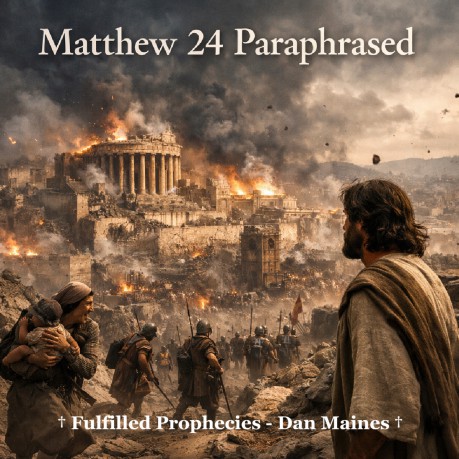
Matthew 24
Paraphrased
By Dan Maines
Introduction
† Matthew 24 records
Jesus explaining the coming judgment that would fall on Jerusalem and
the temple within that generation. The disciples had just admired the
temple buildings, but Jesus immediately warned them that the entire
system was about to collapse. This chapter is not about the end of
the physical world, it is about the end of the Old Covenant age and
the destruction of Jerusalem in AD 70.
†
Jesus repeatedly tied these events to the lifetime of the people
standing before Him. The timing statements throughout the chapter
make it clear that the prophecy concerned their generation, not a
distant future thousands of years later (Matthew 24:34).
†
Understanding this chapter requires remembering the covenant setting.
The temple, sacrifices, priesthood, and city were all about to be
judged because Israel rejected the Messiah (Matthew 23:37-38).
†
Matthew 24, Mark 13, and Luke 21 record the same Olivet Discourse.
Each writer preserves the same warning from Jesus about the coming
destruction of Jerusalem. Luke provides additional clarity by
explaining that the abomination of desolation refers to Jerusalem
being surrounded by armies (Luke 21:20).
Matthew
24:1
Jesus left the temple, and as He was walking away
His disciples pointed out the impressive temple buildings to Him.
†
The disciples were still impressed by the physical glory of the
temple, but Jesus was about to reveal that the entire structure was
doomed (Matthew 23:38).
† Josephus later
recorded that the temple was completely destroyed by the Roman army
in AD 70, exactly as Jesus warned.
Matthew 24:2
Jesus
answered and told them that not one stone of the temple would remain
on another, everything would be torn down.
†
This prophecy was fulfilled when the Roman army under Titus destroyed
Jerusalem and dismantled the temple in AD 70.
†
Josephus describes the destruction in detail, confirming that the
temple complex was leveled.
Matthew 24:3
Later
Jesus sat on the Mount of Olives, and the disciples asked Him
privately when these things would happen, and what sign would mark
His coming and the end of the age.
† The
question concerned the destruction Jesus had just predicted.
†
The end of the age refers to the end of the Old Covenant age centered
around the temple system (Hebrews 8:13).
Matthew
24:4
Jesus warned them to make sure no one deceived
them.
† False teachers and false messiahs
were already appearing during the first century.
†
Josephus records multiple men claiming prophetic authority before the
war with Rome.
Matthew 24:5
Many would
come claiming authority in His name and would deceive many people.
†
First century history records several messianic claimants who led
revolts or movements.
† These false leaders
contributed to the chaos that eventually led to Jerusalem's
destruction.
Matthew 24:6
They would hear
of wars and rumors of wars, but they were not to panic because these
things had to happen, but the end had not yet come.
†
The Roman world experienced constant conflict during this period.
†
Jesus made it clear these events were signs leading up to the coming
judgment.
Matthew 24:7
Nations would rise
against nations, kingdoms against kingdoms, and there would be
famines and earthquakes in various places.
†
Historical records confirm earthquakes in places such as Laodicea and
Pompeii during the first century.
† Acts also
records a major famine during the reign of Claudius (Acts
11:28).
Matthew 24:8
All these events were
only the beginning of birth pains.
† These
signs indicated the approaching judgment but were not the final
event.
† The language reflects the growing
turmoil leading up to the Jewish war.
Matthew
24:9
Believers would be persecuted, hated, and even
killed because of their loyalty to Christ.
†
The book of Acts and early church history record severe persecution
during this time.
† Nero's persecution in the
60s AD fits this description.
Matthew 24:10
Many
would stumble, betray one another, and hate one another.
†
The internal divisions among Jews and among believers became severe
during the war years.
† Josephus describes
intense betrayal and violence within Jerusalem.
Matthew
24:11
Many false prophets would appear and deceive many
people.
† Several prophetic figures arose in
the first century claiming divine guidance.
†
Their teachings often misled the people during the crisis.
Matthew
24:12
Because lawlessness increased, the love of many
would grow cold.
† Social collapse and
violence intensified in Jerusalem before its fall.
†
Josephus described widespread cruelty and moral breakdown.
Matthew
24:13
The one who endured until the end would be
saved.
† Endurance meant surviving the coming
tribulation surrounding Jerusalem's destruction.
†
Faithful believers escaped the city before the siege.
Matthew
24:14
The gospel of the kingdom would be preached in
the whole world before the end came.
† The
apostles testified that the gospel had already spread throughout the
Roman world (Colossians 1:23).
† Paul also
confirmed that the gospel had been made known to all the nations
(Romans 16:26).
† This shows the prophecy was
fulfilled within the first century.
Matthew 24:15
When
they saw the abomination of desolation standing in the holy place,
they were to understand that the crisis had arrived.
†
This refers to the Roman armies surrounding Jerusalem.
†
Luke explains the same event clearly: when you see Jerusalem
surrounded by armies then recognize that her desolation is near (Luke
21:20).
Matthew 24:16
Those in Judea were
to flee to the mountains.
† Early Christian
sources report that believers fled to Pella before the siege.
†
This escape preserved the early church.
Matthew
24:17
Anyone on the housetop was not to delay by going
back inside.
† The warning emphasized
urgency.
† Once the Roman siege began escape
would become impossible.
Matthew 24:18
Anyone
in the field was not to return to retrieve belongings.
†
The focus was immediate survival.
† The
danger was imminent.
Matthew 24:19
Pregnant
women and nursing mothers would face extreme difficulty during that
time.
† The siege conditions created terrible
suffering for families.
† Josephus records
severe famine inside the city.
Matthew 24:20
They
were to pray their escape would not happen in winter or on the
Sabbath.
† Travel restrictions and harsh
weather would make fleeing harder.
† The
warning was practical and urgent.
Matthew 24:21
There
would be great tribulation unlike anything that had happened
before.
† The Jewish war and the destruction
of Jerusalem were catastrophic.
† Josephus
described unimaginable suffering and death.
Matthew
24:22
If those days were not shortened no one would
survive, but for the sake of the elect they were limited.
†
The Roman campaign ended sooner than expected.
†
This allowed believers to survive the conflict.
Matthew
24:23
If anyone claimed the Messiah had appeared
somewhere else they were not to believe it.
†
False messianic claims continued during the war.
†
Jesus warned believers not to be misled.
Matthew
24:24
False messiahs and prophets would perform
impressive signs to deceive people.
† Many
leaders used claims of miracles to gather followers.
†
The deception was powerful during that time.
Matthew
24:25
Jesus reminded them He had warned them ahead of
time.
† The disciples were given advance
knowledge.
† This preparation helped them
recognize the signs.
Matthew 24:26
They
were not to chase rumors of secret appearances of the Messiah.
†
The coming judgment would not be hidden.
† It
would be visible through the historical events unfolding.
Matthew
24:27
His coming would be like lightning flashing
across the sky.
† This describes the sudden
and unmistakable nature of the judgment.
†
Prophetic language often used cosmic imagery for national
judgment.
Matthew 24:28
Where the corpse
is, vultures gather.
† This symbolized the
Roman armies gathering around doomed Jerusalem.
†
Roman standards even used eagle imagery.
Matthew
24:29
Immediately after that tribulation the sun, moon,
and stars would appear darkened.
† Prophets
often used cosmic language to describe the fall of nations (Isaiah
13:10).
† The imagery describes covenant
collapse, not literal astronomical destruction.
Matthew
24:30
The sign of the Son of Man would appear in
heaven, and the tribes of the land would mourn.
†
This refers to Christ's vindication and judgment against Jerusalem.
†
The mourning reflects Israel recognizing the judgment they
rejected.
Matthew 24:31
He would gather
His elect with a great trumpet.
† This
describes the global gathering of believers through the gospel.
†
The church expanded rapidly after Jerusalem's fall.
Matthew
24:32
The fig tree illustrates recognizing the
season.
† Just as budding leaves signal
summer, the signs would reveal the approaching judgment.
†
The disciples were expected to understand the timing.
Matthew
24:33
When they saw these things happening they would
know the event was near.
† The warning was
directed to the first century audience.
†
They would witness the signs themselves.
Matthew
24:34
This generation would not pass away until all
these things took place.
† Jesus placed the
fulfillment squarely within the lifetime of His audience.
†
The same judgment was already announced earlier when Jesus said all
these things will come upon this generation (Matthew 23:36).
†
Jerusalem fell about forty years later exactly as predicted.
Matthew
24:35
Heaven and earth would pass away, but His words
would not pass away.
† Heaven and earth here
refers to the covenant world of Israel.
† The
temple system disappeared, but Christ's words remained true.
Matthew
24:36
No one knew the exact day or hour of the event.
†
The timing was within that generation but the precise moment was
unknown.
† The warning required constant
readiness.
Matthew 24:37
The coming would
resemble the days of Noah.
† People would be
living normal lives until sudden judgment arrived.
†
The siege of Jerusalem caught many unprepared.
Matthew
24:38
People were eating and drinking and living
normally until the flood came.
† Life
continued as usual before disaster struck.
†
The same pattern occurred before Jerusalem's fall.
Matthew
24:39
They did not understand until judgment arrived.
†
Many ignored the warnings.
† The destruction
proved the prophecy true.
Matthew 24:40
Two
men would be in the field, one taken and one left.
†
The language reflects judgment and separation during the crisis.
†
Many were taken by the Roman forces.
Matthew 24:41
Two
women grinding grain, one taken and one left.
†
The judgment affected ordinary daily life.
†
The separation was sudden.
Matthew 24:42
They
were to stay alert because they did not know the hour.
†
The warning emphasized readiness.
† Believers
had to remain watchful.
Matthew 24:43
If a
homeowner knew when a thief was coming he would stay awake.
†
The unexpected timing required vigilance.
†
The same principle applied to the coming judgment.
Matthew
24:44
They also had to be ready because the Son of Man
would come at an unexpected moment.
†
Readiness meant faithfulness to Christ.
† The
judgment would arrive suddenly.
Matthew 24:45
The
faithful servant carries out his responsibilities.
†
Faithful believers continued serving Christ despite persecution.
†
Their reward was preservation and vindication.
Matthew
24:46
Blessed is the servant found doing his duty.
†
Faithfulness during crisis demonstrated true discipleship.
†
Many believers endured persecution faithfully.
Matthew
24:47
The faithful servant would be placed over greater
responsibilities.
† This reflects the growth
and authority of the church after the old system ended.
†
Christ's kingdom expanded.
Matthew 24:48
The
wicked servant assumes the master will delay.
†
Many ignored Christ's warnings.
† Their
complacency led to disaster.
Matthew 24:49
He
mistreats others and lives carelessly.
† This
reflects the corruption of leaders in Jerusalem before the war.
†
Their abuse and violence were widely recorded.
Matthew
24:50
The master returns unexpectedly.
†
Judgment arrives when people least expect it.
†
Jerusalem's fall came suddenly and decisively.
Matthew
24:51
The wicked servant is judged severely.
†
This symbolizes the fate of unfaithful leaders and unbelieving
Israel.
† The destruction of the city
confirmed the warning.
Historical References
†
Josephus recorded the destruction of Jerusalem and the temple in AD
70 in The Jewish War.
† Eusebius reported
that Christians fled Jerusalem before the siege and escaped to
Pella.
† Epiphanius also confirmed that the
church left Jerusalem before the war and settled in Pella.
†
Tacitus described the Roman campaign that devastated Judea and
destroyed the city.
† Clement of Alexandria
recorded that the gospel spread rapidly throughout the Roman world
before Jerusalem's fall.
How It Applies To Us Today
†
Jesus proved that His words are completely reliable because
everything He predicted happened exactly as He said (Matthew
24:35).
† The chapter reminds us that God's
judgments in history are real and serious.
†
It also reminds us that Christ reigns now and His kingdom continues
to grow.
† Believers today are called to
remain faithful and alert just as the early disciples were.
†
Jesus showed that biblical prophecy was not written to confuse
believers but to warn real people about real events that were about
to happen. When we read prophecy in its proper time context it
becomes clear and consistent (Matthew 24:34).
†
The destruction of Jerusalem proved that Christ truly reigns as King.
The same leaders who rejected Him were judged within their own
generation exactly as He said (Matthew 26:64).
†
The chapter reminds us that trusting Christ's words is more reliable
than trusting popular religious traditions. Many teachers today still
move these prophecies into the future even though history already
confirms their fulfillment (John 16:33).
†
Matthew 24 also reminds believers that the kingdom of Christ did not
end in AD 70, it continued to expand. The fall of the temple removed
the old system and cleared the way for the gospel to spread freely
throughout the nations (Hebrews 12:28).
Q&A
Appendix
Q: Did Jesus say these events
would happen in the future thousands of years later?
A:
No. Jesus clearly said this generation would not pass away until all
these things took place (Matthew 24:34).
Q: Was
the temple actually destroyed the way Jesus predicted?
A:
Yes. The Roman army destroyed Jerusalem and the temple in AD 70
exactly as Jesus warned (Matthew 24:2).
Q: Did
the gospel really spread through the world before AD 70?
A:
Yes. Paul wrote that the gospel had been proclaimed in all creation
under heaven (Colossians 1:23), and that it had been made known to
all the nations (Romans 16:26).
Q: If Matthew
24 was fulfilled in AD 70, what about the coming of the Son of
Man?
A: The language comes from Daniel 7:13-14
and describes the Son of Man receiving authority and bringing
judgment. Jesus applied this same language when speaking to the high
priest about the coming judgment (Matthew 26:64).
Q:
What does the phrase end of the age mean in Matthew 24:3?
A:
The disciples were asking about the end of the temple age, not the
end of the planet. The Greek word aion refers to an age or covenant
era. Jesus had just declared judgment on the temple system (Matthew
23:38), and Hebrews later confirms that the Old Covenant was becoming
obsolete and ready to disappear (Hebrews 8:13).
Q:
What does the abomination of desolation refer to?
A:
Jesus connected it to the moment Jerusalem would be surrounded by
armies. Luke records the explanation directly: But when you see
Jerusalem surrounded by armies, then recognize that her desolation is
near (Luke 21:20). This occurred when the Roman armies surrounded the
city before the destruction in AD 70.
Q: What
does heaven and earth passing away mean in Matthew 24:35?
A:
In prophetic language heaven and earth often represent a covenant
world or political order. The Old Covenant temple system was the
center of Israel's world, and it passed away when Jerusalem and the
temple were destroyed (Hebrews 12:26-28).
Q:
Who are the elect gathered in Matthew 24:31?
A:
The elect refers to believers being gathered into Christ's kingdom
through the preaching of the gospel. The apostles were sent into the
nations, and the church grew rapidly throughout the Roman world
(Matthew 28:19, Colossians 1:23).
Q: Do Matthew
24:40-41 teach a rapture where believers are taken away?
A:
No. In the context of Matthew 24 the ones taken are taken in
judgment, not taken to heaven. Jesus compared it to the days of Noah
where the wicked were taken away by the flood while Noah remained
alive on the earth (Matthew 24:37-39). The same pattern appears here,
the ones taken are those removed in judgment.
Q:
How do we know the ones taken are the ones judged?
A:
Jesus had just used the example of Noah. The flood came and took them
all away (Matthew 24:39). The ones taken were the wicked who were
judged. The righteous were the ones who remained alive. This shows
that Matthew 24:40-41 is describing the removal of the wicked during
the judgment on Jerusalem, not a future rapture.
Q:
What does the statement Where the corpse is, there the vultures will
gather mean in Matthew 24:28?
A: The imagery
points directly to the Roman armies that destroyed Jerusalem. Roman
legions carried eagle standards as their military symbols. The Greek
word translated vultures can also refer to eagles. When Jesus said
the birds would gather around the corpse, He was describing the Roman
armies surrounding the doomed city. This matches the warning given in
Luke 21:20 where Jesus said that when Jerusalem is surrounded by
armies her desolation is near. The Roman eagle standards literally
gathered around Jerusalem during the siege that ended in AD 70.
Q:
What about the sun, moon, and stars being darkened in Matthew 24:29,
doesn't that mean the end of the physical universe?
A:
No. This language comes directly from Old Testament prophetic
judgment imagery. The prophets regularly described the fall of
nations using cosmic language. For example, Isaiah described the fall
of Babylon by saying the stars of heaven and their constellations
will not flash forth their light, the sun will be dark when it rises
and the moon will not shed its light (Isaiah 13:10). Ezekiel used the
same imagery when describing the fall of Egypt (Ezekiel 32:7-8).
Jesus was using the same prophetic language to describe the collapse
of Jerusalem and the Old Covenant world in AD 70.
†
This is the fulfilled perspective we proclaim at Fulfilled Prophecies
†
© Fulfilled Prophecies - Dan Maines.
Source
Index
† Matthew 24:1-51, Luke 21:20,
Matthew 23:36, Romans 16:26, Colossians 1:23
†
Josephus, The Jewish War, Eusebius, Ecclesiastical
History, Epiphanius, Panarion 29.7.7-8, Tacitus,
Histories 5.13
Links