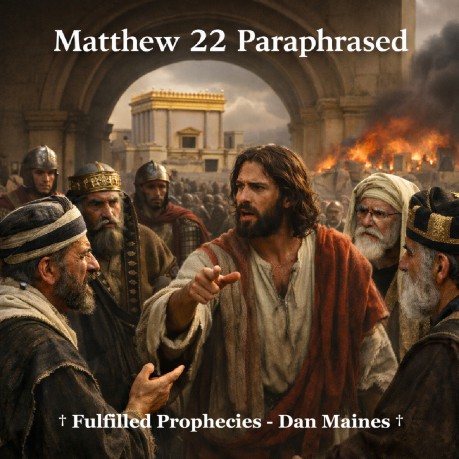
Matthew 22
Paraphrased
By Dan Maines
Introduction
† Jesus continues
speaking to the leaders of Israel who had already rejected Him. The
chief priests and Pharisees had challenged His authority in the
previous chapter, so He now answers them with parables that expose
their unbelief and warn them of the judgment that was about to fall
on their generation (Matthew 21:45-46).
†
This chapter shows three major confrontations. First, Jesus describes
Israel rejecting the kingdom invitation. Second, the religious
leaders try to trap Him with political and theological questions.
Third, Jesus exposes their misunderstanding of the Messiah. All of
this takes place only days before His crucifixion.
†
From the fulfilled perspective, these warnings pointed directly to
the destruction of Jerusalem in AD 70. The leaders rejected the King,
the invitation went out to others, and judgment came on the city that
rejected Him (Matthew 23:36-38; Luke 21:20-22).
The
Parable Of The Wedding Feast
Matthew 22:1
And
Jesus answered and spoke to them again in parables, saying,
†
Jesus continues addressing the same religious leaders He confronted
in the temple. They understood He was speaking about them (Matthew
21:45).
† Parables often revealed truth to
those willing to hear while exposing the blindness of those who
rejected God's message (Matthew 13:13).
† The
setting is still the temple in Jerusalem only days before the
crucifixion.
Matthew 22:2
The kingdom of
heaven is like a king who gave a wedding feast for his son.
†
The king represents God the Father, and the son represents Christ.
The wedding feast represents the arrival of the kingdom and the
covenant blessings offered through the Messiah (Isaiah 25:6).
†
The imagery of a wedding was common in Jewish teaching and symbolized
covenant relationship and celebration (Hosea 2:19-20).
†
The invitation represents the call to Israel first, because the
covenant promises were given to them (Romans 9:4-5).
Matthew
22:3
And he sent out his slaves to call those who had
been invited to the wedding feast, and they were unwilling to come.
†
The servants represent the prophets and later the apostles who called
Israel to repentance (2 Chronicles 36:15-16).
†
Israel had long been invited through the covenant promises, yet many
refused when the time of fulfillment arrived.
†
This rejection continued during Jesus' ministry and through the
preaching of the apostles.
Matthew 22:4
Again
he sent out other slaves saying, Tell those who have been invited,
Behold I have prepared my dinner, my oxen and my fattened livestock
are all butchered and everything is ready, come to the wedding
feast.
† This shows the patience of God in
repeatedly inviting Israel to respond.
†
Jesus and the apostles continued calling Israel to repentance even
after many rejected the message.
† The
kingdom was ready because the Messiah had arrived.
Matthew
22:5
But they paid no attention and went their separate
ways, one to his own farm, another to his business.
†
Many simply ignored the message because they were focused on daily
life.
† Indifference to God's invitation is
just as serious as open rebellion.
† This
reflects how many in Israel ignored Jesus' message despite witnessing
His miracles.
Matthew 22:6
And the rest
seized his slaves and mistreated them and killed them.
†
This reflects the long history of Israel persecuting the prophets
(Matthew 23:37).
† It also foreshadows the
persecution of the apostles after Christ's resurrection (Acts
7:52).
† Stephen and James were among the
first Christian martyrs.
Matthew 22:7
But
the king was enraged, and he sent his armies and destroyed those
murderers and set their city on fire.
† This
is a direct prophecy of the destruction of Jerusalem in AD 70.
†
Jesus repeatedly warned that judgment would come on that generation
for rejecting the Messiah (Matthew 23:36).
†
The Roman armies fulfilled this when Jerusalem was burned during the
siege (Luke 21:20-24).
Matthew 22:8
Then
he said to his slaves, The wedding feast is ready, but those who were
invited were not worthy.
† Israel as a nation
rejected the invitation through unbelief.
†
Worthiness here refers to responding to the invitation, not earning
salvation.
† Because many refused, the
invitation was extended further.
Matthew 22:9
Go
therefore to the main highways, and invite whomever you find to the
wedding feast.
† This represents the gospel
going out beyond the original invited guests.
†
The apostles carried the message beyond Jerusalem into the wider
world (Acts 1:8).
† Gentiles were included in
the kingdom invitation.
Matthew 22:10
And
those slaves went out into the streets and gathered together all whom
they found, both evil and good, and the wedding hall was filled with
dinner guests.
† The kingdom invitation goes
to all people.
† Both good and bad means
people from every background were called.
†
The early church included Jews and Gentiles together in Christ
(Ephesians 2:14-16).
Matthew 22:11
But
when the king came in to look over the dinner guests, he saw a man
there who was not dressed in wedding clothes.
†
Wedding garments symbolize righteousness provided by God.
†
The kingdom invitation must be accepted properly, not merely entered
outwardly.
† True participation requires
genuine acceptance of the King.
Matthew 22:12
And
he said to him, Friend, how did you come in here without wedding
clothes? And the man was speechless.
† The
man had no excuse because the garment would normally be provided.
†
This illustrates the danger of trying to enter God's kingdom on one's
own terms.
† Religious appearance without
true righteousness cannot stand before God.
Matthew
22:13
Then the king said to the servants, Bind him hand
and foot and throw him into the outer darkness, in that place there
will be weeping and gnashing of teeth.
†
Jesus often used this phrase to describe exclusion from the
kingdom.
† It represents judgment and
separation from God's blessing.
† This
warning was directed especially at those who rejected Christ while
claiming religious status.
Matthew 22:14
For
many are called, but few are chosen.
† Many
hear the invitation, but only those who respond in faith truly
enter.
† This summarizes the entire
parable.
† Israel as a nation was called, yet
many rejected the invitation.
Paying Taxes To
Caesar
Matthew 22:15
Then the
Pharisees went and plotted together how they might trap Him in what
He said.
† The religious leaders were now
openly trying to destroy Him.
† They wanted
to create a political accusation against Him.
†
Their goal was to turn either Rome or the Jewish people against
Him.
Matthew 22:16
And they sent their
disciples to Him along with the Herodians, saying, Teacher, we know
that You are truthful and teach the way of God in truth, and defer to
no one, for You are not partial to any.
† The
Pharisees and Herodians normally opposed each other, but they united
against Jesus.
† Their flattering words were
a setup for the trap they were about to present.
†
They hoped to force Him into a political statement.
Matthew
22:17
Tell us then, what do You think? Is it lawful to
pay a poll tax to Caesar, or not?
† If Jesus
said yes, many Jews would view Him as supporting Roman oppression.
†
If He said no, they could accuse Him of rebellion against Rome.
†
It was a carefully designed trap.
Matthew 22:18
But
Jesus perceived their malice, and said, Why are you testing Me,
hypocrites?
† Jesus immediately exposes their
motives.
† He calls them hypocrites because
their question was dishonest.
† Their concern
was not truth but entrapment.
Matthew 22:19
Show
Me the coin used for the poll tax. And they brought Him a denarius.
†
The denarius carried the image of Caesar.
†
By producing the coin, they admitted they were already using Roman
currency.
† This set up Jesus' famous
response.
Matthew 22:20
And He said to
them, Whose likeness and inscription is this?
†
The coin clearly displayed Caesar's authority.
†
Jesus was guiding them to answer their own question.
†
The issue centered on rightful authority.
Matthew
22:21
They said to Him, Caesar's. Then He said to them,
Then render to Caesar the things that are Caesar's, and to God the
things that are God's.
† Jesus avoided their
trap by distinguishing civil authority from divine authority.
†
Government may require certain obligations, but ultimate allegiance
belongs to God.
† This answer amazed both His
followers and His enemies.
Matthew 22:22
And
hearing this, they were amazed, and leaving Him, they went away.
†
The trap completely failed.
† His wisdom
silenced His opponents.
† Yet their hostility
continued to grow.
The Question About The
Resurrection
Matthew 22:23
On
that day some Sadducees who say there is no resurrection came to
Jesus and questioned Him,
† The Sadducees
denied the resurrection and most supernatural elements.
†
They accepted only the first five books of Moses as authoritative.
†
Their question attempted to ridicule the idea of
resurrection.
Matthew 22:24
Teacher, Moses
said, If a man dies having no children, his brother as next of kin
shall marry his wife and raise up children for his brother.
†
This law came from Deuteronomy 25:5.
† It was
intended to preserve family lineage in Israel.
†
The Sadducees used it to create a hypothetical problem.
Matthew
22:25
Now there were seven brothers with us, and the
first married and died, and having no children left his wife to his
brother.
Matthew 22:26
So also the second,
and the third, down to the seventh.
Matthew 22:27
Last
of all the woman died.
Matthew 22:28
In
the resurrection therefore, whose wife of the seven will she be? For
they all had married her.
† The story was
meant to make resurrection seem absurd.
†
They assumed resurrection life would function exactly like earthly
life.
† Their argument rested on a
misunderstanding of scripture.
Matthew 22:29
But
Jesus answered and said to them, You are mistaken, not understanding
the Scriptures nor the power of God.
† Jesus
directly rebukes their theological error.
†
They misunderstood both God's power and His word.
†
Many religious leaders made the same mistake.
Matthew
22:30
For in the resurrection they neither marry nor
are given in marriage, but are like angels in heaven.
†
Resurrection life does not follow the same structure as earthly
life.
† Marriage exists for this age.
†
The resurrection involves a transformed state.
Matthew
22:31
But regarding the resurrection of the dead, have
you not read what was spoken to you by God:
Matthew
22:32
I am the God of Abraham, and the God of Isaac,
and the God of Jacob? He is not the God of the dead but of the
living.
† Jesus quotes Exodus 3:6.
†
God spoke of the patriarchs as living even though they had died
physically.
† This proved resurrection from
the very books the Sadducees accepted.
Matthew
22:33
When the crowds heard this, they were astonished
at His teaching.
† The people recognized the
authority of His answer.
† The Sadducees were
completely refuted.
† Jesus demonstrated
perfect understanding of scripture.
The Greatest
Commandment
Matthew 22:34
But
when the Pharisees heard that Jesus had silenced the Sadducees, they
gathered themselves together.
† Another group
now attempts to challenge Him.
† The
religious leaders were determined to defeat Him publicly.
†
Yet every attempt continued to fail.
Matthew 22:35
One
of them, a lawyer, asked Him a question, testing Him,
†
A lawyer in this context was an expert in the Law of Moses.
†
His goal was to trap Jesus in a theological dispute.
†
Jewish teachers often debated which commandments were
greatest.
Matthew 22:36
Teacher, which is
the great commandment in the Law?
† The Law
contained hundreds of commandments.
†
Teachers frequently ranked them by importance.
†
This question sought to provoke controversy.
Matthew
22:37
And He said to him, You shall love the Lord your
God with all your heart, and with all your soul, and with all your
mind.
† Jesus quotes Deuteronomy 6:5.
†
This command summarizes complete devotion to God.
†
Love is the foundation of true obedience.
Matthew
22:38
This is the great and foremost commandment.
†
Everything in the Law begins with devotion to God.
†
Without this, religious activity becomes empty.
†
True faith begins with love for God.
Matthew 22:39
The
second is like it, You shall love your neighbor as yourself.
†
This comes from Leviticus 19:18.
† Love for
others reflects genuine obedience to God.
†
Jesus shows that the Law centers on love.
Matthew
22:40
On these two commandments depend the whole Law
and the Prophets.
† Every command in
scripture flows from these two principles.
†
Love for God and love for others summarize the entire moral law.
†
This statement simplifies what many had complicated.
The
Question About David's Son
Matthew 22:41
Now
while the Pharisees were gathered together, Jesus asked them a
question:
† After answering their challenges,
Jesus now questions them.
† This exposes
their misunderstanding of the Messiah.
† It
also shows their limited view of scripture.
Matthew
22:42
What do you think about the Christ, whose son is
He? They said to Him, The son of David.
†
Everyone knew the Messiah would come from David's line (2 Samuel
7:12).
† The Pharisees correctly recognized
this prophecy.
† But they did not understand
the full identity of the Messiah.
Matthew 22:43
He
said to them, Then how does David in the Spirit call Him Lord,
saying,
Matthew 22:44
The Lord said to my
Lord, Sit at My right hand, until I put Your enemies beneath Your
feet.
† Jesus quotes Psalm 110:1.
†
David calls the Messiah Lord, showing the Messiah is greater than
David.
† This reveals the divine authority of
the Messiah.
Matthew 22:45
If David then
calls Him Lord, how is He his son?
† Jesus
highlights a mystery they could not explain.
†
The Messiah is both David's descendant and David's Lord.
†
This points to the divine nature of Christ.
Matthew
22:46
No one was able to answer Him a word, nor did
anyone dare from that day on to ask Him another question.
†
The religious leaders were completely silenced.
†
Their authority had been publicly challenged and defeated.
†
From this point forward they moved toward arresting Him.
Historical
References
† Josephus records that
the religious leadership in Jerusalem frequently opposed prophetic
voices and resisted calls to repentance, a pattern that continued in
the first century (Josephus, Antiquities of the Jews 20.8).
†
Eusebius later noted that the warnings Jesus gave about judgment on
Jerusalem were fulfilled during the Roman siege of AD 70 (Eusebius,
Ecclesiastical History 3.5).
† Tacitus
describes how the Roman armies burned Jerusalem during the war,
matching the imagery Jesus used in the parable of the king destroying
the city (Tacitus, Histories 5.12).
How It Applies To Us
Today
† God's invitation to the
kingdom must not be ignored. Many people hear the message but treat
it as unimportant (Matthew 22:5).
† Religious
appearance alone is not enough. The wedding garment represents true
righteousness through Christ (Isaiah 61:10).
†
We must give proper respect to civil authority while keeping our
ultimate loyalty to God (Matthew 22:21).
†
Loving God and loving others remain the foundation of faithful living
(Matthew 22:37-40).
† Many people hear the
invitation of the kingdom but delay responding because they are
distracted by daily life. Jesus showed that ignoring the invitation
is just as dangerous as openly rejecting it (Matthew 22:5).
†
God continues to call people into His kingdom today through the
gospel message. The invitation is still open, but it must be taken
seriously (Matthew 22:9-10).
† True faith is
not about outward religion but about being clothed in the
righteousness God provides. The man without the wedding garment shows
that appearance alone cannot stand before God (Matthew 22:11-12).
†
We must never try to approach God on our own terms. The kingdom
requires submission to the King and acceptance of His provision
(Matthew 22:13).
† Our loyalty to God must
always come before political or earthly systems. Jesus showed that
earthly authority has limits, but God's authority does not (Matthew
22:21).
† Loving God must be the center of
our lives. When our heart truly belongs to Him, obedience naturally
follows (Matthew 22:37).
† Loving our
neighbor reflects genuine faith. The entire Law is summarized by
loving God and loving others (Matthew 22:39-40).
†
Many religious leaders in Jesus' day knew scripture but still missed
the Messiah standing in front of them. Knowledge without humility can
still lead to blindness (Matthew 22:29).
† We
must always let scripture interpret scripture. Jesus used the very
writings the Sadducees accepted to show the truth about resurrection
(Matthew 22:31-32).
† Christ is not only the
son of David but David's Lord. Recognizing who Jesus truly is remains
the most important question every person must answer (Matthew
22:42-45).
† Jesus warned Israel that
rejecting God's invitation would bring judgment. History proved His
words true when Jerusalem was destroyed in AD 70 (Luke 21:20-22).
†
Religious leaders in Jesus' day believed their position guaranteed
their standing with God, yet they rejected the very Messiah they
claimed to be waiting for (John 5:39-40).
†
Scripture knowledge alone does not produce faith. The Pharisees knew
the Law but still could not recognize the One the Law pointed to
(Matthew 22:41-45).
† God often gives
repeated warnings before judgment. Israel received generations of
prophets, then the ministry of Christ, then the apostles before the
final judgment came (2 Chronicles 36:15-16).
†
Every generation must answer the same question Jesus asked the
Pharisees, What do you think about the Christ? (Matthew 22:42).
Q
& A Appendix
Q: Did the burning of
the city in the parable refer to a future end of the world?
A:
No. Jesus was warning about the coming destruction of Jerusalem in
that generation. Matthew 23:36 says all these things will come upon
this generation. Luke 21:20-22 also describes Jerusalem surrounded by
armies.
Q: Why did Jesus say many are called
but few are chosen?
A: Because many hear the
message but only some respond in faith. Matthew 7:13-14 describes the
narrow gate that few find.
Q: Why could the
Sadducees not answer Jesus?
A: Because Jesus
used the very books they accepted to prove resurrection. Exodus 3:6
shows God speaking of Abraham, Isaac, and Jacob as living.
Q:
Who were the original guests invited to the wedding feast?
A:
The invitation first went to Israel because they were the covenant
people who had received the promises. Romans 9:4 says to whom belongs
the adoption as sons, the glory, the covenants, the giving of the
Law, the temple service, and the promises. Jesus sent His message
first to Israel, but many rejected it (Matthew 22:3).
Q:
What does the burning of the city represent in the parable?
A:
It represents the destruction of Jerusalem. Jesus warned that
judgment would fall on that generation for rejecting Him. Matthew
23:36 says Truly I say to you, all these things will come upon this
generation. Luke 21:20 says when you see Jerusalem surrounded by
armies, then recognize that her desolation is near.
Q:
Who are the people gathered from the highways in the parable?
A:
This represents the gospel going beyond the original invitation.
After Israel's rejection, the message spread outward to many others.
Acts 13:46 says It was necessary that the word of God be spoken to
you first, since you repudiate it and judge yourselves unworthy of
eternal life, behold, we are turning to the Gentiles.
Q:
What is the wedding garment in the parable?
A:
The garment represents righteousness provided by God, not something
people produce themselves. Isaiah 61:10 says He has clothed me with
garments of salvation, He has wrapped me with a robe of
righteousness.
Q: Why did Jesus say Render to
Caesar the things that are Caesar's?
A: Jesus
was separating civil responsibility from devotion to God. Believers
may respect civil authority, but God alone receives ultimate
allegiance. Romans 13:1 says Every person is to be in subjection to
the governing authorities.
Q: Why did the
Sadducees deny the resurrection?
A: The
Sadducees only accepted the books of Moses as authoritative and
rejected later teachings about resurrection. Acts 23:8 says the
Sadducees say that there is no resurrection, nor an angel, nor a
spirit, but the Pharisees acknowledge them all.
Q:
How did Jesus prove the resurrection to the Sadducees?
A:
He quoted Exodus, which they accepted as scripture. Exodus 3:6 says I
am the God of Abraham, and the God of Isaac, and the God of Jacob.
Jesus explained that God is not the God of the dead but of the living
(Matthew 22:32).
Q: Why did Jesus summarize the
Law with two commandments?
A: Because every
command in scripture ultimately reflects love for God and love for
others. Romans 13:10 says Love does no wrong to a neighbor, therefore
love is the fulfillment of the Law.
Q: Why
could the Pharisees not answer Jesus' question about David's son?
A:
Because Psalm 110:1 shows the Messiah is greater than David. Psalm
110:1 says The Lord says to my Lord Sit at My right hand until I make
Your enemies a footstool for Your feet. The Messiah would be both
David's descendant and David's Lord.
Q: Why did
the leaders stop questioning Jesus after this chapter?
A:
Because every attempt to trap Him publicly failed. His answers
exposed their misunderstanding of scripture and their hypocrisy.
Matthew 22:46 says No one was able to answer Him a word, nor did
anyone dare from that day on to ask Him another question.
†
This is the fulfilled perspective we proclaim at Fulfilled Prophecies
†
© Fulfilled Prophecies - Dan Maines.
Source
Index
† Matthew 22; Matthew
21:45-46; Matthew 23:36-38; Luke 21:20-24; Isaiah 25:6; Hosea
2:19-20; Romans 9:4-5; Acts 1:8; Ephesians 2:14-16; Deuteronomy 6:5;
Leviticus 19:18; Psalm 110:1; Exodus 3:6; Matthew 7:13-14; Isaiah
61:10
† Josephus, Antiquities of the Jews;
Eusebius, Ecclesiastical History; Tacitus, Histories.
Links