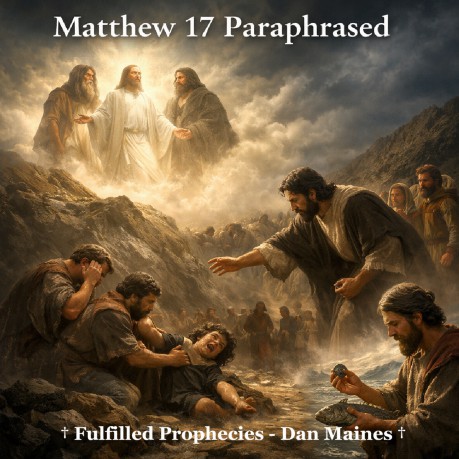
Matthew 17 Paraphrased Introduction Matthew 17:1 Matthew 17:2 Matthew 17:3 Matthew 17:4 Matthew 17:5 Matthew 17:6 Matthew 17:7 Matthew 17:8 Matthew 17:9 Matthew 17:10 Matthew 17:11 Matthew 17:12 Matthew 17:13 Matthew 17:14 Matthew 17:15 Matthew 17:16 Matthew 17:17 Matthew 17:18 Matthew 17:19 Matthew 17:20 Matthew 17:21 Matthew 17:22 Matthew 17:23 Matthew 17:24 Matthew 17:25 Matthew 17:26 Matthew 17:27 Historical References How It Applies To Us Today Q & A Appendix Q What was the purpose of the transfiguration? Q Who was the Elijah that was supposed to come? Q Why did the disciples fail to cast out the
demon? Q Why did Jesus pay the temple tax if He was the
Son of God? Q Why were only Peter, James, and John taken up
the mountain? Q Why did Moses and Elijah appear with Jesus? Q What did the bright cloud represent? Q Why did the Father say listen to Him? Q Why were the disciples afraid when they heard
the voice? Q Why did Jesus tell them not to speak about the
vision yet? Q Why did the scribes teach that Elijah must come
first? Q What does restore all things mean in Matthew
17:11? Q Why did Jesus call them an unbelieving
generation? Q What did Jesus mean by faith the size of a
mustard seed? Q What does moving mountains mean? Q Why did Jesus say prayer and fasting were
needed? Q Why were the disciples grieved when Jesus
predicted His death? Q What was the two drachma tax? Q Why did Jesus say the sons are exempt? Q Why did Jesus perform the miracle with the fish
and coin? Q How does the transfiguration connect to the
coming kingdom? Q What did the transfiguration teach the
disciples about Jesus? Q Why did Moses and Elijah disappear leaving only
Jesus? Q What does this chapter ultimately reveal about
Jesus? † This is the fulfilled perspective we proclaim at
Fulfilled Prophecies † Source Index
By Dan Maines
† Jesus was
steadily revealing who He was to His disciples, not only through
miracles but through moments where His divine authority was openly
shown (Matthew 16:16-17).
† Matthew 17
records three major events, the transfiguration, the healing of a
demon possessed boy, and the temple tax lesson, each showing Christ's
authority over the Law, over spiritual powers, and over the temple
system itself (Matthew 17:5; Hebrews 3:3-6).
†
From the fulfilled perspective, these events were preparing the
disciples for the coming covenant transition that would climax in the
judgment of Jerusalem in their generation (Matthew 16:27-28; Matthew
24:34).
After six days Jesus took with
Him Peter and James and John his brother, and led them up on a high
mountain by themselves.
† Jesus intentionally
separated three witnesses, a common biblical pattern when God reveals
something important, requiring two or three witnesses to establish a
matter (Deuteronomy 19:15).
† Peter later
confirmed this moment as a real historical event when he wrote about
seeing Christ's majesty with his own eyes (2 Peter 1:16-18).
†
Early Christians understood this event as a preview of Christ's
kingdom authority that would soon be revealed in power (Matthew
16:28).
And He was transfigured before
them, and His face shone like the sun, and His garments became as
white as light.
† The word transfigured
describes a visible change revealing Christ's divine glory that was
normally hidden during His earthly ministry (John 1:14).
†
This shining appearance echoes the glory that appeared when God
revealed Himself to Moses on Mount Sinai (Exodus 34:29-30).
†
It demonstrated that Jesus possessed the same divine glory that
belonged to God alone (Hebrews 1:3).
And behold, Moses and Elijah
appeared to them, talking with Him.
† Moses
represented the Law and Elijah represented the Prophets, the two
major sections of the Hebrew Scriptures (Luke 24:27).
†
Their presence showed that the Law and the Prophets pointed directly
to Christ and were now finding their fulfillment in Him (Romans
10:4).
† Luke records that they were speaking
with Jesus about His departure that He was about to accomplish in
Jerusalem (Luke 9:31).
Peter said to Jesus, Lord, it
is good for us to be here, if You wish, I will make three tabernacles
here, one for You, and one for Moses, and one for Elijah.
†
Peter likely connected this moment with the Feast of Tabernacles, a
celebration associated with God's presence dwelling among His people
(Leviticus 23:42-43).
† However, Peter
misunderstood the moment, placing Moses and Elijah on the same level
as Christ (Mark 9:6).
† The following voice
from heaven corrected this misunderstanding and declared the
superiority of Jesus.
While he was still speaking,
behold, a bright cloud overshadowed them, and behold, a voice out of
the cloud said, This is My beloved Son, with whom I am well pleased,
listen to Him.
† The cloud represents the
same divine presence that appeared during Israel's wilderness journey
(Exodus 13:21).
† God the Father directly
commands the disciples to listen to Jesus, showing that the authority
of the Son surpasses the Law and the Prophets (Hebrews 1:1-2).
†
This moment confirmed Peter's earlier confession that Jesus was the
Christ, the Son of the living God (Matthew 16:16).
When the disciples heard this,
they fell face down to the ground and were terrified.
†
Fear was a normal response when people encountered the direct
presence of God's glory (Ezekiel 1:28).
†
Their reaction showed they understood the seriousness of the divine
voice they had just heard.
† Throughout
scripture, encounters with God's glory often caused people to fall
down in awe and fear (Daniel 10:9).
And Jesus came to them and
touched them and said, Get up, and do not be afraid.
†
Jesus consistently calmed fear when His disciples encountered
overwhelming divine moments (Matthew 14:27).
†
His touch demonstrated His role as mediator between God and man (1
Timothy 2:5).
† The command not to fear
appears frequently when God reveals His presence to His people
(Isaiah 41:10).
And lifting up their eyes, they
saw no one except Jesus Himself alone.
†
Moses and Elijah disappearing symbolized that the Law and the
Prophets had served their purpose and now pointed fully to Christ
(Romans 10:4).
† Jesus standing alone
emphasized that He is the final and ultimate authority (Hebrews
12:24).
† The disciples were being prepared
to understand that Christ alone would lead the new covenant people of
God.
As they were coming down from
the mountain, Jesus commanded them, saying, Tell the vision to no one
until the Son of Man has risen from the dead.
†
Jesus often instructed silence about certain events until the proper
time, so that His mission would unfold according to God's plan (Mark
1:44).
† The resurrection would later provide
the full explanation of His identity and mission (Romans 1:4).
†
Only after the resurrection would the disciples fully understand what
they had witnessed.
And His disciples asked Him,
Why then do the scribes say that Elijah must come first?
†
The scribes based this belief on the prophecy found in Malachi 4:5
about Elijah coming before the day of the Lord.
†
The disciples were trying to understand how that prophecy fit with
what they had just witnessed.
† Jesus
clarified that the prophecy had already been fulfilled.
And He answered and said,
Elijah is coming and will restore all things.
†
Jesus acknowledged the prophecy but explained its proper
fulfillment.
† The restoration spoken of
referred to preparing the people for the coming of the Messiah (Luke
1:16-17).
† This restoration work was
connected to John the Baptist's ministry.
But I say to you that Elijah
already came, and they did not recognize him, but did to him whatever
they wished, so also the Son of Man is going to suffer at their
hands.
† Jesus identified John the Baptist as
the Elijah who had come in the spirit and power of Elijah (Matthew
11:14).
† Just as John was rejected and
killed, Jesus predicted that He would also suffer rejection.
†
This continued the pattern of Israel rejecting God's prophets
(Matthew 23:37).
Then the disciples understood
that He had spoken to them about John the Baptist.
†
The disciples now realized that Malachi's prophecy had already been
fulfilled in John.
† This meant the promised
day of the Lord judgment was approaching within their generation
(Malachi 4:5-6; Matthew 23:36).
† It
confirmed that the prophetic timeline was already unfolding.
When they came to the crowd, a
man came up to Jesus, falling on his knees before Him and saying.
†
The posture of kneeling showed humility and desperation for help
(Mark 1:40).
† Crowds constantly surrounded
Jesus because of His reputation for healing and authority.
†
This scene contrasts the glory on the mountain with the broken
condition of the world below.
Lord, have mercy on my son,
for he is a lunatic and is very ill, for he often falls into the fire
and often into the water.
† The father
describes severe suffering that placed the boy in constant danger.
†
The term used here reflects what people in that time believed about
certain illnesses.
† The true cause would
soon be revealed as a demonic affliction.
I brought him to Your
disciples, and they could not cure him.
† The
disciples had previously been given authority over demons (Matthew
10:1).
† Their failure revealed a lack of
faith and spiritual readiness.
† This moment
became a teaching opportunity for Jesus.
And Jesus answered and said,
You unbelieving and perverted generation, how long shall I be with
you, how long shall I put up with you, bring him here to Me.
†
Jesus addressed the broader unbelief surrounding Him, not only the
disciples.
† The phrase unbelieving
generation appears frequently when Jesus rebukes Israel's spiritual
blindness (Matthew 12:39).
† His frustration
reflected the persistent rejection of God's works among the people.
And Jesus rebuked him, and the
demon came out of him, and the boy was cured at once.
†
Jesus demonstrated absolute authority over demonic forces.
†
Unlike other exorcists of that era, Jesus cast out demons by direct
command (Luke 11:20).
† This miracle again
confirmed His divine authority.
Then the disciples came to
Jesus privately and said, Why could we not drive it out?
†
The disciples recognized their failure and wanted to understand
why.
† Private instruction from Jesus often
followed moments of confusion (Mark 4:34).
†
This showed their desire to grow in understanding.
And He said to them, Because
of the littleness of your faith, for truly I say to you, if you have
faith the size of a mustard seed, you will say to this mountain, Move
from here to there, and it will move, and nothing will be impossible
to you.
† The mustard seed illustration
emphasized the power of genuine faith even when it appears small.
†
Moving mountains was a common Jewish expression describing overcoming
great obstacles (Zechariah 4:7).
† Jesus was
teaching that faith in God unlocks power far beyond human ability.
But this kind does not go out
except by prayer and fasting.
† Spiritual
authority requires dependence on God rather than self confidence.
†
Prayer and fasting reflect humility and reliance on God's power.
†
Jesus showed that spiritual battles require spiritual preparation.
And while they were gathering
together in Galilee, Jesus said to them, The Son of Man is going to
be delivered into the hands of men.
† Jesus
again predicted His coming suffering and death.
†
These predictions prepared the disciples for the events that would
soon unfold (Matthew 20:18-19).
† The title
Son of Man connects to Daniel's prophecy about the Messiah (Daniel
7:13).
And they will kill Him, and He
will be raised on the third day. And they were deeply grieved.
†
The disciples struggled to understand how the Messiah could suffer
and die.
† The resurrection would later
confirm Jesus' victory over death (Acts 2:24).
†
Their grief shows they had not yet grasped the full purpose of the
cross.
When they came to Capernaum,
those who collected the two drachma tax came to Peter and said, Does
your teacher not pay the two drachma tax?
†
This tax supported the temple in Jerusalem (Exodus 30:13).
†
By this time the temple system was still functioning but would soon
face judgment in AD 70 (Matthew 24:2).
† The
question tested Jesus' relationship to the temple system.
He said, Yes. And when he came
into the house, Jesus spoke to him first, saying, What do you think,
Simon, from whom do the kings of the earth collect customs or poll
tax, from their sons or from strangers?
†
Jesus used a simple illustration about royal authority.
†
The question was designed to show that the Son of God was not
obligated to pay a tax for His own Father's house.
†
It pointed to Jesus' unique relationship with God.
When Peter said, From
strangers, Jesus said to him, Then the sons are exempt.
†
Jesus declared that He, as the Son, was not obligated to pay the
temple tax.
† This statement quietly revealed
His divine identity.
† Yet He still chose to
avoid unnecessary offense.
However, so that we do not
offend them, go to the sea and throw in a hook, and take the first
fish that comes up, and when you open its mouth, you will find a
shekel, take that and give it to them for you and Me.
†
Jesus miraculously provided the payment, showing His authority even
over creation.
† The miracle revealed that He
could easily provide what was needed.
† It
also showed humility, choosing peace rather than unnecessary conflict
(Romans 12:18).
†
Justin Martyr wrote that the transfiguration confirmed Christ as the
one greater than Moses and the prophets in Dialogue with Trypho.
†
Irenaeus explained that Moses and Elijah appearing with Christ showed
that the Law and the Prophets testified about Him in Against Heresies
Book 4.
† Eusebius noted that the fulfillment
of the Elijah prophecy through John the Baptist proved the prophetic
timeline leading up to the judgment of Jerusalem in Ecclesiastical
History.
†
Christ alone is the authority we follow, not religious systems or
traditions (Colossians 2:16-17).
† Faith,
even when small, becomes powerful when it rests in God rather than
human strength (Hebrews 11:6).
† Jesus has
authority over spiritual forces, sickness, and every challenge we
face (Matthew 28:18).
† The kingdom Christ
revealed to His disciples is now the spiritual kingdom believers live
in today (Luke 17:20-21).
A
It revealed Christ's divine glory and confirmed that He is greater
than the Law and the Prophets, pointing to Him as the fulfillment of
both (Matthew 17:2-5; Hebrews 1:1-2).
A
Jesus said John the Baptist fulfilled that role by coming in the
spirit and power of Elijah (Matthew 17:12-13; Luke 1:16-17).
A Jesus said it was because of their
lack of faith and dependence on God (Matthew 17:20; Mark 9:29).
A He paid it to avoid unnecessary
offense even though He was not obligated to do so (Matthew 17:26-27).
A Jesus often chose these three
as close witnesses during key moments of revelation, including the
transfiguration and later in Gethsemane, so their testimony could
confirm what they saw (Matthew 17:1; Matthew 26:37; 2 Peter 1:16-18).
A
Moses represented the Law and Elijah represented the Prophets,
together they symbolized the entire Old Covenant testimony pointing
to Christ as its fulfillment (Matthew 17:3; Luke 24:27; Romans 10:4).
A
The cloud symbolized the presence of God, just as the cloud led
Israel in the wilderness and filled the tabernacle and temple (Exodus
13:21; Exodus 40:34-35; 1 Kings 8:10-11).
A
God was declaring that Jesus now held the final authority, surpassing
the Law and the Prophets, because He is the Son through whom God now
speaks (Matthew 17:5; Hebrews 1:1-2).
A Throughout scripture, people often
fell in fear when encountering God's direct presence because His
glory revealed their human weakness (Ezekiel 1:28; Daniel 10:9).
A The full meaning of the
transfiguration could only be understood after the resurrection
confirmed who Jesus truly was (Matthew 17:9; Romans 1:4).
A They were referring to the prophecy in
Malachi that Elijah would appear before the day of the Lord, but
Jesus explained that John the Baptist fulfilled that prophecy
(Malachi 4:5-6; Matthew 17:12-13).
A The restoration referred to preparing
Israel for the coming of the Messiah by calling the people to
repentance and turning hearts back to God (Luke 1:16-17).
A Many in Israel continually
rejected God's works and the testimony of His prophets, even while
witnessing miracles firsthand (Matthew 17:17; Matthew 12:39).
A He was showing that even small
but genuine faith in God has the power to overcome obstacles that
appear impossible (Matthew 17:20; Luke 17:6).
A
In Jewish language this phrase described removing great obstacles or
accomplishing what seemed impossible through God's power (Zechariah
4:7).
A Some spiritual struggles require
deeper dependence on God, and prayer and fasting express humility and
reliance on His strength rather than our own (Matthew 17:21; James
4:7-10).
A They expected the
Messiah to reign immediately and had not yet understood that His
suffering and resurrection were necessary for God's redemptive plan
(Matthew 17:23; Luke 24:25-27).
A
It was the annual temple tax used to support the temple service in
Jerusalem, originally commanded under the Law of Moses (Exodus
30:13-16).
A
As the Son of God, Jesus was not obligated to pay a tax for His
Father's house, but He chose to pay it anyway to avoid unnecessary
offense (Matthew 17:26-27).
A The miracle demonstrated His
authority over creation and showed that even when He humbled Himself,
He still possessed divine power (Matthew 17:27; Colossians 1:16).
A The event gave the disciples
a preview of Christ's glory that would soon be revealed in power
during the judgment and kingdom transition within their generation
(Matthew 16:27-28; Matthew 24:34).
A It showed them that
Jesus was not just a teacher or prophet but the divine Son whose
glory surpassed Moses and Elijah (Matthew 17:2-5; Hebrews 3:3-6).
A This symbolized that the Law and the
Prophets had completed their role and that Christ alone now stands as
the final authority (Romans 10:4; Hebrews 12:24).
A It shows His authority over the Law,
over demons, over sickness, over the temple system, and over creation
itself (Matthew 17:3; Matthew 17:18; Matthew 17:27; Matthew 28:18).
© Fulfilled Prophecies - Dan
Maines.
† Matthew
17:1-27; Matthew 16:27-28; Luke 9:31; Hebrews 1:1-3; Daniel 7:13;
Malachi 4:5-6
† Justin Martyr, Dialogue with
Trypho; Irenaeus, Against Heresies Book 4; Eusebius, Ecclesiastical
History
Links