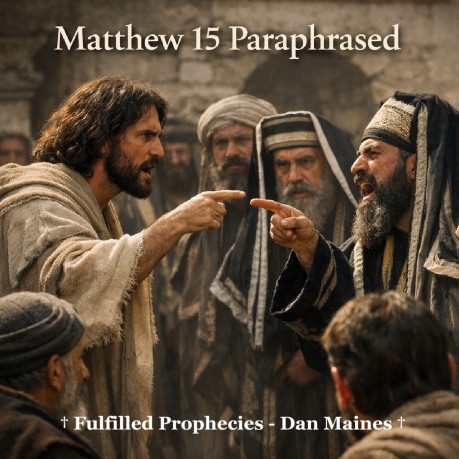
Matthew 15 Paraphrased Introduction Matthew 15:1 Matthew 15:2 Matthew 15:3 Matthew 15:4 Matthew 15:5 Matthew 15:6 Matthew 15:7 Matthew 15:8 Matthew 15:9 Matthew 15:10 Matthew 15:11 Matthew 15:12 Matthew 15:13 Matthew 15:14 Matthew 15:15 Matthew 15:16 Matthew 15:17 Matthew 15:18 Matthew 15:19 Matthew 15:20 Matthew 15:21 Matthew 15:22 Matthew 15:23 Matthew 15:24 Matthew 15:25 Matthew 15:26 Matthew 15:27 Matthew 15:28 Matthew 15:29 Matthew 15:30 Matthew 15:31 Matthew 15:32 Matthew 15:33 Matthew 15:34 Matthew 15:35 Matthew 15:36 Matthew 15:37 Matthew 15:38 Matthew 15:39 Historical References How It Applies To Us Today Q & A Appendix Q Why did Jesus quote Isaiah when confronting the
Pharisees? Q Why did Jesus call the Pharisees blind
guides? Q Why did Jesus test the Canaanite woman before
healing her daughter? Q What does this chapter teach about tradition in
religion? Q Why did Jesus perform another feeding miracle
in this chapter? Q How does this chapter connect to the coming
judgment on Jerusalem? † This is the fulfilled perspective we proclaim at
Fulfilled Prophecies † Source Index
By Dan Maines
† Jesus
confronts the growing problem among the religious leaders, they had
elevated human traditions above the commandments of God, which
distorted the true meaning of the Law (Isaiah 29:13).
†
The conflict in this chapter exposes the difference between outward
religion and true obedience that comes from the heart (1 Samuel
16:7).
† Matthew records this event to show
that the corruption of Israel's leadership was one of the reasons
judgment would eventually fall on that generation (Matthew 23:36).
Then some Pharisees and scribes
came to Jesus from Jerusalem and said,
†
These leaders traveled from Jerusalem because Jesus' influence was
spreading rapidly, and they wanted to challenge His authority (John
7:32).
† Jerusalem was the center of
religious authority in Israel, so this confrontation represents the
official religious establishment confronting the Messiah (Matthew
21:23).
Why do Your disciples break the
tradition of the elders? For they do not wash their hands when they
eat bread.
† The issue was not hygiene but
ritual tradition, these ceremonial washings were man made rules added
to the Law (Mark 7:3-4).
† By elevating
tradition to the same level as God's command, the leaders were
corrupting the Law itself (Deuteronomy 4:2).
And He answered and said to
them, Why do you yourselves break the commandment of God for the sake
of your tradition?
† Jesus immediately
exposes their hypocrisy by showing that their traditions were
actually causing them to violate God's commands (Isaiah 29:13).
†
This reversal turns the accusation back on them and reveals their
spiritual blindness (Matthew 23:24).
For God said, Honor your father
and mother, and, He who speaks evil of father or mother is to be put
to death.
† Jesus quotes directly from the
Law to show that the command to honor parents was clear and binding
(Exodus 20:12; Exodus 21:17).
† The
seriousness of the command demonstrates how deeply the leaders had
distorted God's Law through their traditions (Deuteronomy 27:16).
But you say, Whoever says to
his father or mother, Whatever I have that would help you has been
given to God,
† This refers to the Corban
tradition, where a person could declare their possessions dedicated
to God to avoid helping their parents (Mark 7:11).
†
The practice allowed people to appear religious while neglecting
their family responsibilities (Proverbs 28:24).
he is not to honor his father
or his mother. And by this you invalidated the word of God for the
sake of your tradition.
† Jesus makes the
central point clear, their tradition directly contradicted God's
command (Isaiah 29:13).
† When human
tradition replaces scripture, it always results in corruption of
truth (Colossians 2:8).
You hypocrites, rightly did
Isaiah prophesy of you:
† Jesus identifies
their behavior as the exact fulfillment of Isaiah's warning about
empty religious worship (Isaiah 29:13).
†
Hypocrisy means wearing a mask, outward religion without inward
obedience (Matthew 23:27).
This people honors Me with
their lips, but their heart is far away from Me.
†
God has always looked at the heart rather than outward religious
performance (1 Samuel 16:7).
† Empty words
without obedience are meaningless to God (James 1:26).
But in vain do they worship Me,
teaching as doctrines the precepts of men.
†
Worship becomes worthless when it is built on human traditions
instead of God's word (Isaiah 29:13).
† This
same danger exists whenever religious systems elevate traditions
above scripture (Colossians 2:22).
After Jesus called the crowd
to Him, He said to them, Hear and understand.
†
Jesus now shifts from confronting the leaders to teaching the crowd
directly (Matthew 13:9).
† This instruction
reveals that spiritual understanding requires listening carefully to
truth (Proverbs 4:7).
It is not what enters the
mouth that defiles the man, but what proceeds out of the mouth, this
defiles the man.
† Jesus is explaining that
moral corruption comes from the heart, not from ceremonial food laws
(Mark 7:18-23).
† This teaching begins to
expose the deeper spiritual nature of the Law's fulfillment (Jeremiah
31:33).
Then the disciples came and
said to Him, Do You know that the Pharisees were offended when they
heard this statement?
† The disciples
recognized that Jesus' teaching directly challenged the authority of
the religious leaders (John 7:48).
† Truth
often offends those who rely on tradition rather than scripture
(Galatians 4:16).
But He answered and said,
Every plant which My heavenly Father did not plant shall be
uprooted.
† Jesus is warning that religious
systems not established by God will ultimately be destroyed (Psalm
1:4-6).
† This also anticipates the coming
judgment on the corrupt leadership of Israel (Matthew 23:38).
Let them alone, they are blind
guides of the blind. And if a blind man guides a blind man, both will
fall into a pit.
† Jesus describes the
spiritual blindness of the leaders who were supposed to guide Israel
(Isaiah 56:10).
† When false teachers lead
others, both the leaders and their followers suffer the consequences
(Romans 2:19-21).
Peter said to Him, Explain the
parable to us.
† Even the disciples sometimes
struggled to fully grasp Jesus' teachings (Mark 8:17).
†
Their willingness to ask questions shows their desire to understand
the truth more deeply (Luke 24:45).
Jesus said, Are you still
lacking in understanding also?
† Jesus gently
corrects the disciples for not grasping the spiritual meaning of His
teaching (Hebrews 5:12).
† Spiritual
understanding develops over time as truth is revealed (John 16:12).
Do you not understand that
everything that goes into the mouth passes into the stomach, and is
eliminated?
† Jesus uses a simple physical
explanation to show that food cannot corrupt the soul (Romans
14:17).
† The focus of God's concern has
always been the inner person (Psalm 51:6).
But the things that proceed
out of the mouth come from the heart, and those defile the man.
†
Words reveal the true condition of the heart (Luke 6:45).
†
Sin originates from the inner nature of humanity, not external
circumstances (Jeremiah 17:9).
For out of the heart come evil
thoughts, murders, adulteries, sexual immoralities, thefts, false
witness, slanders.
† Jesus lists the kinds of
sins that originate from the corrupted human heart (Galatians
5:19-21).
† These are violations of God's
moral law and cannot be corrected by outward rituals (Romans 3:20).
These are the things which
defile the man, but to eat with unwashed hands does not defile the
man.
† Jesus clearly rejects the Pharisaic
tradition that elevated ceremonial washing above moral obedience
(Mark 7:23).
† This teaching shifts the focus
from ritual religion to genuine righteousness (Micah 6:8).
Jesus went away from there,
and withdrew into the district of Tyre and Sidon.
†
Tyre and Sidon were Gentile regions, showing that Jesus' ministry was
beginning to reach beyond Israel (Isaiah 49:6).
†
This movement anticipates the later inclusion of the nations into the
covenant blessings (Acts 13:47).
And a Canaanite woman from
that region came out and began to cry out, saying, Have mercy on me,
Lord, Son of David, my daughter is cruelly demon possessed.
†
This woman demonstrates remarkable faith by recognizing Jesus as the
Son of David, a Messianic title (Matthew 9:27).
†
Her plea also shows that Gentiles were already recognizing Christ's
authority (Isaiah 60:3).
But He did not answer her a
word. And His disciples came and implored Him, saying, Send her away,
because she keeps shouting at us.
† Jesus'
silence serves as a test of the woman's persistence and faith
(Hebrews 11:6).
† The disciples' reaction
reflects the common Jewish attitude toward Gentiles at that time
(Acts 10:28).
But He answered and said, I
was sent only to the lost sheep of the house of Israel.
†
Jesus' earthly mission focused first on Israel because they were the
covenant people (Romans 1:16).
† The promises
given to the patriarchs were to be fulfilled through Israel before
extending to the nations (Genesis 12:3).
But she came and began to bow
down before Him, saying, Lord, help me.
† Her
humility and persistence demonstrate genuine faith (James 4:10).
†
True faith approaches God with dependence and humility (Psalm 34:18).
And He answered and said, It
is not good to take the children's bread and throw it to the dogs.
†
This statement reflects the common Jewish expression distinguishing
Israel from Gentiles (Matthew 10:6).
† Yet
Jesus uses the moment to reveal the depth of the woman's faith (Luke
7:9).
But she said, Yes, Lord, but
even the dogs feed on the crumbs which fall from their masters'
table.
† Her response shows remarkable
humility and confidence in Jesus' mercy (Psalm 145:9).
†
Faith does not demand rights, it trusts in God's grace (Ephesians
2:8).
Then Jesus said to her, O
woman, your faith is great, it shall be done for you as you wish. And
her daughter was healed at once.
† Jesus
publicly praises her faith, something rarely stated even about His
disciples (Matthew 8:10).
† The healing
demonstrates Christ's authority over spiritual forces (Luke 4:36).
Departing from there, Jesus
went along by the Sea of Galilee, and having gone up on the mountain,
He was sitting there.
† Jesus often withdrew
to elevated places for teaching and ministry (Matthew 5:1).
†
These locations allowed large crowds to gather and hear His teaching
(Mark 3:13).
And large crowds came to Him,
bringing with them those who were lame, crippled, blind, mute, and
many others, and they laid them down at His feet, and He healed
them.
† The miracles demonstrated that Jesus
was fulfilling the prophecies concerning the Messiah (Isaiah
35:5-6).
† These healings were signs pointing
to the restoration promised in the kingdom (Luke 7:22).
So the crowd marveled as they
saw the mute speaking, the crippled restored, and the lame walking,
and the blind seeing, and they glorified the God of Israel.
†
The miracles caused the people to recognize the power of God working
through Jesus (Psalm 103:2-3).
† The phrase
God of Israel reflects that many witnesses were likely Gentiles in
this region (Matthew 4:25).
And Jesus called His disciples
to Him, and said, I feel compassion for the people, because they have
remained with Me now three days and have nothing to eat, and I do not
want to send them away hungry, for they might faint on the way.
†
Jesus' compassion shows His concern for both spiritual and physical
needs (Psalm 145:15-16).
† This moment leads
to another miracle that demonstrates His provision (John 6:5-13).
The disciples said to Him,
Where would we get so many loaves in this desolate place to satisfy
such a large crowd?
† The disciples again
struggle to remember the earlier feeding miracle (Matthew
14:15-21).
† This shows how easily people
forget God's past works (Psalm 78:11).
And Jesus said to them, How
many loaves do you have? And they said, Seven, and a few small
fish.
† Jesus often used what little was
available to demonstrate God's power (2 Kings 4:42-44).
†
Faith begins with trusting God with what we already have (Luke
16:10).
And He directed the people to
sit down on the ground.
† The orderly
preparation reflects that God is a God of order (1 Corinthians
14:33).
† Jesus prepares the crowd before
performing the miracle (John 6:10).
And He took the seven loaves
and the fish, and giving thanks, He broke them and started giving
them to the disciples, and the disciples gave them to the people.
†
Jesus gives thanks to the Father before providing the miracle (1
Timothy 4:4).
† The disciples act as the
distributors, demonstrating their role in ministry (Matthew 10:1).
And they all ate and were
satisfied, and they picked up what was left over of the broken
pieces, seven large baskets full.
† God's
provision is always abundant, far beyond what people expect
(Ephesians 3:20).
† The leftover baskets
demonstrate the completeness of the miracle (Psalm 107:9).
And those who ate were four
thousand men, besides women and children.
†
The total crowd would have been far larger when counting families
(Matthew 14:21).
† This miracle again
confirms Jesus as the provider for His people (Psalm 132:15).
And sending away the crowds,
Jesus got into the boat and came to the region of Magadan.
†
Jesus frequently moved between regions during His ministry,
continuing to spread His message (Matthew 9:35).
†
These movements prepared the way for the wider proclamation of the
gospel (Acts 1:8).
†
Eusebius recorded that early Christians understood Jesus'
confrontations with the Pharisees as evidence of the corruption of
the religious leadership that would later face judgment in AD 70
(Eusebius, Ecclesiastical History 3.5).
†
Josephus describes how the religious leadership of Jerusalem had
become deeply influenced by traditions and internal corruption during
the first century (Josephus, Antiquities of the Jews 13.10).
†
Irenaeus wrote that Christ revealed the true intent of the Law by
exposing how traditions had replaced obedience to God (Irenaeus,
Against Heresies 4.13).
†
This chapter reminds us that religious tradition must never replace
the clear teaching of scripture (Colossians 2:8).
†
God cares about the condition of the heart more than outward
religious appearances (1 Samuel 16:7).
† True
faith, like the Canaanite woman's faith, trusts God's mercy even when
circumstances seem difficult (Hebrews 11:6).
†
Jesus still provides for His people just as He provided for the
crowds in the wilderness (Matthew 6:33).
Q Why
did Jesus confront the Pharisees so strongly?
A
Because their traditions had replaced God's commandments and were
misleading the people (Matthew 15:3-9).
Q What
does Jesus mean when He says what comes out of the mouth defiles a
person?
A He is teaching that sin originates in
the heart, not in external rituals or food laws (Matthew 15:18-20;
Luke 6:45).
Q Why did Jesus initially say He
was sent only to Israel?
A His earthly ministry
began with Israel as the covenant people, but the blessing was always
intended to reach the nations (Matthew 15:24; Genesis 12:3).
Q
What does the feeding of the four thousand demonstrate?
A
It shows Christ's authority, compassion, and ability to provide
abundantly for those who follow Him (Matthew 15:32-38).
A Because Isaiah had already warned
that Israel's leaders would honor God with their lips while their
hearts were far from Him. Jesus shows that the same spiritual
condition still existed in His day (Matthew 15:7-9; Isaiah 29:13).
A They claimed to teach God's Law, but
their traditions had replaced the commandments of God. Because they
were spiritually blind, they were leading the people into the same
blindness (Matthew 15:13-14; Romans 2:19-21).
A Her persistence
revealed genuine faith. Jesus used the moment to show that true faith
could be found even among Gentiles while many in Israel were
rejecting Him (Matthew 15:21-28; Matthew 8:10).
A It shows that when human traditions
replace scripture, they corrupt the truth and mislead people. God's
word must always remain the authority (Matthew 15:3-6; Colossians
2:8).
A The feeding of the four
thousand demonstrated again that the Messiah provides for His people
and has authority over creation. It also revealed His compassion for
the crowds who followed Him (Matthew 15:32-38; Psalm 107:9).
A Jesus exposed the
corruption of Israel's leadership, which later led to the judgment He
warned about throughout the Gospels. Their rejection of God's
commandments and their traditions prepared the way for that national
judgment (Matthew 23:36-38; Luke 19:41-44).
© Fulfilled Prophecies - Dan
Maines.
† Matthew
15; Isaiah 29:13; Exodus 20:12; Exodus 21:17; Mark 7:3-23; Luke 6:45;
Isaiah 35:5-6; Matthew 14:15-21; Genesis 12:3
†
Eusebius, Ecclesiastical History 3.5; Josephus, Antiquities of the
Jews 13.10; Irenaeus, Against Heresies 4.13
Links