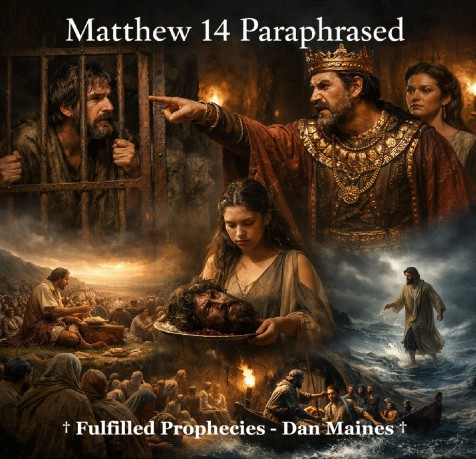
Matthew 14
Paraphrased
By Dan Maines
Introduction
†
Matthew 14 records major events in the ministry of Jesus, including
the death of John the Baptist, the feeding of the five thousand, and
Jesus walking on the sea. These events reveal both the rejection of
God's messengers by corrupt rulers and the growing revelation of the
Messiah to Israel (Matthew 11:12; Matthew 16:16).
†
The chapter shows how the message of repentance brought conflict with
political authority, while Christ's miracles demonstrated the arrival
of God's kingdom among that generation (Matthew 12:28; Luke 7:22).
†
These events also take place during the final decades leading to the
covenant judgment Jesus later announced against Jerusalem, showing
the urgency of the message being preached to Israel (Matthew 23:36;
Luke 19:41-44).
Matthew 14:1
At that time
Herod the tetrarch heard the news about Jesus,
†
Herod Antipas governed Galilee under Roman authority and was deeply
disturbed by the growing reports of Jesus' miracles and teaching
(Luke 3:1; Luke 9:7).
† News about Christ's
works was spreading rapidly across the region because the miracles
confirmed that something extraordinary was happening in Israel
(Matthew 4:23-24).
† Even political leaders
could not ignore the influence of Jesus as crowds gathered to hear
him and witness his power (Mark 6:14).
Matthew 14:2
and
he said to his servants, This is John the Baptist, he has risen from
the dead, and that is why miraculous powers are at work in him.
†
Herod's fear reflected the guilt he carried after ordering the death
of John the Baptist (Mark 6:16).
† The rulers
recognized that supernatural power was present in Jesus' ministry,
even though they misunderstood its source (John 3:2).
†
John's powerful preaching had left such a strong impression that
Herod believed his spirit had returned (Matthew 3:5-6).
Matthew
14:3
For when Herod had John arrested, he bound him and
put him in prison because of Herodias, the wife of his brother
Philip.
† John had publicly rebuked Herod for
taking his brother's wife, which violated the law of Moses (Leviticus
18:16; Leviticus 20:21).
† Prophets
throughout Israel's history confronted rulers about sin, often
suffering persecution for speaking the truth (1 Kings 18:17-18).
†
John's imprisonment shows the cost of faithful preaching when it
challenges those in power (Matthew 5:10-12).
Matthew
14:4
For John had been saying to him, It is not lawful
for you to have her.
† John's rebuke was
based on the law given to Israel which condemned such a relationship
(Leviticus 18:16).
† He served as a prophetic
voice calling the nation to repentance just as Elijah had done in
earlier generations (Malachi 4:5-6).
† This
courage demonstrates the responsibility of God's messengers to
confront sin without compromise (Ezekiel 3:17-19).
Matthew
14:5
Although Herod wanted to put him to death, he
feared the crowd, because they regarded John as a prophet.
†
The people widely believed John was a true prophet sent by God
(Matthew 21:26).
† Herod's fear of the crowd
shows how political leaders often weigh public opinion when making
decisions.
† This moment reveals the tension
between political authority and prophetic truth.
Matthew
14:6
But when Herod's birthday came, the daughter of
Herodias danced before them and pleased Herod,
†
Royal celebrations often involved elaborate banquets and
entertainment for rulers and their guests (Esther 1:5-8).
†
The event created the setting that would ultimately lead to John's
execution (Mark 6:21).
† Moments of careless
celebration often lead to serious consequences when wisdom is
absent.
Matthew 14:7
so much that he
promised with an oath to give her whatever she asked.
†
Rash vows were warned against in scripture because they could lead to
destructive outcomes (Ecclesiastes 5:4-5).
†
Herod made the promise to impress those attending the banquet.
†
Pride and reputation often drive people to commit themselves to
foolish decisions.
Matthew 14:8
Having
been prompted by her mother, she said, Give me here on a platter the
head of John the Baptist.
† Herodias used her
daughter to carry out revenge against John for exposing her sin (Mark
6:24).
† Hatred toward God's messengers often
grows when people refuse to repent.
† The
persecution of prophets was a long pattern within Israel's history
(Matthew 23:34-35).
Matthew 14:9
Although
he was grieved, the king commanded it to be given because of his
oaths, and because of his dinner guests.
†
Herod knew the request was wrong but valued his reputation more than
justice.
† Fear of embarrassment before
others can push leaders into moral failure.
†
This moment reveals the weakness of authority that lacks
righteousness.
Matthew 14:10
He sent and
had John beheaded in the prison.
† John the
Baptist sealed his prophetic ministry with his life.
†
Jesus later described John as the greatest born among women because
of his role in preparing the way (Matthew 11:11).
†
The death of prophets at the hands of rulers was tragically common
throughout Israel's history (Luke 13:33-34).
Matthew
14:11
And his head was brought on a platter and given
to the girl, and she brought it to her mother.
†
The brutality of the scene exposes the corruption within Herod's
household.
† Vengeance often drives people
toward acts that shock the conscience.
†
Scripture repeatedly records how rejecting God's messengers leads to
escalating violence (2 Chronicles 36:16).
Matthew
14:12
His disciples came and took away the body and
buried it, and they went and reported to Jesus.
†
John's followers honored him with a proper burial.
†
They brought the news to Jesus, recognizing the connection between
John's mission and Christ's work.
† John's
ministry had prepared the nation for the coming of the Messiah (John
1:29-31).
Matthew 14:13
Now when Jesus
heard about John, he withdrew from there in a boat to a secluded
place by himself, and when the people heard of this, they followed
him on foot from the cities.
† Jesus withdrew
after hearing about John's death, likely for prayer and reflection
(Mark 6:31).
† The crowds continued pursuing
him because they desired healing and teaching.
†
The growing number of followers shows how powerful his ministry had
become among the people.
Matthew 14:14
When
he went ashore, he saw a large crowd, and felt compassion for them
and healed their sick.
† The compassion of
Jesus reveals the heart of the Messiah toward suffering people
(Isaiah 61:1).
† Healing the sick fulfilled
prophetic expectations about the coming kingdom (Isaiah 35:5-6).
†
These miracles confirmed that God's power was present in Christ's
ministry.
Matthew 14:15
When it was
evening, the disciples came to him and said, This place is desolate
and the hour is already late, so send the crowds away, that they may
go into the villages and buy food for themselves.
†
The disciples were concerned about the physical needs of the large
crowd.
† The setting resembled Israel's
wilderness experience where God provided food for his people (Exodus
16:4).
† This moment prepared the disciples
to witness another demonstration of divine power.
Matthew
14:16
But Jesus said to them, They do not need to go
away, you give them something to eat.
† Jesus
challenged the disciples to trust God rather than the limits of their
resources.
† The miracle would involve the
disciples participating in distributing the food.
†
Christ often used such moments to teach the disciples deeper
faith.
Matthew 14:17
They said to him, We
have nothing here except five loaves and two fish.
†
The disciples saw only the small amount of food available.
†
Human reasoning often focuses on scarcity instead of divine
provision.
† The limited supply highlights
the magnitude of the miracle that followed.
Matthew
14:18
And he said, Bring them here to me.
†
Jesus began with the small resources already present.
†
God frequently multiplies what appears insignificant (2 Kings
4:42-44).
† The command shows that divine
provision begins with trusting Christ.
Matthew
14:19
Ordering the people to sit down on the grass, he
took the five loaves and the two fish, and looking up toward heaven,
he blessed the food, and breaking the loaves he gave them to the
disciples, and the disciples gave them to the crowds,
†
Jesus acknowledged the Father as the source of provision before
distributing the food.
† The disciples acted
as servants distributing the miracle to the people.
†
This moment reveals the Messiah as the shepherd providing for Israel
(Psalm 23:1).
Matthew 14:20
and they all
ate and were satisfied. They picked up what was left over of the
broken pieces, twelve full baskets.
† The
abundance demonstrated that God's provision exceeded the need.
†
Twelve baskets may symbolize provision for the twelve tribes of
Israel.
† The miracle showed that the Messiah
could sustain the people of God.
Matthew 14:21
There
were about five thousand men who ate, besides women and children.
†
The full crowd likely exceeded ten thousand people.
†
The scale of the miracle made it impossible to deny what had
occurred.
† This event greatly increased the
fame of Jesus throughout the region.
Matthew
14:22
Immediately he made the disciples get into the
boat and go ahead of him to the other side, while he sent the crowds
away.
† Jesus dismissed the crowd to prevent
political attempts to make him king (John 6:15).
†
He directed the disciples across the sea while he remained behind.
†
This prepared them for another powerful demonstration of his
authority.
Matthew 14:23
After he had sent
the crowds away, he went up on the mountain by himself to pray, and
when it was evening, he was there alone.
†
Prayer was central to Jesus' ministry.
† He
frequently withdrew to spend time with the Father (Luke 5:16).
†
Even after miracles he sought solitude and communion with
God.
Matthew 14:24
But the boat was
already a long distance from the land, battered by the waves, for the
wind was contrary.
† Sudden storms were
common on the Sea of Galilee due to the surrounding terrain.
†
The disciples struggled against strong winds and waves.
†
This situation prepared them for another miracle revealing Christ's
authority.
Matthew 14:25
And in the fourth
watch of the night he came to them, walking on the sea.
†
The fourth watch occurred between roughly 3 and 6 in the morning.
†
Walking on water demonstrated authority that belongs to God alone
(Job 9:8).
† This miracle revealed Jesus'
power over the forces of nature.
Matthew 14:26
When
the disciples saw him walking on the sea, they were terrified, and
said, It is a ghost! And they cried out in fear.
†
The disciples reacted with fear because they could not understand
what they were witnessing.
† Encounters with
divine power often produce fear before understanding.
†
Their response shows how extraordinary the moment was.
Matthew
14:27
But immediately Jesus spoke to them, saying, Take
courage, it is I, do not be afraid.
† Jesus
calmed their fear by identifying himself.
†
God's presence repeatedly brings reassurance to his people (Isaiah
41:10).
† His words revealed authority and
compassion at the same time.
Matthew 14:28
Peter
said to him, Lord, if it is you, command me to come to you on the
water.
† Peter showed bold faith in asking to
walk toward Jesus.
† He trusted that Christ's
command could make the impossible possible.
†
This moment reveals both courage and spiritual curiosity.
Matthew
14:29
And he said, Come! And Peter got out of the boat,
and walked on the water and came toward Jesus.
†
Peter briefly shared in the miracle through faith in Christ's
command.
† The event demonstrates how faith
can overcome natural limitations.
† Yet it
also foreshadows the weakness of human faith.
Matthew
14:30
But seeing the wind, he became frightened, and
beginning to sink, he cried out, Lord, save me!
†
Peter lost focus on Jesus and became overwhelmed by the storm.
†
Fear replaced faith when circumstances took his attention.
†
This moment reveals how quickly doubt can weaken trust.
Matthew
14:31
Immediately Jesus stretched out his hand and took
hold of him, and said to him, You of little faith, why did you
doubt?
† Jesus rescued Peter while also
correcting his doubt.
† Faith must remain
focused on Christ rather than surrounding circumstances.
†
This moment helped shape the growth of the disciples.
Matthew
14:32
When they got into the boat, the wind stopped.
†
The storm ceased immediately when Jesus entered the boat.
†
This demonstrated authority over nature itself.
†
Such power confirmed the divine identity of Christ.
Matthew
14:33
And those who were in the boat worshiped him,
saying, You are certainly God's Son!
† The
disciples responded with worship because they recognized his
authority.
† Their confession reveals growing
understanding about who Jesus truly was.
†
The miracles throughout Matthew were leading them to this
conclusion.
Matthew 14:34
When they had
crossed over, they came to land at Gennesaret.
†
Gennesaret was a fertile area along the Sea of Galilee known for its
agriculture.
† Jesus continued ministering as
he traveled through the region.
† The
miracles had prepared the people to seek him out.
Matthew
14:35
And when the men of that place recognized him,
they sent word into all that surrounding district and brought to him
all who were sick,
† News about Jesus spread
quickly among nearby towns.
† People brought
their sick because they believed he could heal them.
†
His reputation as a healer continued to grow throughout the
region.
Matthew 14:36
and they implored
him that they might just touch the fringe of his cloak, and as many
as touched it were cured.
† The people
believed even touching his garment could bring healing.
†
This reflects the earlier healing of the woman who touched his cloak
in faith (Matthew 9:20-22).
† The power
present in Christ confirmed that God's kingdom had arrived among
them.
Historical References
†
Josephus records the execution of John the Baptist under Herod
Antipas, confirming the historical context of this chapter (Josephus,
Antiquities of the Jews 18.5.2).
† Eusebius
wrote about the martyrdom of John the Baptist as a major event
remembered by early Christians (Eusebius, Ecclesiastical History
1.11).
† Clement of Alexandria referred to
John as the final prophet who prepared the way for the Messiah
(Clement of Alexandria, Stromata).
How It Applies To Us
Today
† John's courage reminds us
that truth must be spoken even when it challenges powerful people
(Acts 5:29).
† The feeding of the five
thousand shows that Christ provides more than enough for those who
trust him (Philippians 4:19).
† Peter walking
on the water reminds us that faith must remain focused on Christ
rather than our circumstances (Hebrews 12:2).
Q & A
Appendix
Q: Why did Herod think Jesus
was John raised from the dead?
A: His guilty
conscience over executing John caused him to believe John had
returned, revealing how deeply the prophet's death troubled him (Mark
6:14-16).
Q: What was the significance of
feeding the five thousand?
A: The miracle
revealed Jesus as the provider for Israel and echoed God's provision
during the wilderness journey (Exodus 16:4; John 6:35).
Q:
Why did Peter begin to sink while walking on water?
A:
Peter shifted his focus from Jesus to the storm around him, showing
how doubt can weaken faith (Matthew 14:30-31; James 1:6).
Q:
Why was John the Baptist imprisoned by Herod?
A:
John publicly rebuked Herod for taking Herodias, his brother's wife,
which violated the law given to Israel. His imprisonment shows how
rulers often reject the truth when it exposes their sin (Leviticus
18:16; Luke 3:19-20).
Q: Why did Jesus feed the
crowd instead of sending them away?
A: Jesus
showed compassion for the people and demonstrated that the Messiah
provides for his people just as God provided manna for Israel in the
wilderness (Exodus 16:4; Matthew 14:14-16).
Q:
Why were twelve baskets of leftovers collected?
A:
The twelve baskets reflect abundance and likely symbolize provision
for the twelve tribes of Israel, showing that the Messiah had come to
provide for the whole nation (Matthew 15:37; Luke 22:30).
Q:
Why did the people believe touching Jesus' cloak could heal them?
A:
Earlier miracles showed that faith in Christ brought healing,
including the woman who touched his garment and was immediately
healed (Matthew 9:20-22; Mark 5:27-29).
Q: What
does Jesus walking on the sea reveal about him?
A:
The miracle demonstrates authority that belongs to God alone,
confirming that Jesus possessed divine power over creation itself
(Job 9:8; Psalm 107:28-30).
Q: Why did the
disciples worship Jesus in the boat?
A: After
seeing the storm immediately stop and witnessing Jesus walking on the
sea, they recognized his divine authority and confessed that he truly
was the Son of God (Matthew 14:32-33; John 20:28).
†
This is the fulfilled perspective we proclaim at Fulfilled Prophecies
†
© Fulfilled Prophecies - Dan Maines.
Source
Index
† Matthew 14:1-36; Matthew
11:12; Matthew 16:16; Matthew 23:36; Matthew 4:23-24; Matthew 3:5-6;
Matthew 5:10-12; Matthew 9:20-22; Matthew 12:28
†
Isaiah 35:5-6; Isaiah 41:10; Isaiah 61:1; Psalm 23:1; Job 9:8; Exodus
16:4; 2 Kings 4:42-44
† Josephus, Antiquities
of the Jews 18.5.2; Eusebius, Ecclesiastical History 1.11; Clement of
Alexandria, Stromata
Links