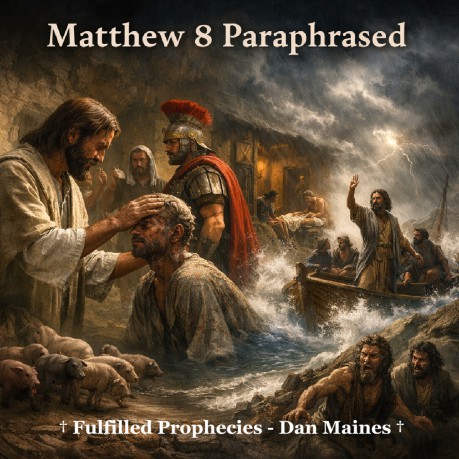
Matthew 8 Paraphrased Introduction † Matthew 8 shows the authority of Jesus being
demonstrated through real events that people witnessed. These
miracles weren't performed for spectacle, they were signs proving the
kingdom of God had arrived among them (Matthew 4:23; Matthew
12:28). Matthew 8:1 † The crowds followed because His teaching
carried authority that the religious leaders didn't have (Matthew
7:28-29). Matthew 8:2 † Leprosy caused complete separation from
society under the Law of Moses (Leviticus 13:45-46). Matthew 8:3 † Under the Law touching a leper normally
brought uncleanness, but Jesus reversed the condition by bringing
cleansing instead (Luke 5:13). Matthew 8:4 † The Law required a priest to verify healing
before someone could reenter society (Leviticus 14:2-4). Matthew 8:5 † A centurion was a Roman officer commanding
roughly one hundred soldiers (Luke 7:2). Matthew 8:6 † The centurion's concern shows unusual
compassion for a servant within Roman culture. Matthew 8:7 † Jesus immediately showed willingness to help
someone outside the Jewish nation. Matthew 8:8 † The centurion recognized Christ's authority
without needing physical presence. Matthew 8:9 † The centurion understood how authority works
through command. Matthew 8:10 † This statement exposed the lack of faith
among many who possessed the Scriptures. Matthew 8:11 † This predicted the gathering of believers
from all nations. Matthew 8:12 † Physical descent from Abraham wasn't enough
without faith (Matthew 3:9). Matthew 8:13 † The healing occurred instantly without Jesus
being physically present. Matthew 8:14 † This event shows that Jesus ministered within
ordinary homes as well as public places (Mark 1:29-30). Matthew 8:15 † The immediate recovery shows the completeness
of Christ's healing power. Matthew 8:16 † Jesus demonstrated authority over both
physical sickness and spiritual oppression. Matthew 8:17 † Matthew directly connects the healing
ministry of Jesus to Isaiah 53:4. Matthew 8:18 † Jesus often withdrew from crowds to continue
His mission elsewhere. Matthew 8:19 † The statement sounded devoted but didn't yet
understand the cost of discipleship. Matthew 8:20 † Jesus lived without permanent earthly
security. Matthew 8:21 † This request likely referred to delaying
discipleship responsibilities. Matthew 8:22 † Jesus emphasized that the call of the kingdom
takes priority. Matthew 8:23 † The disciples continued learning through both
teaching and experience. Matthew 8:24 † The Sea of Galilee is known for sudden storms
caused by surrounding geography. Matthew 8:25 † The disciples reacted with fear even though
they had already witnessed miracles. Matthew 8:26 † Jesus addressed their fear before calming the
storm. Matthew 8:27 † The disciples recognized that this authority
belonged only to God. Matthew 8:28 † Living among tombs symbolized isolation and
spiritual darkness. Matthew 8:29 † The demons recognized Jesus as the Son of God
even when many people didn't. Matthew 8:30 † The presence of pigs shows this was a
predominantly Gentile region. Matthew 8:31 † The demons recognized that Jesus had the
authority to remove them. Matthew 8:32 † The destruction of the herd revealed the
destructive nature of the demons. Matthew 8:33 † Witnesses spread the news quickly because of
the shocking event. Matthew 8:34 † Instead of celebrating the miracle many
feared the disruption it brought. Historical References † Josephus described the climate of expectation
surrounding miracle workers and prophets during the first century in
Antiquities of the Jews. How It Applies To Us Today † Faith recognizes the authority of Christ just
as the centurion did. Q & A Appendix Q Why did Jesus praise the centurion's faith? Q What does sitting with Abraham, Isaac, and
Jacob mean? Q Why did Jesus calm the storm? Q Why did the people ask Jesus to leave after the
demons were cast out? Q Why did Jesus tell the healed leper to show
himself to the priest? Q What does this chapter show about the authority
of Jesus? Q Why were demons afraid of Jesus in the region
of the Gadarenes? Q What lesson about faith is taught through the
centurion? † This is the fulfilled perspective we proclaim at
Fulfilled Prophecies † Source Index † Matthew 8; Matthew 3:9; Matthew 4:23; Matthew
7:28-29; Matthew 12:28; Matthew 21:43; Matthew 23:36; Isaiah 35:5-6;
Isaiah 53:4; Genesis 12:3; Luke 7:2-9; Luke 13:28-29; Mark 1:29-34;
John 1:11; John 4:50-53; Psalm 103:2-3; Psalm 107:29; 1 John 3:8;
Colossians 1:16-17 † Josephus, Antiquities of the Jews; Irenaeus,
Against Heresies; Eusebius, Ecclesiastical History; Clement of
Alexandria, Stromata; Tertullian, Apology.
By Dan Maines
† The chapter moves from healing
disease to commanding nature and casting out demons, revealing that
every part of creation answers to Christ's authority (Colossians
1:16-17).
† These events also fulfilled the
prophetic expectation that the Messiah would restore what sin had
broken and carry the burdens of the people (Isaiah 35:5-6; Isaiah
53:4).
After Jesus came down from the
mountain, large crowds followed Him.
† This moment continues the scene
after the Sermon on the Mount, showing that the power behind His
words was now being demonstrated through His actions.
†
Eusebius recorded that reports about Jesus spread rapidly through
Judea because people saw both His teaching and His power.
A man with leprosy approached
Him, bowed down, and said, Lord, if you're willing, you can make me
clean.
†
The man didn't question Christ's ability, he only appealed to His
mercy and willingness (Mark 1:40).
† Irenaeus
later pointed to this moment as proof that Christ had authority over
the curse affecting human life.
Jesus reached out and touched
him saying, I am willing, be made clean. Instantly the leprosy
disappeared.
† The
immediate healing showed divine authority that only God possesses
(Psalm 103:2-3).
† Clement of Alexandria
explained that Christ's healings showed the restoration power of
God's kingdom.
Jesus told him, See that you
tell no one, but go show yourself to the priest and present the
offering Moses commanded as a testimony to them.
†
This instruction forced the religious authorities to acknowledge the
miracle officially.
† It served as evidence
that the Messiah's work was occurring within Israel.
When Jesus entered Capernaum, a
Roman centurion came to Him asking for help.
†
His presence shows that faith in Christ was already reaching beyond
Israel.
† Tertullian wrote that this event
foreshadowed the gospel spreading among the nations.
He said, Lord, my servant is
lying at home paralyzed and suffering terribly.
†
Luke records that this servant was highly valued by him (Luke 7:2).
†
This moment demonstrates humility from a man who held significant
authority.
Jesus said to him, I will come
and heal him.
† This
demonstrated that God's mercy wasn't limited to ethnic Israel (Acts
10:34-35).
† The prophets had already
foretold that the nations would receive the light of the Messiah
(Isaiah 49:6).
The centurion replied, Lord, I'm
not worthy for You to come under my roof, but just speak the word and
my servant will be healed.
† His
humility stands in contrast to many religious leaders who rejected
Jesus (John 1:11).
† Augustine later noted
that this Gentile demonstrated greater understanding than many in
Israel.
For I'm also a man under
authority with soldiers under me. I say to one go and he goes, and to
another come and he comes.
† He recognized that
Christ's authority operates the same way but on a greater level.
†
This comparison reveals remarkable faith from someone outside the
covenant nation.
When Jesus heard this He was
amazed and said to those following Him, Truly I tell you, I haven't
found such faith in Israel.
† It
also pointed toward the coming inclusion of Gentiles in the kingdom
(Matthew 21:43).
† Justin Martyr later cited
this passage to explain why believers from the nations entered God's
kingdom.
I tell you that many will come
from east and west and sit down with Abraham, Isaac, and Jacob in the
kingdom of heaven.
† It fulfilled the promise
that through Abraham all families of the earth would be blessed
(Genesis 12:3).
† Jesus described the kingdom
as a covenant gathering shared by those who believe (Luke 13:28-29).
But the sons of the kingdom
will be thrown into the outer darkness where there will be weeping
and grinding of teeth.
† This warning
pointed toward the coming judgment upon unbelieving Israel.
†
Josephus later recorded the suffering and destruction that came upon
Jerusalem in AD 70.
Jesus said to the centurion, Go
your way, it will happen just as you believed. And his servant was
healed at that very moment.
† This demonstrated
the authority of Christ's spoken word (John 4:50-53).
†
Faith became the means by which the blessing was received.
When Jesus came into Peter's
house, He saw Peter's mother in law lying sick with a fever.
†
The passage confirms that Peter was married.
†
Early Christian records acknowledge Peter's family life.
Jesus touched her hand and the
fever left her, and she got up and began serving Him.
† Her response of
service shows gratitude and restored strength.
†
This moment reveals the practical compassion of Christ.
That evening many people who
were demon possessed were brought to Him, and He drove out the
spirits with a word and healed everyone who was sick.
†
The deliverance from demons showed the defeat of the forces of
darkness (1 John 3:8).
† These widespread
miracles confirmed that the kingdom of God had arrived.
This fulfilled what was spoken
through Isaiah the prophet saying He took our weaknesses and carried
our diseases.
† The
Messiah was prophesied to bear the burdens of humanity.
†
Early Christian teachers consistently used Isaiah 53 as proof of
Christ's identity.
When Jesus saw the crowd around
Him growing larger, He gave orders to cross over to the other side of
the lake.
† His ministry wasn't
driven by popularity but by purpose.
†
Movement across the Sea of Galilee was common in His ministry.
A scribe came and said to Him,
Teacher, I'll follow You wherever You go.
† Many
were attracted to Jesus without realizing the sacrifice involved
(Luke 9:57).
† This reveals the difference
between enthusiasm and commitment.
Jesus said to him, Foxes have
dens and birds have nests, but the Son of Man has nowhere to lay His
head.
† His mission required sacrifice
and constant movement.
† Discipleship meant
sharing in that same willingness to follow without comfort.
Another disciple said, Lord,
first let me go and bury my father.
† Cultural
obligations often competed with spiritual commitment.
†
Jesus was revealing the urgency of the kingdom.
But Jesus said to him, Follow
Me and let the dead bury their own dead.
† Spiritual life requires
immediate response.
† The statement contrasts
spiritual life with those spiritually unresponsive.
When He got into the boat His
disciples followed Him.
† Traveling by boat
across the Sea of Galilee was common for reaching nearby towns.
†
These journeys often led to moments revealing Christ's authority.
Suddenly a violent storm
developed on the sea so that waves were covering the boat, but Jesus
was asleep.
† The storm
created real danger for the boat and those inside.
†
The scene sets the stage for another demonstration of Christ's
authority.
They came to Him and woke Him
saying, Lord save us, we're going to die.
† Their
response reflects how easily faith can be shaken by circumstances.
†
This moment highlights the difference between fear and trust.
He said to them, Why are you
afraid, you people of little faith? Then He got up and rebuked the
winds and the sea and everything became calm.
† His command over nature revealed
divine authority (Psalm 107:29).
† The sudden
calm demonstrated power beyond human control.
The men were amazed and said,
What kind of man is this that even the winds and the sea obey Him?
† The miracle deepened
their understanding of who Jesus truly was.
†
The event confirmed that creation itself responds to the voice of
Christ.
When He came to the other side
into the region of the Gadarenes, two demon possessed men came out
from the tombs and met Him. They were extremely violent so that no
one could pass that way.
† These men were feared
because of the destructive power of the demons controlling them.
†
This encounter reveals the severe reality of spiritual oppression.
They shouted saying, What do
You want with us Son of God? Have You come here to torment us before
the appointed time?
† Their
question shows awareness of coming judgment.
†
This moment reveals the authority of Christ over the spiritual realm.
Now a large herd of pigs was
feeding some distance away.
† Pigs were
considered unclean animals under Jewish law (Leviticus 11:7).
†
The setting highlights that the event occurred outside traditional
Jewish territory.
The demons begged Him saying,
If You drive us out send us into the herd of pigs.
† Their plea shows
their limited power under Christ's command.
†
The moment demonstrates that even demonic forces must obey Him.
He said to them, Go. They came
out and entered the pigs and the whole herd rushed down the steep
bank into the sea and drowned.
† It also
confirmed that the men were truly delivered.
†
The dramatic event made the reality of the miracle undeniable.
Those who were tending the pigs
ran away and went into the city reporting everything including what
happened to the demon possessed men.
† The transformation of
the men would have been immediately visible.
†
The report caused widespread reaction among the people.
The entire city came out to
meet Jesus, and when they saw Him they pleaded with Him to leave
their region.
† The loss
of the pigs likely affected their economy.
†
This reaction shows that some people reject Christ even when they
witness His power.
† Irenaeus wrote
that Christ's miracles proved the restoration of creation through the
Messiah.
† Eusebius recorded that the early
church viewed these events as historical demonstrations of divine
authority.
† Following Jesus
requires commitment beyond comfort or convenience.
†
Christ's authority over sickness, demons, and nature reminds us that
all creation remains under His rule.
† The
response to Jesus still divides people between faith and rejection.
A
Because the centurion trusted Christ's authority without requiring
physical presence, showing deeper faith than many in Israel (Matthew
8:10; John 4:50-53).
A It represents participation in
the covenant promises fulfilled through Christ and extended to
believers from every nation (Matthew 8:11; Galatians 3:28-29).
A
The miracle revealed His authority over creation and strengthened the
disciples' understanding of who He was (Psalm 107:29; Matthew
8:26-27).
A The event disrupted
their lives and economy, showing that some people reject Christ even
when confronted with His power (Matthew 8:34).
A The Law required a
priest to confirm that a leper was cleansed before returning to
society. By sending the man to the priest, Jesus provided official
proof that the healing was real and that the Messiah's work was
happening in Israel (Leviticus 14:2-4; Matthew 8:4).
A Matthew 8 shows that Jesus has
authority over disease, demons, and even the forces of nature. Each
event demonstrates that creation itself responds to His command,
confirming His identity as the Son of God (Matthew 8:3; Matthew 8:16;
Matthew 8:26-27).
A The demons recognized Jesus
as the Son of God and understood that He had authority to judge them.
Their fear shows that even spiritual powers are subject to Christ's
authority (Matthew 8:29; Luke 8:31).
A The centurion believed that Jesus
only needed to speak a word for healing to happen. His understanding
of authority led him to trust Christ completely, which is why Jesus
said He had not found such faith in Israel (Matthew 8:8-10).
© Fulfilled Prophecies - Dan
Maines.
Links