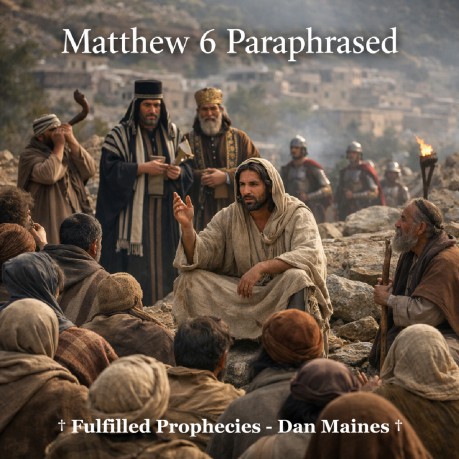
Matthew 6 Paraphrased Introduction Matthew 6:1 Matthew 6:2 Matthew 6:3 Matthew 6:4 Matthew 6:5 Matthew 6:6 Matthew 6:7 Matthew 6:8 Matthew 6:9 Matthew 6:10 Matthew 6:11 Matthew 6:12 Matthew 6:13 Matthew 6:14 Matthew 6:15 Matthew 6:16 Matthew 6:17 Matthew 6:18 Matthew 6:19 Matthew 6:20 Matthew 6:21 Matthew 6:22 Matthew 6:23 Matthew 6:24 Matthew 6:25 Matthew 6:26 Matthew 6:27 Matthew 6:28 Matthew 6:29 Matthew 6:30 Matthew 6:31 Matthew 6:32 Matthew 6:33 Matthew 6:34 Historical References How It Applies To Us Today Q & A Appendix Q Why did Jesus warn about public religious
acts? Q Why does Jesus connect forgiveness with being
forgiven? Q What does it mean to seek God's kingdom
first? Q Why does Jesus say not to worry about
tomorrow? Q Why did Jesus emphasize praying in secret? Q What does Jesus mean when He says you can't
serve God and wealth? Q Why did Jesus use birds and flowers as
examples? Q What kind of treasure was Jesus telling people
to store in heaven? † This is the fulfilled perspective we proclaim at
Fulfilled Prophecies † Source Index
By Dan Maines
† Jesus
continues the Sermon on the Mount by exposing the difference between
outward religion and genuine devotion to God (Matthew 5:20).
†
The focus of this chapter is motives, giving, prayer, fasting,
possessions, and trusting God rather than worrying (Matthew 6:1).
†
Everything here was spoken to people living under the approaching
judgment of their generation, calling them to true righteousness
before the coming kingdom transition (Matthew 23:36).
Be careful not to practice your
acts of righteousness in front of people just to be noticed by them,
otherwise you won't have any reward from your Father in heaven.
†
Jesus exposes the hypocrisy common among religious leaders who
performed spiritual acts for public praise rather than for God
(Matthew 23:5).
† True righteousness is
measured by the heart, not by public display, because God sees what
people can't see (1 Samuel 16:7).
† Early
Christian writer Clement of Alexandria warned believers not to seek
praise from men but to live quietly before God.
So when you give to the poor,
don't make a show of it like the hypocrites do in the synagogues and
streets so people will praise them. Truly, they've already received
their reward.
† The giving itself wasn't
condemned, the motive was. Hypocrites turned charity into a
performance (Matthew 23:14).
† Once human
praise is the goal, the reward is already finished, nothing remains
from God (Luke 14:12-14).
† Tertullian wrote
that Christian charity should flow from sincerity, not public
recognition.
But when you give to the poor,
don't even let your left hand know what your right hand is doing.
†
This expression shows how quiet and private generosity should be
(Proverbs 19:17).
† God values humility, not
self promotion (James 4:6).
† The Didache
instructed early believers to give generously without boasting.
Then your giving will be done in
secret, and your Father who sees what is done in secret will reward
you.
† God sees actions hidden from public
view and judges the motive behind them (Hebrews 4:13).
†
This reward isn't earthly praise but God's approval (Colossians
3:23-24).
† Irenaeus emphasized that God
examines the inner person, not just outward actions.
When you pray, don't be like the
hypocrites who love to stand and pray in synagogues and on street
corners so people will notice them. Truly, they've already received
their reward.
† Public prayer itself isn't
wrong, but praying to be seen is the problem (Luke 18:10-14).
†
Jesus repeatedly exposed religious leaders who used religion to
elevate themselves (Matthew 23:13).
† Origen
wrote that prayer should come from sincerity rather than public
theater.
But when you pray, go into your
room, close the door, and pray to your Father who is unseen, and your
Father who sees what is done in secret will reward you.
†
Private prayer removes the temptation to perform for others (Psalm
145:18).
† God hears sincere prayer
regardless of location or audience (Jeremiah 29:12-13).
†
Early Christians often practiced quiet personal prayer as described
by Eusebius.
And when you pray, don't repeat
empty phrases like the Gentiles do, because they think they'll be
heard because of their many words.
† Pagan
religions believed long repetitive prayers forced the gods to respond
(1 Kings 18:26-29).
† Jesus teaches that
prayer isn't about volume or length but sincerity (Ecclesiastes
5:2).
† Justin Martyr described Christian
prayer as thoughtful communication with God rather than ritual
repetition.
Don't be like them, because your
Father knows what you need before you ask Him.
†
Prayer isn't informing God of needs, He already knows them (Psalm
139:4).
† Prayer builds relationship and
dependence on God (Philippians 4:6).
†
Augustine later wrote that prayer shapes our hearts rather than
informing God.
Pray then like this: Our Father
in heaven, may your name be honored as holy.
†
Calling God Father emphasizes relationship, something Israel
understood but Jesus clarified more deeply (Isaiah 63:16).
†
Honoring God's name means living in a way that reflects His character
(Ezekiel 36:23).
† The early church
frequently used this model prayer as a guide, as recorded in the
Didache.
May your kingdom come. May your
will be done on earth as it is in heaven.
†
The kingdom Jesus spoke about was already approaching in that
generation (Matthew 16:27-28).
† God's will
being done refers to the fulfillment of His redemptive plan through
Christ (Ephesians 1:9-10).
† Eusebius wrote
that the kingdom spread as the gospel went out through the Roman
world.
Give us today the food we need
for this day.
† This reflects daily
dependence on God similar to Israel receiving manna in the wilderness
(Exodus 16:4).
† God promises to provide for
those who trust Him (Psalm 37:25).
† Early
Christians practiced daily reliance on God rather than storing up
excess wealth.
Forgive us our debts, just as
we have forgiven those who owe us.
† Sin is
described as a debt owed to God (Colossians 2:13-14).
†
Forgiveness from God is connected with forgiving others (Mark
11:25).
† Cyprian wrote that believers must
show the same mercy they ask from God.
And don't lead us into
temptation, but deliver us from evil.
†
Believers ask God for protection from trials that could lead to sin
(James 1:13).
† God provides a way of escape
from temptation (1 Corinthians 10:13).
† The
early church often prayed for strength during persecution.
If you forgive others when they
sin against you, your heavenly Father will also forgive you.
†
Forgiveness is a core principle of the kingdom Jesus was establishing
(Matthew 18:21-22).
† Those who receive mercy
must show mercy (James 2:13).
† Ignatius
urged believers to forgive one another as Christ forgave them.
But if you don't forgive
others, your Father won't forgive your sins.
†
A hard heart toward others reveals a heart that hasn't grasped God's
mercy (Matthew 18:32-35).
† Jesus warned
repeatedly against hypocrisy in forgiveness (Luke 6:37).
†
The early church emphasized reconciliation among believers.
When you fast, don't look
gloomy like the hypocrites who disfigure their faces so people will
notice they're fasting. Truly they've already received their
reward.
† Fasting was meant to humble the
heart before God (Isaiah 58:6).
† The
Pharisees often used fasting as a display of spiritual superiority
(Luke 18:12).
† Tertullian noted that fasting
should be sincere, not theatrical.
But when you fast, wash your
face and groom yourself.
† Jesus teaches that
spiritual discipline shouldn't be used to gain public attention
(Ecclesiastes 7:16).
† Humility in devotion
reflects genuine faith (Micah 6:8).
† Early
Christians often fasted quietly without outward signs.
Then your fasting won't be
obvious to people, but to your Father who is unseen, and your Father
who sees what is done in secret will reward you.
†
Again Jesus emphasizes that God sees what people cannot (Hebrews
4:13).
† The reward comes from God, not from
public admiration (Colossians 3:23-24).
†
Irenaeus stressed that God values sincerity above outward ritual.
Don't store up treasures for
yourselves on earth where moth and rust destroy and thieves break in
and steal.
† Earthly wealth is temporary and
easily lost (Proverbs 23:4-5).
† Jesus
redirects attention from material security to eternal values (Luke
12:15).
† Clement of Alexandria taught that
possessions shouldn't control the believer.
Instead store up treasures in
heaven where moth and rust don't destroy and thieves don't break in
and steal.
† Heavenly treasure refers to
faithful living that honors God (1 Timothy 6:18-19).
†
Spiritual priorities outlast earthly wealth (2 Corinthians 4:18).
†
Early Christian writers emphasized investing in eternal things rather
than temporary wealth.
Because where your treasure is,
your heart will be there too.
† What people
value most reveals the true condition of their heart (Luke 12:34).
†
Jesus calls for loyalty to God above material things (Matthew
22:37).
† Augustine taught that the heart
follows whatever it loves most.
The eye is the lamp of the
body, so if your eye is healthy your whole body will be full of
light.
† The eye symbolizes perception and
moral focus (Proverbs 4:25).
† A healthy
spiritual perspective fills a person with truth and clarity (Psalm
119:105).
† Early teachers understood this as
the purity of one's inner vision.
But if your eye is unhealthy
your whole body will be full of darkness. If the light in you is
darkness, how great that darkness is.
† A
corrupt heart leads to moral blindness (Isaiah 5:20).
†
Spiritual blindness was a common problem among the religious leaders
(Matthew 23:16).
† Origen warned that
corrupted desires distort spiritual understanding.
No one can serve two masters,
because either he'll hate one and love the other, or he'll be devoted
to one and despise the other. You can't serve God and wealth.
†
Loyalty divided between God and money leads to spiritual conflict
(Luke 16:13).
† Jesus exposes wealth as one
of the greatest rivals to devotion to God (1 Timothy 6:10).
†
Early Christians often warned against the spiritual danger of greed.
For this reason I say to you,
don't worry about your life, what you'll eat or drink, or about your
body, what you'll wear. Isn't life more than food and the body more
than clothing.
† Jesus addresses anxiety by
reminding people that God sustains life itself (Psalm 55:22).
†
Worry reveals misplaced trust in human security rather than God's
care (Philippians 4:6).
† Early Christian
teachers encouraged believers to trust God's provision.
Look at the birds of the sky,
they don't sow or reap or gather into barns, yet your heavenly Father
feeds them. Aren't you worth far more than they are.
†
God's care for creation shows His greater care for humanity (Psalm
147:9).
† Jesus uses nature to illustrate
God's daily provision (Job 38:41).
† Basil
the Great later used this verse to teach reliance on God's
providence.
And which of you by worrying
can add a single hour to his life.
† Anxiety
cannot extend life or control the future (Psalm 39:5).
†
Worry often harms rather than helps (Proverbs 12:25).
†
Early Christian writings frequently warned against living in fear of
the future.
And why do you worry about
clothing. Look at how the lilies of the field grow, they don't labor
or spin thread.
† Jesus again points to
creation as evidence of God's provision (Psalm 104:24).
†
Nature flourishes without anxiety about the future (Luke 12:27).
†
Early commentators often used this passage to illustrate God's
generosity.
Yet I tell you that even
Solomon in all his glory wasn't clothed like one of these.
†
Solomon represented the height of earthly wealth and splendor (1
Kings 10:4-7).
† Even that glory cannot match
the beauty God places in creation (Ecclesiastes 2:11).
†
Early Christian writers used this comparison to emphasize God's
creative power.
If God clothes the grass of the
field which is alive today and tomorrow is thrown into the furnace,
won't He do much more for you, you of little faith.
†
Jesus highlights God's faithful provision for His people (Psalm
37:25).
† Doubt about provision reflects weak
faith in God's care (Hebrews 11:6).
† Early
Christian sermons often encouraged believers not to doubt God's
provision.
So don't worry saying what will
we eat or what will we drink or what will we wear.
†
Jesus repeats the command because worry was deeply rooted in human
thinking (Luke 12:29).
† Faith replaces fear
by trusting God's promises (Isaiah 41:10).
†
Early Christian communities relied heavily on shared provision and
trust in God.
Because the Gentiles eagerly
seek all these things, and your heavenly Father knows that you need
them.
† Pagan cultures focused heavily on
material survival and prosperity (Matthew 6:7).
†
God's people are called to live differently, trusting His knowledge
of their needs (Psalm 23:1).
† Early
Christian teachers stressed that believers should not live like the
surrounding world.
But seek first His kingdom and
His righteousness, and all these things will be provided for you.
†
Prioritizing God's kingdom was central to Jesus' message (Matthew
4:17).
† When God's rule becomes the
priority, material needs fall into proper place (Luke 12:31).
†
Eusebius wrote that early Christians focused on the kingdom rather
than earthly security.
So don't worry about tomorrow,
because tomorrow will worry about itself. Each day has enough trouble
of its own.
† Jesus calls believers to live
faithfully one day at a time (Lamentations 3:22-23).
†
God's grace meets the needs of each day as it comes (Hebrews 13:5).
†
Early Christian teaching often emphasized patience and daily trust in
God.
†
Clement of Alexandria taught that true righteousness is practiced for
God alone.
† Tertullian wrote that Christian
charity and fasting must come from sincerity rather than public
display.
† Justin Martyr described prayer as
sincere communication with God rather than ritual repetition.
†
Eusebius recorded that early Christians focused on the kingdom and
eternal reward rather than earthly wealth.
†
True faith isn't about impressing people but living honestly before
God.
† Generosity, prayer, and spiritual
discipline should come from sincere devotion.
†
Believers are called to trust God for daily needs instead of living
in constant anxiety.
† Our priorities reveal
our hearts, when God's kingdom comes first everything else falls into
its proper place.
A Because many religious leaders
practiced righteousness for human praise rather than for God (Matthew
23:5).
A Because a heart that understands
God's mercy will show mercy to others (Matthew 18:33).
A It means placing God's rule and
righteousness above material concerns and personal ambition (Matthew
6:33).
A Because God provides for His people
daily and anxiety cannot control the future (Matthew 6:34).
A
Because God looks at the heart and not the performance of religion
before people (Matthew 6:6; 1 Samuel 16:7).
A He means loyalty can't
be divided. A person will ultimately love and pursue one master over
the other (Matthew 6:24; 1 Timothy 6:9-10).
A He was showing that if God
faithfully provides for creation, He'll certainly care for the people
created in His image (Matthew 6:26-30; Psalm 147:9).
A Faithful obedience,
generosity, and devotion to God that carries eternal value rather
than temporary earthly wealth (Matthew 6:20; 1 Timothy 6:18-19).
© Fulfilled Prophecies - Dan
Maines.
† Matthew
6:1-34; Matthew 23:5; Luke 12:31; Matthew 16:27-28
†
Clement of Alexandria, Tertullian, Justin Martyr, Eusebius
Links