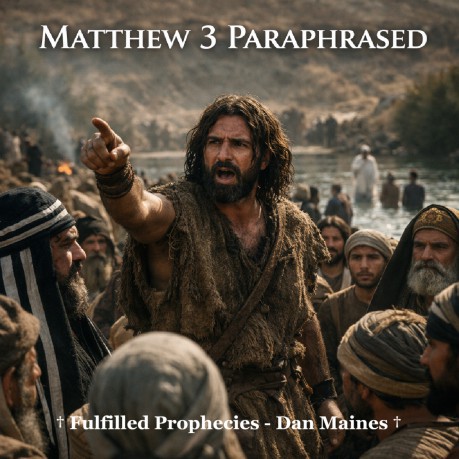
Matthew 3 Paraphrased Introduction † Matthew 3 introduces John the Baptist and the
beginning of the public call for Israel to repent before the coming
judgment that would fall on that generation. John wasn't preaching a
new religion, he was preparing the covenant people for the arrival of
their Messiah and the closing of the Old Covenant age (Malachi 3:1;
Luke 1:16-17). † His message was urgent because the kingdom of
heaven was drawing near. In the fulfilled perspective this points to
the approaching climax of redemptive history that would reach its
completion in the first century with the judgment of Jerusalem and
the full establishment of Christ's kingdom (Matthew 16:27-28; Matthew
24:34). † The events of this chapter show the
transition from the prophetic expectation of the Old Covenant into
the revealed ministry of Christ. John stands as the final Old
Covenant prophet preparing the way for the Messiah (Malachi 4:5-6;
Luke 7:26-28). Matthew 3:1 † John emerges in the wilderness because the
wilderness had always been a place of preparation and renewal in
Israel's history. Israel came through the wilderness when they first
entered covenant with God (Exodus 19:1-6). † His ministry fulfilled the prophecy of a
messenger who would prepare the way for the Lord before the coming
day of judgment (Malachi 3:1). † Luke confirms that John came in the spirit
and power of Elijah to prepare the people for the Lord (Luke
1:16-17). Matthew 3:2 † Repentance means a change of heart and
direction. Israel needed to turn back to God because the promised
kingdom was drawing near in their generation (Matthew 4:17). † The phrase kingdom of heaven refers to the
reign of God being established through the Messiah and his covenant
people (Daniel 2:44). † Jesus later confirmed the same message that
the kingdom was near during that generation (Matthew 10:7). Matthew 3:3 † Matthew directly connects John's ministry
with Isaiah's prophecy showing that he was the promised forerunner of
the Messiah (Isaiah 40:3). † Preparing the way meant calling Israel to
repentance so they would be ready to receive the Messiah. † The language also reflects the ancient
practice of clearing roads before the arrival of a king. Matthew 3:4 † John's clothing deliberately reflected the
appearance of Elijah the prophet (2 Kings 1:8). † This visual connection reinforced that John
fulfilled the prophecy that Elijah would come before the day of the
Lord (Malachi 4:5). † His simple lifestyle showed separation from
the corrupt religious leadership of Jerusalem. Matthew 3:5 † John's message spread quickly because the
people sensed that something significant was happening in Israel. † The gathering crowds show that many were
expecting the arrival of the Messiah during that time. † Josephus also records the widespread
influence of John the Baptist among the Jewish people. Matthew 3:6 † Baptism symbolized cleansing and repentance.
It showed a person's desire to turn away from sin and return to God. † Confession of sins demonstrated that
repentance involved open acknowledgment of wrongdoing (Proverbs
28:13). † This preparation pointed forward to the
greater cleansing that would come through Christ. Matthew 3:7 † John directly confronts the religious leaders
because they represented the corruption that had overtaken Israel. † The coming wrath refers to the judgment that
would soon fall upon Jerusalem and the temple system (Matthew 23:36). † Jesus later used the same language when
rebuking these same leaders (Matthew 23:33). Matthew 3:8 † Genuine repentance produces visible change in
a person's life. † The prophets had long warned Israel that
outward religion without true obedience was worthless (Isaiah
1:16-17). † Jesus later taught that a tree is known by
its fruit (Matthew 7:16). Matthew 3:9 † John challenges the idea that physical
descent from Abraham guaranteed covenant blessing. † God has always been able to raise up faithful
people beyond biological lineage (Romans 9:6-8). † This statement foreshadows the inclusion of
the nations into God's covenant family. Matthew 3:10 † This imagery speaks of imminent judgment. † The trees represent Israel's leadership and
those who refused repentance. † The destruction of Jerusalem in AD 70 would
bring that warning to fulfillment. Matthew 3:11 † John clearly distinguishes his preparatory
ministry from the greater work of Christ. † The baptism with the Holy Spirit points to
the outpouring that began at Pentecost (Acts 2:1-4). † The fire refers to judgment that would purify
and separate the faithful from the unfaithful (Malachi 3:2-3). Matthew 3:12 † The imagery of threshing shows separation
between the faithful and the unfaithful within Israel. † Wheat represents those who received the
Messiah. † Chaff represents those who rejected him and
faced judgment during that generation. Matthew 3:13 † Jesus approaches John publicly marking the
beginning of his earthly ministry. † Though sinless, Jesus identifies with the
people he came to redeem. † This moment publicly reveals the Messiah to
Israel. Matthew 3:14 † John understood the superiority of Christ. † His hesitation shows his recognition of
Jesus' authority and holiness. † Even the greatest prophet recognized that the
Messiah stood above him. Matthew 3:15 † Jesus submits to baptism to fulfill God's
redemptive plan. † His obedience demonstrates perfect
righteousness. † This act also identifies him as the
representative of his people. Matthew 3:16 † The descent of the Spirit confirms Jesus as
the anointed Messiah. † This moment fulfills the prophecy that the
Spirit would rest upon the chosen servant of the Lord (Isaiah 11:2). † It publicly reveals the divine approval of
Christ's mission. Matthew 3:17 † The Father's voice confirms Jesus as the Son
of God. † This declaration echoes the messianic
language of Psalm 2:7. † It also fulfills Isaiah's prophecy about the
servant who pleases the Lord (Isaiah 42:1). Historical References † Josephus recorded that John the Baptist had a
powerful influence among the Jews and gathered large crowds because
of his call to righteousness. † Justin Martyr wrote that John prepared the
people for the coming of Christ by calling them to repentance. † Eusebius later affirmed that John stood as
the final prophet announcing the arrival of the Messiah. How It Applies To Us Today † John's message still reminds us that
repentance is the doorway into God's kingdom. † It shows that religious identity alone
doesn't save anyone, true faith produces real fruit. † It reminds us that Christ is the center of
God's redemptive plan and the one we must follow. Q & A Appendix Q Why was John called the Baptist? Q Why did Jesus get baptized if he had no sin? Q What does baptism with the Holy Spirit and fire
mean? Q Who were the Pharisees and Sadducees that John
rebuked? Q What did John mean when he said God could raise
up children for Abraham from stones? Q What does the axe at the root of the trees
represent? Q What does the wheat and chaff imagery mean? † This is the fulfilled perspective we proclaim at
Fulfilled Prophecies † Source Index † Matthew 3:1-17; Malachi 3:1; Isaiah 40:3;
Luke 1:16-17; Matthew 16:27-28
By Dan Maines
In those days John the Baptist
appeared in the wilderness of Judea, preaching to the people.
He was saying, Repent, because
the kingdom of heaven is about to arrive.
This was the one spoken of
through the prophet Isaiah when he said, A voice is calling out in
the wilderness, Prepare the way for the Lord, make his paths
straight.
John wore clothing made from
camel's hair and had a leather belt around his waist, and his food
was locusts and wild honey.
People from Jerusalem, all
Judea, and the entire region around the Jordan were going out to him.
They were being baptized by him
in the Jordan River as they confessed their sins.
When John saw many Pharisees and
Sadducees coming to his baptism he said to them, You brood of vipers,
who warned you to escape the coming wrath?
Therefore produce fruit that
shows true repentance.
Do not assume you can say to
yourselves, We have Abraham as our father. God is able to raise up
children for Abraham from these stones.
The axe is already lying at the
root of the trees. Every tree that does not produce good fruit will
be cut down and thrown into the fire.
I baptize you with water for
repentance, but the one coming after me is greater than I am. I am
not worthy to carry his sandals. He will baptize you with the Holy
Spirit and fire.
His winnowing fork is in his
hand and he will thoroughly clear his threshing floor. He will gather
his wheat into the barn, but he will burn the chaff with unquenchable
fire.
Then Jesus came from Galilee to
the Jordan to John in order to be baptized by him.
But John tried to stop him,
saying, I need to be baptized by you, and yet you come to me?
But Jesus answered him, Allow
it now, because this is the proper way for us to fulfill all
righteousness. Then John permitted him.
After being baptized, Jesus
immediately came up from the water, and the heavens were opened, and
he saw the Spirit of God descending like a dove and resting on him.
And a voice from heaven said,
This is my beloved Son, in whom I am well pleased.
A
Because he baptized people as a sign of repentance and preparation
for the coming Messiah (Matthew 3:6; Mark 1:4).
A
He did it to fulfill righteousness and publicly begin his mission as
the Messiah (Matthew 3:15).
A It refers to Christ bringing both
spiritual renewal to believers and judgment upon the unrepentant
(Acts 2:1-4; Malachi 3:2-3).
A They were two major religious
leadership groups in Israel during the first century. The Pharisees
focused on strict tradition and oral law, while the Sadducees
controlled much of the temple leadership. John rebuked them because
they relied on their status rather than true repentance (Matthew
3:7-9; Matthew 23:1-3).
A John was
teaching that covenant membership wasn't based on physical ancestry.
God could raise up faithful people by His power, meaning faith and
obedience mattered more than lineage (Matthew 3:9; Romans 9:6-8).
A It represents the coming judgment
that was about to fall upon unrepentant Israel. The warning pointed
to the destruction that would come upon Jerusalem and the temple
system in that generation (Matthew 3:10; Matthew 23:36; Luke
21:20-22).
A
Wheat represents those who received Christ and entered the kingdom,
while chaff represents those who rejected Him and faced judgment.
This separation was fulfilled during the events leading up to and
including the destruction of Jerusalem (Matthew 3:12; Matthew 13:30;
Matthew 24:34).
© Fulfilled Prophecies - Dan
Maines.
† Josephus,
Antiquities of the Jews 18.5.2; Justin Martyr, Dialogue with Trypho;
Eusebius, Church History 1.11
Links