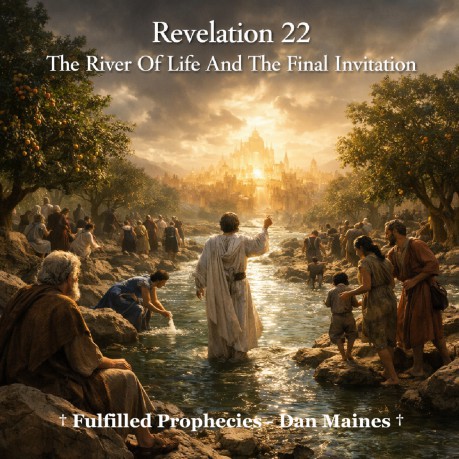
Revelation 22 The River Of
Life And The Final Invitation Introduction † Revelation 22 brings the final vision of the
book to completion. What began in Genesis with a garden and the tree
of life ends here with the restoration of life through Christ. The
imagery is not random, it is covenant fulfillment. What was lost in
Eden has now been restored through the Lamb. † Throughout Revelation the focus has been the
end of the Old Covenant world and the establishment of the New
Covenant kingdom. This chapter shows the completed result. The curse
is removed, God's presence is restored, and access to the tree of
life is opened again. † The vision also confirms the timing of the
book. The events John recorded were about things that would happen
soon to his generation. The kingdom blessings shown here are the
result of Christ's victory and the judgment that fell in AD 70. Revelation 22:1-2 And he showed me a river of the water of life, clear as crystal,
coming from the throne of God and of the Lamb, in the middle of its
street. On either side of the river was the tree of life, bearing
twelve kinds of fruit, yielding its fruit every month; and the leaves
of the tree were for the healing of the nations. † The river recalls Ezekiel 47:1-12, where
living water flows from the temple to heal the land. Here, it flows
from God's throne, showing His direct presence among His people. The
tree of life, once barred in Eden (Genesis 3:24), is restored,
proving redemption is complete. † Proof, the Dead Sea Scrolls (1QH 6.12-13)
speak of living waters from God as a symbol of His covenant
blessings, fulfilled here. † The imagery intentionally returns the reader
to Genesis 2:10 where a river flowed out of Eden to water the garden.
Revelation closes the biblical story by showing that what was lost in
the first garden is restored in the New Covenant kingdom through
Christ. (Genesis 2:10) Revelation 22:3 There will no longer be any curse; and the throne of God and of
the Lamb will be in it, and His bond-servants will serve Him. † The curse of Eden is fully removed. God's
throne is now central among His people. † Proof, Galatians 3:13, Christ became a curse
for us, fulfilling the law's demands. † The removal of the curse shows that the
separation introduced by Adam's sin has been overcome through
Christ's redemptive work. What began in Genesis with judgment now
ends with restoration in the New Covenant kingdom. (Genesis 3:17-19) Revelation 22:4-5 They will see His face, and His name will be on their foreheads.
And there will no longer be any night; and they will not have need of
the light of a lamp nor the light of the sun, because the Lord God
will illumine them; and they will reign forever and ever. † Seeing God's face fulfills the deepest
covenant promise. His name on their foreheads contrasts with the mark
of the beast, His people belong to Him forever. † Proof, Numbers 6:24-26 foretold God's
blessing: The Lord make His face shine on you. Fulfilled now in
Christ. † Jesus declared Himself to be the light of the
world, and those who follow Him will not walk in darkness. The light
described here reflects the full realization of that promise in the
kingdom of Christ. (John 8:12) Revelation 22:6 And he said to me, These words are faithful and true; and the
Lord, the God of the spirits of the prophets, sent His angel to show
His bond-servants the things which must soon take place. † The angel affirms the nearness of
fulfillment. Soon cannot mean thousands of years later, it confirms
first-century realization. † Proof, Revelation 1:1 begins with the same
phrase, framing the book's audience relevance. † The statement must soon take place
establishes the entire prophetic framework of the book. The events
described were relevant to the churches that first received the
message. Revelation 22:7 And behold, I am coming quickly. Blessed is the one who keeps the
words of the prophecy of this book. † Christ repeats His promise of imminence. His
coming was judgment upon Jerusalem, vindicating His people. † Proof, Matthew 24:34, This generation will
not pass away until all these things take place. † The same urgency appears throughout the New
Testament where the apostles spoke of the coming judgment as near.
James also told the early believers that the Judge was standing right
at the door. (James 5:8-9) Revelation 22:8-9 I, John, am the one who heard and saw these things. And when I
heard and saw them, I fell down to worship at the feet of the angel
who showed me these things. And he said to me, Do not do that; I am a
fellow servant of yours and of your brothers the prophets, and of
those who keep the words of this book. Worship God! † John is overwhelmed by the vision and falls
down before the angel, but the angel immediately corrects him. Even a
heavenly messenger must not receive worship. This reinforces the
absolute rule that worship belongs to God alone. (Revelation 22:8-9) † The angel identifies himself as a fellow
servant with John, the prophets, and all believers who keep the words
of the prophecy. This shows that heavenly messengers and faithful
believers share the same purpose of serving God. (Revelation 22:9) † This moment also echoes Revelation 19:10
where John attempted the same act and received the same correction.
True prophecy always directs worship to God alone. (Revelation 19:10) Revelation 22:10-11 And he said to me, Do not seal up the words of the prophecy of
this book, for the time is near. Let the one who does wrong still do
wrong, and the one who is filthy still be filthy, and the one who is
righteous still practice righteousness, and the one who is holy still
keep himself holy. † Unlike Daniel, who was told to seal his
prophecy (Daniel 12:4), John is told not to seal his, because
fulfillment was near. This proves Revelation is not for a far future
age, but for John's generation. † The command about the wicked continuing in
their sin shows that judgment was already approaching. The separation
between the faithful and the rebellious had become clear. Revelation 22:12-13 Behold, I am coming quickly, and My reward is with Me, to reward
each one as his work deserves. I am the Alpha and the Omega, the
first and the last, the beginning and the end. † Christ's imminent coming brought both reward
and judgment. His titles affirm His sovereignty over all redemptive
history. † Proof, Isaiah 44:6, I am the first and I am
the last, fulfilled in Christ. † His declaration as Alpha and Omega confirms
that the entire covenant story from beginning to completion centers
on Him. Revelation 22:14-15 Blessed are those who wash their robes, so that they will have the
right to the tree of life, and may enter the city by the gates.
Outside are the dogs, the sorcerers, the sexually immoral persons,
the murderers, the idolaters, and everyone who loves and practices
lying. † The contrast is clear: those washed in Christ
enter the city, the unrepentant remain outside. † Proof, early Christians like Ignatius (Letter
to the Ephesians 18) affirmed holiness as the sign of belonging to
the city of God. † Washing robes refers to cleansing through the
sacrifice of Christ, granting believers access to the life once lost
in Eden. Revelation 22:16 I, Jesus, have sent My angel to testify to you of these things for
the churches. I am the root and the descendant of David, the bright
morning star. † Jesus identifies Himself as both root and
offspring of David, showing His messianic fulfillment. The bright
morning star symbolizes His eternal reign. † Proof, Numbers 24:17 prophesied a star from
Jacob, fulfilled in Christ. † This title emphasizes that Christ's reign
marks the dawn of a new covenant age. Revelation 22:17 The Spirit and the bride say, Come. And let the one who hears say,
Come. And let the one who is thirsty come; the one who desires, let
him take the water of life without cost. † The invitation is universal. The Spirit and
the bride together call the thirsty to salvation in Christ. † Proof, Isaiah 55:1 again finds fulfillment
here. † Jesus gave the same invitation earlier when
He called the thirsty to come and drink from Him as the source of
living water. (John 7:37-38) Revelation 22:18-19 I testify to everyone who hears the words of the prophecy of this
book: if anyone adds to them, God will add to him the plagues that
are written in this book; and if anyone takes away from the words of
the book of this prophecy, God will take away his part from the tree
of life and from the holy city, which are written in this book. † A solemn warning underscores the sanctity of
prophecy. God's word must not be tampered with, especially regarding
its timing and fulfillment. † This warning echoes Deuteronomy 4:2 which
warned Israel not to add to or subtract from God's commands. Revelation 22:20 He who testifies to these things says, Yes, I am coming quickly.
Amen. Come, Lord Jesus. † John affirms Christ's imminent coming. His
prayer echoes the longing of the early church for vindication and
completion. † The repeated statement coming quickly
confirms the first-century timeframe emphasized throughout the book. Revelation 22:21 The grace of the Lord Jesus be with all. Amen. † Revelation closes with grace, reminding the
church that all judgment and fulfillment exist within the framework
of God's covenant grace. Historical References † Ignatius, Letter to the Ephesians 18, taught
that holiness marks those who belong to the people of God. † Josephus, Wars of the Jews 6.4-6, recorded
the destruction of Jerusalem, confirming the historical judgment
context surrounding the events Revelation described. † Eusebius, Ecclesiastical History 3.5,
explained that early Christians recognized the destruction of
Jerusalem as fulfillment of Christ's prophetic warnings. † Clement of Alexandria, Stromata 6.14, wrote
about the restoration of life and knowledge through Christ,
reflecting the restoration imagery found in Revelation 22. How It Applies To Us Today † We live in the New Jerusalem, drinking freely
of the water of life. † The curse is lifted, and eternal communion
with God is ours. † Christ's fulfilled coming proves His word is
true and certain. † Our task is to proclaim the same invitation:
Come, take of the water of life without cost. Q & A Appendix Q If Revelation says Jesus was coming quickly,
why do many believe it refers to the distant future? A Because many interpret the book through later
theological traditions instead of its time statements. Revelation
repeatedly says the events would happen soon. Jesus also said these
things would occur within that generation. (Matthew 24:34; Revelation
1:1) Q What does the river of life represent? A The river represents the life that flows from
God to His people. Ezekiel saw the same imagery when water flowed
from the temple bringing healing to the land. (Ezekiel 47:1-12) Q What does it mean that the curse is removed? A The curse refers to the separation and death
introduced by sin in Genesis. Christ removed that curse by becoming a
curse for us under the law. (Genesis 3:17-19; Galatians 3:13) Q Why is access to the tree of life important? A The tree of life symbolizes restored fellowship
with God. Humanity lost access to it after the fall, but through
Christ believers now receive eternal life. (Genesis 3:24; Revelation
22:14) Q What does the healing of the nations mean in
Revelation 22:2? A The healing of the nations refers to the
restoration that comes through the gospel of Christ. Under the Old
Covenant the nations were largely outside the covenant promises, but
through Christ salvation was opened to all peoples. The leaves of the
tree symbolize the life and restoration that flows from God's kingdom
to the world. Isaiah 2:2-3; Isaiah 49:6; Ephesians 2:11-19. Q If the curse is removed in Revelation 22:3, why
does sin still exist in the world? A The curse refers to the covenant separation
caused by the fall and enforced through the Old Covenant law. Christ
removed that curse by fulfilling the law and establishing the New
Covenant. Believers now have access to God and life through Christ
even though the world still contains sin. Genesis 3:17-19; Galatians
3:13; Hebrews 10:19-22. Q Why does Revelation repeat that Christ is
coming quickly? A The repeated statement confirms that the
prophecy concerned events near to John's audience. Jesus had already
said that the judgment He described would occur within that
generation. The repeated phrase reinforces that the fulfillment was
approaching for the first century church. Matthew 24:34; Revelation
1:1; Revelation 22:7. Q Why was John told not to seal the prophecy in
Revelation 22:10? A Daniel was told to seal his prophecy because
its fulfillment was far away, but John was told not to seal his
because the time was near. This contrast shows that Revelation was
written for the churches of John's generation who were about to
witness these events. Daniel 12:4; Revelation 22:10. Q What does it mean that Jesus is the Alpha and
the Omega? A The title Alpha and Omega means that Christ
stands at both the beginning and the completion of God's redemptive
plan. He fulfills the promises given through the prophets and brings
the covenant story to its completion. Isaiah 44:6; Revelation 22:13. Q Does the river of life in Revelation 22
describe a literal future river? A No. The imagery follows the prophetic language
used throughout the Old Testament where living water represents life
and blessing flowing from God. Ezekiel saw water flowing from the
temple bringing life to the land, and Jesus later used the same
imagery when He invited the thirsty to come to Him and drink. The
river in Revelation represents the life that comes from God through
Christ. Ezekiel 47:1-12; John 7:37-38. Q What does the healing of the nations mean if
the kingdom is already established? A The healing of the nations refers to the spread
of the gospel and the restoration of people from every nation through
Christ. Under the Old Covenant the covenant blessings were centered
in Israel, but in the New Covenant salvation extends to all nations.
The leaves symbolize the life and restoration that come through the
message of Christ. Isaiah 49:6; Matthew 28:19; Ephesians 2:11-19. Q Why can't the New Jerusalem in Revelation 21-22
be a future physical city? A Scripture identifies the New Jerusalem as God's
people, not a physical city. The church is described as God's
dwelling place built together as a spiritual house. The imagery of a
city represents the covenant community where God dwells with His
people. Ephesians 2:19-22; Hebrews 12:22-24; Revelation 21:2. † This is the fulfilled perspective we proclaim at
Fulfilled Prophecies † © Fulfilled Prophecies - Dan Maines. Source Index † Revelation 22:1-21; Genesis 2:10; Genesis
3:17-19, 24; Numbers 6:24-26; Numbers 24:17; Isaiah 44:6; Isaiah
55:1; Ezekiel 47:1-12; Daniel 12:4; Matthew 24:34; John 7:37-38; John
8:12; Galatians 3:13; James 5:8-9; Revelation 1:1; Revelation 19:10 † Dead Sea Scrolls 1QH 6.12-13; Ignatius Letter
to the Ephesians 18; Josephus Wars of the Jews 6.4-6; Eusebius
Ecclesiastical History 3.5; Clement of Alexandria Stromata 6.14
By Dan Maines
Links