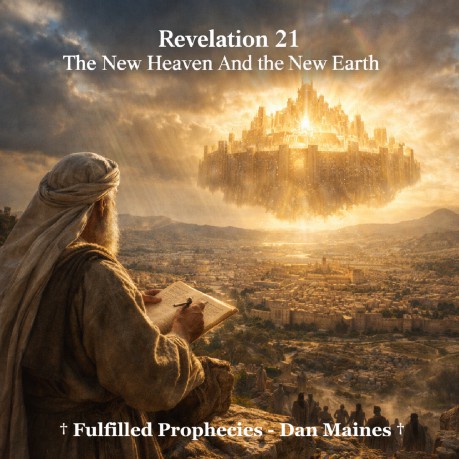
Revelation 21 The New Heaven
And The New Earth Introduction † Revelation 21 reveals the final vision of
covenant fulfillment. After the judgment of Babylon and the passing
of the old covenant order, John is shown the completed reality of
God's new creation. † The language of new heaven and new earth is
prophetic covenant language used throughout the Old Testament to
describe the establishment of a new covenant order. The focus is not
the destruction of the physical universe but the passing of the old
covenant system centered in Jerusalem and the temple. † When Jerusalem and the temple were destroyed
in AD 70, the old covenant world came to its end. What John sees here
is the fully revealed new covenant kingdom where God permanently
dwells with His people. Revelation 21:1 † The passing of the first heaven and earth
refers to the end of the old covenant order that revolved around the
temple, sacrifices, and priesthood. † The prophets used heaven and earth language
to describe covenant systems. The old covenant world centered in
Jerusalem has now passed away and the new covenant world has fully
arrived. † The statement there is no longer any sea
represents the removal of separation and chaos. The sea often
symbolized the nations and disorder, but in the new covenant the
barrier between peoples has been removed through Christ. † Hebrews 12:26-28 explains that God would once
more shake heaven and earth so that what can be shaken would be
removed and what cannot be shaken would remain. That shaking refers
to the removal of the old covenant system and the establishment of
the unshakable kingdom. Revelation 21:2 † The New Jerusalem is clearly identified as
the bride of Christ, showing that this city represents the people of
God rather than a literal city. † The church is described as the bride
throughout Scripture, meaning the covenant community redeemed by
Christ. † The city coming down from heaven shows that
the church originates from God. The kingdom is established by divine
authority and not by earthly power. † Galatians 4:26 identifies the Jerusalem above
as our mother, showing that the heavenly Jerusalem represents the
covenant people of God rather than a literal future city. Revelation 21:3-4 † This fulfills the covenant promise that God
would dwell among His people and walk among them as their God. † The removal of death reflects the end of
covenant separation from God. Through Christ eternal life is secured
for His people. † The first things passing away refers to the
old covenant world of temple sacrifices and priesthood that ended
when Jerusalem fell. Revelation 21:5-6 † God declares that the covenant transformation
is complete and the new covenant world is fully established. † The words it is done reflect the completion
of God's redemptive plan through Christ. † The water of life represents the free gift of
eternal life offered to all who come to Christ. Revelation 21:7-8 † The inheritance of the kingdom belongs to
those who remain faithful to Christ. † The lake of fire represents the final
covenant judgment against God's enemies. † The contrast shows that the blessings of the
new covenant belong only to those who overcome through faith. Revelation 21:9-11 † The angel directly identifies the city as the
bride of the Lamb, proving that the city represents the redeemed
people of God. † The brilliance of the city symbolizes the
glory and righteousness given to the church through Christ. † The imagery reflects the beauty and purity of
the covenant community. Revelation 21:12-14 † The tribes of Israel and the apostles
together represent the unity of God's people from both covenants. † The imagery shows that the promises given to
Israel are fulfilled in the church. † The gates facing every direction symbolize
that people from every nation now have access to the covenant
kingdom. Revelation 21:15-17 † The cube shape reflects the design of the
Most Holy Place in the temple. † This imagery shows that God's entire people
now function as the holy dwelling place of God. † The measurements symbolize completeness and
perfection in the covenant community. Revelation 21:18-21 † The precious stones symbolize beauty, purity,
and permanence. † The imagery shows the glory of God's redeemed
people. † Unlike the earthly Jerusalem that rejected
Christ, the New Jerusalem is incorruptible. Revelation 21:22-23 † The absence of a temple shows that the old
covenant temple system has ended permanently. † God's presence now dwells directly among His
people. † Christ Himself is the light of the covenant
city. † Jesus declared that true worship would no
longer be tied to a physical location but would be in spirit and
truth, showing that God's presence would dwell directly with His
people. Revelation 21:24-26 † The open gates symbolize the universal
invitation of the gospel. † The nations walking by its light show that
the covenant kingdom includes people from every nation. † The glory of the nations entering the city
reflects the worldwide reach of Christ's kingdom. † This fulfills the promise that the nations
would come to the light of God's kingdom and share in the blessings
of the covenant. Revelation 21:27 † The covenant city is holy and undefiled
because it represents God's redeemed people. † Only those belonging to Christ are part of
this covenant community. † The book of life represents the secure
identity of those redeemed by the Lamb. Historical References † Eusebius wrote that the fall of Jerusalem
fulfilled Christ's prophecies and marked the end of the
temple-centered covenant order. † Irenaeus described the church as the dwelling
place of God among men. † Justin Martyr taught that believers in Christ
are the true heirs of God's promises. † Tertullian wrote that the church is the true
temple of God, showing that God's dwelling is among His people rather
than in a physical building. How It Applies To Us Today † Believers already belong to the New Jerusalem
through Christ. † God's presence now dwells with His people
rather than in a physical temple. † The kingdom of God continues to grow as the
gospel spreads among the nations. † Our identity is rooted in the eternal
covenant community established by Christ. Q & A Appendix Q If the new heaven and new earth are covenantal,
why is the language so cosmic? A Prophetic writings regularly used cosmic
imagery to describe covenant changes and the rise or fall of covenant
orders. Q How do we know the New Jerusalem represents the
church? A Scripture consistently identifies God's
redeemed people as the bride of Christ, and the city is directly
called the bride of the Lamb. Q Why is there no temple in the New Jerusalem? A Because God's presence now dwells directly with
His people through Christ. Q If Revelation 21 is fulfilled, why does the
world still have suffering and death? A Revelation 21 describes the end of covenant
death and separation from God. Through Christ the power of death has
been defeated and believers now share in eternal life. Q Futurists say Revelation 21 must be future
because it describes a new heaven and earth. How do we know it refers
to covenant change instead of the physical universe? A The Bible repeatedly uses heaven and earth
language for covenant systems. When God established Israel, He spoke
of planting the heavens and laying the foundations of the earth. The
New Testament explains that the old covenant heaven and earth would
be shaken and removed so that the unshakable kingdom would remain. Q If the New Jerusalem is the church, why is it
described as a city with walls, gates, and measurements? A Revelation is written in symbolic prophetic
imagery. The walls, gates, and measurements represent the structure,
protection, and completeness of God's covenant people. The twelve
tribes and twelve apostles show the unity of God's people from both
covenants forming one city. Q Why does Revelation say the nations walk in the
light of the city if it is the church? A The church carries the light of Christ into the
world. As the gospel spreads, the nations walk in that light and
enter the covenant community through faith in Christ. The imagery
shows the worldwide expansion of God's kingdom. † This is the fulfilled perspective we proclaim at
Fulfilled Prophecies † Source Index † Revelation 21; Isaiah 54:11-12; Isaiah 60:11;
Isaiah 65:17; Leviticus 26:11-12; 1 Kings 6:20; John 8:12; John
4:21-24; Galatians 4:26; Hebrews 12:26-28; Hebrews 12:22; 1
Corinthians 15:54; Philippians 4:3 † Eusebius, Ecclesiastical History; Irenaeus,
Against Heresies; Justin Martyr, Dialogue With Trypho; Tertullian,
Against Marcion
By Dan Maines
Then I saw a new heaven and
a new earth; for the first heaven and the first earth passed away,
and there is no longer any sea.
And I saw the holy city, new
Jerusalem, coming down out of heaven from God, prepared as a bride
adorned for her husband.
And I heard a loud voice
from the throne, saying, "Behold, the tabernacle of God is among
the people, and He will dwell among them, and they shall be His
people, and God Himself will be among them, and He will wipe away
every tear from their eyes; and there will no longer be any death;
there will no longer be mourning, or crying, or pain; the first
things have passed away."
And He who sits on the
throne said, "Behold, I am making all things new." And He
said, "Write, for these words are faithful and true." Then
He said to me, "It is done. I am the Alpha and the Omega, the
beginning and the end. I will give water to the one who thirsts from
the spring of the water of life, without cost."
The one who overcomes will
inherit these things, and I will be his God and he will be My son.
But for the cowardly, and unbelieving, and abominable, and murderers,
and sexually immoral persons, and sorcerers, and idolaters, and all
liars, their part will be in the lake that burns with fire and
brimstone, which is the second death.
Then one of the seven
angels who had the seven bowls full of the seven last plagues came
and spoke with me, saying, "Come here, I will show you the
bride, the wife of the Lamb." And he carried me away in the
Spirit to a great and high mountain, and showed me the holy city,
Jerusalem, coming down out of heaven from God, having the glory of
God. Her brilliance was like a very valuable stone, like a stone of
crystal-clear jasper.
It had a great and high
wall, with twelve gates, and at the gates twelve angels; and names
were written on the gates, which are the names of the twelve tribes
of the sons of Israel. There were three gates on the east, three
gates on the north, three gates on the south, and three gates on the
west. And the wall of the city had twelve foundation stones, and on
them were the twelve names of the twelve apostles of the Lamb.
The one who spoke with
me had a gold measuring rod to measure the city, its gates, and its
wall. The city is laid out as a square, and its length is as great as
the width; and he measured the city with the rod, twelve thousand
stadia; its length, width, and height are equal. And he measured its
wall, 144 cubits, by human measurements, which are also angelic
measurements.
The material of the wall
was jasper; and the city was pure gold, like clear glass. The
foundation stones of the city wall were decorated with every kind of
precious stone. And the twelve gates were twelve pearls; each one of
the gates was a single pearl. And the street of the city was pure
gold, like transparent glass.
I saw no temple in it,
for the Lord God the Almighty and the Lamb are its temple. And the
city has no need of the sun or of the moon to shine on it, for the
glory of God has illuminated it, and its lamp is the Lamb.
The nations will walk by
its light, and the kings of the earth will bring their glory into it.
In the daytime (for there will be no night there) its gates will
never be closed; and they will bring the glory and honor of the
nations into it.
And nothing unclean, and no
one who practices abomination and lying, shall ever come into it, but
only those whose names are written in the Lamb's book of life.
© Fulfilled Prophecies - Dan
Maines.
Links