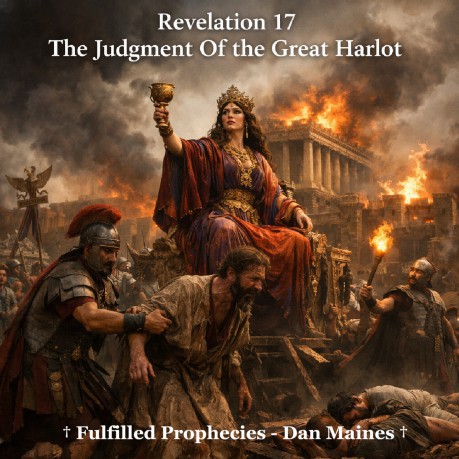
Revelation 17 The Judgment Of
The Great Harlot Introduction † Revelation 17 reveals one of the clearest
judgments in the entire book. John is shown the downfall of a city
that once belonged to God but became spiritually corrupt and violent
toward His people. † The imagery of a prostitute is not new
language. The prophets repeatedly described Jerusalem this way when
she abandoned the covenant and pursued alliances with foreign powers. † Isaiah had already used this language long
before the first century when he said How the faithful city has
become a prostitute, describing Jerusalem's corruption (Isaiah 1:21). † The vision explains why judgment came upon
that city and how the Roman Empire became the instrument of God's
justice in AD 70. † This chapter also identifies the beast, the
kings, and the political structure that brought about the destruction
Jesus warned about during His ministry. Revelation 17:1-2 † The great harlot represents
apostate Jerusalem, which abandoned her covenant relationship with
God and formed political alliances with Rome and the surrounding
nations. † The prophets had already used this language
to describe Jerusalem. Jeremiah 2:20 and Ezekiel 16 both portray the
city as a woman committing adultery with foreign powers. † The phrase many waters represents peoples and
nations influenced by Jerusalem's religious authority throughout the
Roman world. † Josephus records the political corruption and
alliances within Jerusalem that eventually contributed to the
catastrophic war with Rome (Josephus, Wars 4.3.9). Revelation 17:3 † The scarlet beast represents the Roman
imperial power that dominated the Mediterranean world in the first
century. † The woman sitting on the beast shows the
relationship between Jerusalem and Rome. The leadership of Jerusalem
relied on Roman authority and political protection. † This alliance is revealed clearly in John
19:15 when the chief priests declared We have no king but Caesar. † By rejecting Christ and acknowledging Caesar,
Jerusalem placed herself under the authority of the empire that would
later destroy her. Revelation 17:4-5 † Purple and scarlet were colors associated
with royalty and priesthood. These colors mirror the garments
connected to temple authority. † The imagery shows outward religious beauty
covering deep spiritual corruption within the leadership of
Jerusalem. † The golden cup represents spiritual
corruption spreading outward. Jeremiah 51:7 described Babylon as a
golden cup that made the nations drunk. † By rejecting Christ and persecuting His
followers, Jerusalem became the new Babylon in the prophetic sense. Revelation 17:6 † Jesus directly accused Jerusalem of killing
the prophets and persecuting God's messengers. † Matthew 23:37 records Jesus saying Jerusalem,
Jerusalem, who kills the prophets and stones those who are sent to
her. † Jesus also declared that all the righteous
blood shed on earth would come upon that generation (Matthew 23:35). † The city that should have welcomed the
Messiah instead shed the blood of His followers. † Josephus describes violent internal bloodshed
during the siege of Jerusalem where innocent people were murdered
within the city itself (Josephus, Wars 4.5.2). Revelation 17:7-8 † The phrase was, and is not, and will come
reflects the political upheaval surrounding the Roman emperors during
this time. † Nero ruled during the early persecution of
Christians. After his death the empire entered the chaotic period
known as the Year of the Four Emperors. † Tacitus records the instability that followed
Nero's death when the empire seemed close to collapse before
stabilizing again under Vespasian (Tacitus, Histories 1.2). † The beast appears wounded yet revived,
reflecting the continuation of imperial authority even through
political crisis. Revelation 17:9-10 † Rome was famously known as the city built
upon seven hills, making the identification unmistakable to first
century readers. † The kings correspond to the line of Roman
emperors leading to the Jewish war. † Five had fallen, one is refers to Nero during
John's time, and the one who remains briefly refers to Galba. † Suetonius records that Galba ruled only a
short time before being overthrown, confirming the prophecy that he
would remain only a little while (Suetonius, Galba 1). Revelation 17:11 † The eighth refers to the restoration of Roman
authority under Vespasian following the chaos of multiple short
reigns. † Although he appears as another ruler, he
continues the same imperial system. † Josephus describes Vespasian as the emperor
who restored stability to Rome during this turbulent time (Josephus,
Wars 4.10.3). † Even this renewed imperial power ultimately
moves toward destruction under God's sovereign plan. Revelation 17:12-13 † These horns represent client kings and
regional rulers allied with Rome during the Jewish war. † Many eastern rulers provided military
assistance to the Roman campaign against Judea. † Josephus lists multiple rulers and allied
forces that supported Rome's military operations (Josephus, Wars
3.4.2). † Their unified purpose strengthened Rome's
campaign that ultimately destroyed Jerusalem. Revelation 17:14 † Even though Rome and Jerusalem opposed Christ
and persecuted believers, their power could not defeat the Lamb. † Christ's victory was accomplished through His
death, resurrection, and the spread of the gospel. † The faithful followers of Christ share in
that victory through their allegiance to Him. † The destruction of Jerusalem confirmed the
authority of Christ and validated His warnings to that generation. Revelation 17:15-16 † The waters represent the widespread influence
Jerusalem held among Jewish communities across the empire. † The same Roman power she relied upon would
become the instrument of her destruction. † Rome's armies surrounded Jerusalem and burned
the city and the temple. † Josephus records the burning of Jerusalem and
the destruction of the temple during the siege of AD 70 (Josephus,
Wars 6.4.5). Revelation 17:17-18 † Even Rome's actions were under God's
sovereign control. † Revelation already identified the great city
as the place where the Lord was crucified, clearly pointing to
Jerusalem (Revelation 11:8). † The destruction of Jerusalem fulfilled the
warnings Jesus gave during His ministry. † Jesus directly predicted the Roman siege and
called it the days of vengeance in which all things written would be
fulfilled (Luke 21:20-22). † Matthew 23:35-38 records Jesus declaring that
the blood of the righteous would come upon that generation and that
their house would be left desolate. Historical References † Josephus documented the corruption, violence,
and alliances within Jerusalem that led to the Jewish war and the
destruction of the city. † Tacitus recorded the political chaos
following Nero's death and the restoration of imperial stability
under Vespasian. † Suetonius recorded the short reign of Galba,
confirming the brief rule described in the prophecy. † Early Christians fled Jerusalem before the
Roman siege after remembering Christ's warning to escape the city
(Eusebius, Ecclesiastical History 3.5). How It Applies To Us Today † Religious appearance cannot hide spiritual
corruption. † Trusting political power instead of trusting
God leads to destruction. † God remains sovereign over world events and
even powerful empires serve His purposes. † The Lamb reigns as Lord of lords and His
people are called to remain faithful to Him. Q & A Appendix Q: Who is the great harlot in Revelation 17? Q: What do the seven heads represent? Q: Why is Jerusalem called Babylon? Q: Did Jesus predict this judgment? Q: Why is the woman called a harlot instead of
simply a wicked city? Q: What does it mean that the woman is drunk with
the blood of the saints? Q: Why did the beast turn against the harlot if
they were allied together? Q: How do we know the great city refers to
Jerusalem? † This is the fulfilled perspective we proclaim at
Fulfilled Prophecies † Source Index † Revelation 17:1-18; Revelation 11:8; Luke
21:20-22; Matthew 23:35-38; Matthew 23:37; John 19:15; Jeremiah 2:20;
Ezekiel 16; Jeremiah 51:7; Isaiah 1:21; Daniel 7; Psalm 2:6 † Josephus, Wars 3.4.2; 4.3.9; 4.5.2; 4.10.3;
6.4.5; Tacitus, Histories 1.2; Suetonius, Galba 1; Eusebius,
Ecclesiastical History 3.5
By Dan Maines
Then one of the seven
angels who had the seven bowls came and spoke with me, saying, Come
here, I will show you the judgment of the great harlot
who sits on many waters, with whom the kings of the earth committed
acts of sexual immorality, and those who live on the earth became
drunk with the wine of her sexual immorality.
And he carried me away in
the Spirit into a wilderness; and I saw a woman sitting on a scarlet
beast, full of blasphemous names, having seven heads and ten horns.
The woman was clothed in
purple and scarlet, and adorned with gold, precious stones, and
pearls, holding in her hand a gold cup full of abominations and of
the unclean things of her sexual immorality, and on her forehead a
name was written: a mystery, Babylon the great, the mother of harlots
and of the abominations of the earth.
And I saw the woman drunk
with the blood of the saints, and with the blood of the witnesses of
Jesus. When I saw her, I wondered greatly.
And the angel said to me,
Why do you wonder? I will tell you the mystery of the woman and of
the beast that carries her, which has the seven heads and the ten
horns. The beast that you saw was, and is not, and is about to come
up out of the abyss and go to destruction. And those who live on the
earth, whose names have not been written in the book of life from the
foundation of the world, will wonder when they see the beast, that he
was, and is not, and will come.
Here is the mind which
has wisdom. The seven heads are seven mountains upon which the woman
sits, and they are seven kings; five have fallen, one is, the other
has not yet come; and when he comes, he must remain a little while.
The beast which was, and is
not, is himself also an eighth, and is one of the seven, and he goes
to destruction.
The ten horns which you
saw are ten kings who have not yet received a kingdom, but they
receive authority as kings with the beast for one hour. These have
one purpose, and they give their power and authority to the beast.
These will wage war against
the Lamb, and the Lamb will overcome them, because He is Lord of
lords and King of kings; and those who are with Him are the called
and chosen and faithful.
And he said to me, The
waters which you saw where the harlot sits are peoples and multitudes
and nations and languages. And the ten horns which you saw, and the
beast, these will hate the harlot and will make her desolate and
naked, and will eat her flesh and will burn her up with fire.
For God has put it in
their hearts to execute His purpose by having a common purpose, and
by giving their kingdom to the beast, until the words of God will be
fulfilled. The woman whom you saw is the great city, which reigns
over the kings of the earth.
A:
The description matches apostate Jerusalem which rejected Christ and
persecuted the prophets and saints. Matthew 23:37 and Revelation 17:6
identify the city guilty of killing God's messengers.
A:
They represent the seven hills of Rome and the sequence of Roman
emperors leading up to the Jewish war. Revelation 17:9-10 explains
the order of these rulers.
A:
Babylon represents rebellion against God. When Jerusalem rejected
Christ and persecuted believers she became spiritually like Babylon.
Jeremiah 51:7 and Revelation 17:5 connect this imagery.
A:
Yes. Jesus warned that Jerusalem would be judged for killing the
prophets and rejecting Him. Luke 21:20-22 and Matthew 23:35-38
describe the coming destruction.
A: The Bible uses harlot
imagery when God's covenant people abandon Him and form alliances
with foreign powers. Isaiah 1:21 and Ezekiel 16 describe Jerusalem
this same way long before the first century. Revelation continues
that prophetic language to show that Jerusalem broke her covenant
with God and pursued political protection through Rome.
A: It shows that the
city had become guilty of persecuting God's people. Jesus said
Jerusalem killed the prophets and those sent to her (Matthew 23:37).
Revelation 17:6 repeats that charge by describing the city as drunk
with the blood of the saints and the witnesses of Jesus.
A: Revelation
explains that God placed it in their hearts to carry out His purpose
(Revelation 17:17). Jerusalem trusted Rome for political survival,
but the same empire she depended on became the instrument of her
destruction when the Roman armies destroyed the city in AD 70 (Luke
21:20-22).
A: Revelation already identified the
great city as the place where the Lord was crucified (Revelation
11:8). Jesus also said that the blood of the prophets would come upon
that generation in Jerusalem (Matthew 23:35-37), which matches the
description of the city in Revelation 17.
© Fulfilled Prophecies - Dan
Maines.
Links