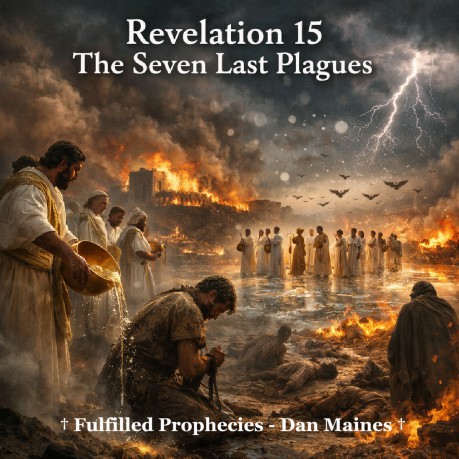
Revelation 15 The Seven Last
Plagues Introduction † Revelation 15 prepares the reader for the
final outpouring of God's covenant wrath. The vision describes the
last stage of judgment that was about to fall on apostate Jerusalem. † The imagery is drawn from the Law and the
prophets. The plagues echo the covenant curses warned about in
Leviticus 26 and Deuteronomy 28. † Just as God once judged Egypt to deliver His
people, He now brings judgment upon the corrupt temple system that
rejected the Messiah. † This chapter shows the closing stage of the
covenant lawsuit against Israel, the moment when God's wrath reaches
its completion. † The chapter also functions as the
introduction to the bowl judgments that follow in Revelation 16.
Chapter 15 shows the preparation in heaven before those final
judgments are poured out. † John is showing that the judgments about to
fall are not random disasters but the final stage of the covenant
consequences that the Law had warned about from the beginning. Revelation 15:1 Then I saw another sign in heaven, great and marvelous, seven
angels who had seven plagues, which are the last, because in them the
wrath of God is finished. † The seven last plagues correspond to the
covenant curses of Leviticus 26 and Deuteronomy 28. These plagues
complete God's wrath, signifying the final judgment on apostate
Jerusalem. † The phrase the wrath of God is finished shows
the covenant case against Israel had reached its conclusion. For
centuries the prophets warned that judgment would come if the nation
rejected God and killed His messengers. † Jesus confirmed this when He declared that
the guilt of the prophets would fall upon His own generation. Matthew 23:36 † The destruction of Jerusalem in AD 70
fulfilled that statement. The plagues described in Revelation are the
final covenant judgments falling upon the system that rejected
Christ. † The covenant background for these plagues is
also found in the Song of Moses, which warned Israel that national
judgment would come if they became corrupt. Deuteronomy 32:36 † This passage shows that the covenant lawsuit
predicted in the Law would eventually reach a point where God would
bring judgment and vindicate His faithful people. Revelation 15:2 And I saw something like a sea of glass mixed with fire, and those
who had been victorious over the beast and his image and the number
of his name, standing on the sea of glass, holding harps of God. † The sea of glass reflects the throne imagery
earlier in Revelation. Revelation 4:6 † The fire mixed with the sea symbolizes
judgment. The saints stand upon it because they share in Christ's
victory over the beast. † These believers refused to worship the Roman
emperor and would not participate in the imperial cult demanded by
Rome. † Tacitus records that Christians were brutally
persecuted during Nero's reign, confirming the suffering that
Revelation describes. † Tacitus wrote that Christians were torn apart
by dogs or burned as living torches in Nero's gardens (Tacitus,
Annals 15.44). † Revelation shows that those martyrs were not
defeated. They stand victorious before the throne of God. Revelation 15:3-4 And they sang the song of Moses, the bond-servant of God, and the
song of the Lamb, saying, Great and marvelous are Your works, Lord
God, the Almighty; righteous and true are Your ways, King of the
nations! Who will not fear You, Lord, and glorify Your name? For You
alone are holy; for all the nations will come and worship before You,
for Your righteous acts have been revealed. † The song of Moses connects this vision
directly to the Exodus. Exodus 15:1 † Israel once sang this song after escaping
Pharaoh. In Revelation the saints sing again after being delivered
from persecution. † The addition of the song of the Lamb shows
the fulfillment of the Exodus story. What began with Moses reaches
its full meaning through Christ. † The merging of both songs shows the unity of
God's plan. The Exodus was the shadow and Christ's redemption is the
fulfillment. † Philo wrote that Israel's songs celebrated
God's power to deliver His people and reminded them that God would
redeem them again (Philo, On the Life of Moses 1.19). † The song also anticipates the universal
worship of God among the nations, fulfilling the promise that the
Messiah's kingdom would extend beyond Israel. Revelation 15:5-6 After these things I looked, and the temple of the tabernacle of
testimony in heaven was opened, and the seven angels who had the
seven plagues came out of the temple, clothed in linen, clean and
bright, and their chests wrapped with golden sashes. † John sees the heavenly temple opened,
reminding us that true authority comes from God's throne rather than
the earthly temple in Jerusalem. † The angels appear in priestly garments, clean
linen with golden sashes. This shows that the coming judgment is holy
and righteous. † Josephus described how priests serving in the
temple wore white linen garments during their duties (Josephus, Wars
5.5.7). † The imagery highlights the contrast between
the corrupt earthly priesthood and the holy authority of the heavenly
temple. Revelation 15:7 And one of the four living creatures gave the seven angels seven
golden bowls full of the wrath of God, who lives forever and ever. † Golden bowls were normally used in temple
worship to hold incense offerings. † In this vision the bowls are filled with
divine wrath, showing that judgment is now replacing the sacrificial
system. † The prayers of the saints and the injustice
done against them had reached their final answer. † The Mishnah describes priests using golden
bowls in temple rituals as part of the sacrificial service (Mishnah,
Tamid 5:4). † Revelation reverses the imagery. Instead of
worship rising from Jerusalem, judgment now pours out upon it. Revelation 15:8 And the temple was filled with smoke from the glory of God and
from His power; and no one was able to enter the temple until the
seven plagues of the seven angels were finished. † The smoke recalls the moment when God's glory
filled the tabernacle in the wilderness. Exodus 40:34-35 † Isaiah also saw the temple filled with smoke
when God announced judgment. Isaiah 6:4 † In Revelation the same imagery signals
judgment rather than inauguration. † The fact that no one could enter the temple
shows that intercession had ended. The time for repentance had
passed. † The prophet Jeremiah described a similar
moment when God told him to stop praying for Jerusalem because its
judgment was sealed. Jeremiah 7:16 † Revelation echoes this same finality. The
covenant verdict had been declared and judgment was about to be
completed. Historical References † Josephus described the famine, violence, and
destruction during the siege of Jerusalem in AD 70, confirming the
covenant curses warned in the Law (Josephus, Wars of the Jews Book
5-6). † Josephus recorded that the famine became so
severe that people fought over scraps of food and entire
neighborhoods were destroyed by fire and internal violence (Josephus,
Wars 5.10-12). † Tacitus recorded Nero's persecution of
Christians, confirming the suffering of believers described in
Revelation (Tacitus, Annals 15.44). † Eusebius wrote that believers fled Jerusalem
before the Roman siege after remembering Jesus' warnings (Eusebius,
Ecclesiastical History 3.5). How it applies to us today † God's judgments are righteous and complete.
History confirms that when God declares judgment it comes exactly as
He said. † The victory of the saints reminds us that
faithfulness is never wasted. Even when believers suffer for the
truth, God honors their faith. † The song of Moses and the song of the Lamb
show that God's plan from the Law to Christ is one unified story. † The temple imagery reminds us that God's
dwelling place is no longer confined to stone buildings but is among
His people. † The fulfilled judgment of AD 70 confirms that
Jesus' words were true and reliable. Q and A Appendix Q: Why are the plagues called the last
plagues? Q: What does the sea of glass represent? Q: Why do the saints sing both the song of Moses
and the song of the Lamb? Q: What does the smoke filling the temple
mean? Q: Why does Revelation use Exodus imagery so
often? Q: Why does Revelation describe the judgment as
coming from the heavenly temple? Q: Why are angels carrying bowls of wrath in this
chapter? Q: Why is the wrath described as being
finished? Q: Why are the saints shown standing and singing
before the bowls are poured out? † This is the fulfilled perspective we proclaim at
Fulfilled Prophecies † Source Index † Revelation 15:1-8; Leviticus 26; Deuteronomy
28; Matthew 23:36; Deuteronomy 32:36; Revelation 4:6; Exodus 15:1;
Exodus 40:34-35; Isaiah 6:4; Jeremiah 7:16 † Tacitus, Annals 15.44; Josephus, Wars of the
Jews 5-6, 5.10-12; Mishnah, Tamid 5:4; Philo, On the Life of Moses
1.19; Eusebius, Ecclesiastical History 3.5
By Dan Maines
Truly I say to you, all these
things will come upon this generation.
For the Lord will
vindicate His people, And will have compassion on His servants, When
He sees that their strength is gone.
and before the throne there
was something like a sea of glass, like crystal
Then Moses and the sons of
Israel sang this song to the Lord, and said, I will sing to the Lord,
for He is highly exalted; the horse and its rider He has hurled into
the sea.
Then the cloud covered the
tent of meeting, and the glory of the Lord filled the tabernacle.
Moses was not able to enter the tent of meeting because the cloud had
settled on it, and the glory of the Lord filled the tabernacle.
And the foundations of the
thresholds trembled at the voice of him who called out, while the
temple was filling with smoke.
As for you, do not pray for
this people, and do not lift up cry or prayer for them, and do not
intercede with Me; for I do not hear you.
A: They represent the completion of
the covenant judgments promised in the Law. Leviticus 26 and
Deuteronomy 28 warned that if Israel rejected the covenant severe
curses would follow, and Revelation shows those curses reaching their
final stage.
A:
The sea of glass represents God's throne and authority. The saints
standing upon it show that through Christ they share in His victory
over the beast and the persecuting powers of their generation
(Revelation 4:6; Revelation 15:2).
A: The song of Moses
celebrates Israel's deliverance from Egypt in Exodus 15. The song of
the Lamb celebrates the greater deliverance accomplished by Christ,
showing the fulfillment of the Exodus pattern.
A: It represents the overwhelming
presence of God in judgment. Just as the tabernacle was filled with
God's glory in Exodus 40:34-35, Revelation shows the temple filled
with divine glory as judgment is carried out.
A: Because the judgment on Jerusalem was
a covenant Exodus. Just as God judged Egypt and delivered His people,
He judged the corrupt temple system and delivered the church into the
fully revealed new covenant kingdom (Exodus 15; Luke 21:22;
Revelation 15:3).
A: Because the
true authority of judgment comes from God, not from the earthly
temple in Jerusalem. By the first century the temple leadership had
become corrupt and had rejected the Messiah. Revelation shows that
the real temple is in heaven, and that God's judgment against
Jerusalem was issued from His throne (Revelation 11:19; Revelation
15:5-6; Hebrews 8:1-2).
A: The bowls represent the final stage
of the covenant judgments that were about to fall. Earlier in
Revelation the saints' prayers were pictured rising to God like
incense (Revelation 5:8; Revelation 8:3-5). Now those same temple
vessels appear again, but instead of incense they carry judgment,
showing that the time for patience had ended and the time for justice
had arrived.
A: The phrase shows that God's
covenant judgment against the old covenant system was reaching its
completion. Jesus warned that Jerusalem would face days of vengeance
when everything written by the prophets would be fulfilled (Luke
21:22). The destruction of Jerusalem in AD 70 completed that covenant
judgment.
A: Their song
shows that the victory of Christ had already secured their triumph.
Even though persecution was still happening on earth, heaven already
recognized the saints as conquerors over the beast and his image
(Revelation 12:11; Revelation 15:2). This vision assures believers
that faithfulness to Christ leads to victory even in the face of
suffering.
© Fulfilled Prophecies - Dan
Maines.
Links