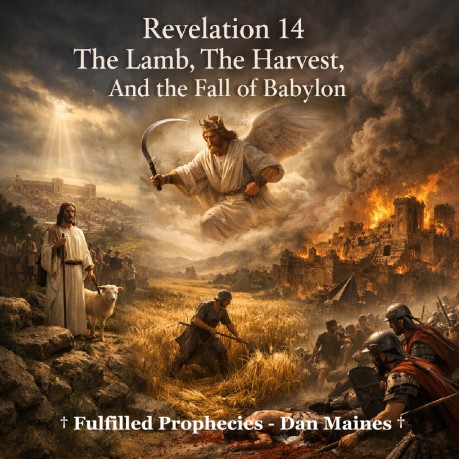
Revelation 14 The Lamb, The
Harvest, And The Fall Of Babylon Introduction † Revelation 14 reveals the victory of the Lamb
in the middle of the conflict described earlier. While the beast and
his followers appeared powerful on earth, heaven shows the true
reality. Christ stands victorious and His people stand with Him. † This chapter unfolds in several scenes. The
Lamb appears with the sealed remnant, the eternal gospel is
proclaimed, Babylon is declared fallen, and the harvest of judgment
takes place. Each scene confirms the authority of Christ and the
certainty of His word. † The vision would have brought comfort to the
first century church. Even as persecution increased and Jerusalem
moved toward destruction, heaven already showed that the Lamb had
secured victory. Revelation 14:1 † The Lamb standing on Mount Zion fulfills
Psalm 2:6 where God declares He has installed His King on Zion.
Christ is already reigning. † The 144,000 represent the faithful remnant of
Israel sealed earlier in Revelation 7. They symbolize the Jewish
believers preserved through the transition from the old covenant
system to the new. † The name of the Father written on their
foreheads identifies them as belonging to God. This stands in
contrast to the mark of the beast which represents allegiance to
Rome. † Mount Zion here represents the heavenly
Jerusalem. Hebrews explains that believers had come to Mount Zion and
to the city of the living God (Hebrews 12:22). Revelation 14:2-3 † The voice like many waters and thunder
reflects the majesty and authority of heaven. † The new song represents redemption
accomplished. When God delivered Israel from Egypt they sang a song
of victory in Exodus 15. † In the same way the redeemed now sing a new
song because Christ accomplished the greater deliverance from sin and
from the condemnation of the law. † Only the redeemed can learn this song because
it belongs to those who experienced the redemption Christ purchased. Revelation 14:4-5 † The purity described here is symbolic purity
rather than literal celibacy. The prophets often described idolatry
as spiritual adultery. † Hosea used the same imagery when condemning
Israel's unfaithfulness (Hosea 2:2). These believers are the
opposite, those who remained faithful to the Lamb. † They are called first fruits because they
represent the beginning of the harvest of the new creation. † James calls believers the first fruits of
God's creatures (James 1:18). Revelation 14:6-7 † This angel represents the universal
proclamation of the gospel before the coming judgment. The message
goes to every nation, tribe, language, and people, showing the global
spread of the message of Christ. † The statement the hour of His judgment has
come shows the immediacy of the coming event. This was not a distant
prophecy but a judgment about to unfold. † Paul confirmed that the gospel had already
spread widely when he wrote that it had been proclaimed in all
creation under heaven (Colossians 1:23). † Paul also said that the faith of the Roman
believers was being proclaimed throughout the whole world, confirming
the rapid spread of the gospel before the coming judgment (Romans
1:8). † The command to worship the Creator echoes the
language of the prophets who called Israel back to the true God
before national judgment fell. Revelation 14:8 † Babylon in Revelation symbolizes apostate
Jerusalem, the city that rejected Christ and persecuted the church. † Earlier Revelation identified the same city
as the place where the Lord was crucified (Revelation 11:8), clearly
pointing to Jerusalem. † Jesus Himself held Jerusalem responsible for
the blood of the prophets and warned that judgment would fall upon
that generation (Matthew 23:35-36). † The language fallen, fallen echoes Isaiah's
prophecy concerning the fall of ancient Babylon (Isaiah 21:9),
showing the prophetic pattern of judgment. Revelation 14:9-11 † This warning addresses those tempted to
compromise with the Roman system and its emperor worship. † Receiving the mark of the beast symbolized
loyalty to Rome and participation in its idolatrous structure. † The imagery of smoke rising forever comes
directly from Old Testament descriptions of national judgment. † Isaiah used the same imagery when describing
the destruction of Edom, where the smoke would rise forever even
though the judgment was temporal (Isaiah 34:9-10). † The imagery therefore describes complete and
irreversible destruction rather than endless torment. Revelation 14:12-13 † These words encouraged believers who were
facing persecution and possible martyrdom. † While those who followed the beast would face
judgment, those who died in Christ would enter rest. † Their works followed them because their
faithfulness to Christ was not forgotten by God. † Early Christian testimony confirms this
confidence. When Polycarp faced martyrdom he spoke of resting in
Christ, reflecting the hope described here. Revelation 14:14-16 † The Son of Man on the cloud fulfills the
prophecy of Daniel 7:13 where the Son of Man receives authority and
dominion. † The harvest imagery reflects the separation
that occurs at the end of the age. † Jesus described this same harvest when He
explained that the harvest is the end of the age and the angels would
gather the harvest (Matthew 13:39-43). † Jesus also warned that the wheat and the
tares would be gathered in the harvest at the end of the age (Matthew
13:30). † This harvest represents the covenantal
judgment that separated the faithful remnant from those who rejected
Christ. Revelation 14:17-20 † The wine press represents the crushing
judgment of God against the rebellious city. † The judgment occurs outside the city,
mirroring how Christ was crucified outside Jerusalem (Hebrews 13:12). † The imagery of blood reaching the horses'
bridles communicates the magnitude of the destruction. † Josephus described massive bloodshed flowing
through the city during the Roman siege, illustrating the devastation
of Jerusalem's fall (Josephus, Wars 6.9.4). Historical References † Josephus recorded the corruption and madness
that overtook Jerusalem's leadership during the final years before
its destruction (Josephus, Wars 5.13.6). † He also described enormous bloodshed during
the fall of the city, confirming the severity of the destruction
(Josephus, Wars 6.9.4). † Tacitus, the Roman historian, recorded the
disasters that struck Judea during the Roman war (Tacitus, Histories
5.13). † Eusebius recorded that the Christians in
Jerusalem fled the city before its destruction, remembering the
warnings given by Jesus (Eusebius, Ecclesiastical History 3.5). How it applies to us today † Revelation 14 reminds us that Christ reigns
even when earthly powers appear strong. † The contrast between the sealed followers of
the Lamb and those who followed the beast calls believers to remain
faithful to Christ. † The fulfilled judgment confirms that every
word spoken by Jesus came to pass exactly as He said. † Because His prophecies proved true, we can
trust every promise He has made. Q and A Appendix Q What does the 144,000 represent? Q What is the eternal gospel mentioned in this
chapter? Q Who is Babylon in Revelation 14? Q What does the harvest represent? Q Why is the winepress trampled outside the
city? Q Why are the 144,000 called first fruits? Q Why is the judgment described using harvest
imagery? Q Why does the angel call people to worship the
Creator? † This is the fulfilled perspective we proclaim at
Fulfilled Prophecies † Source Index † Revelation 14; Psalm 2:6; Hebrews 12:22;
Exodus 15; Hosea 2:2; James 1:18; Colossians 1:23; Romans 1:8; Isaiah
34:9-10; Isaiah 21:9; Daniel 7:13; Matthew 13:30; Matthew 13:39-43;
Matthew 23:35-36; Revelation 7:4; Revelation 11:8 † Josephus, Wars 5.13.6; 6.9.4; Tacitus,
Histories 5.13; Eusebius, Ecclesiastical History 3.5; Polycarp,
Martyrdom of Polycarp
By Dan Maines
Then I looked, and behold,
the Lamb was standing on Mount Zion, and with Him 144,000 who had His
name and the name of His Father written on their foreheads.
And I heard a voice from
heaven, like the sound of many waters and like the sound of loud
thunder, and the voice which I heard was like the sound of harpists
playing on their harps. And they sang a new song before the throne
and before the four living creatures and the elders; and no one was
able to learn the song except the 144,000 who had been purchased from
the earth.
These are the ones who
have not been defiled with women, for they are celibate. These are
the ones who follow the Lamb wherever He goes. These have been
purchased from mankind as first fruits to God and to the Lamb. And no
lie was found in their mouths; they are blameless.
And I saw another angel
flying in midheaven with an eternal gospel to preach to those who
live on the earth, and to every nation, tribe, language, and people;
and he said with a loud voice, Fear God and give Him glory, because
the hour of His judgment has come; worship Him who made the heaven
and the earth, and sea and springs of waters.
And another angel, a second
one, followed, saying, Fallen, fallen is Babylon the great, she who
has made all the nations drink of the wine of the passion of her
sexual immorality.
Then another angel, a
third one, followed them, saying with a loud voice, If anyone
worships the beast and his image, and receives a mark on his forehead
or on his hand, he also will drink of the wine of the wrath of God,
which is mixed in full strength in the cup of His anger; and he will
be tormented with fire and brimstone in the presence of the holy
angels and in the presence of the Lamb. And the smoke of their
torment ascends forever and ever; they have no rest day and night,
those who worship the beast and his image, and whoever receives the
mark of his name.
Here is the perseverance
of the saints who keep the commandments of God and their faith in
Jesus. And I heard a voice from heaven, saying, Write: Blessed are
the dead who die in the Lord from now on! Yes, says the Spirit, so
that they may rest from their labors, for their deeds follow with
them.
Then I looked, and
behold, a white cloud, and sitting on the cloud was one like a son of
man, with a golden crown on His head, and a sharp sickle in His hand.
And another angel came out of the temple, calling out with a loud
voice to Him who sat on the cloud, Put in Your sickle and reap,
because the hour to reap has come, because the harvest of the earth
is ripe. Then He who sat on the cloud swung His sickle over the
earth, and the earth was reaped.
And another angel came
out of the temple which is in heaven, and he also had a sharp sickle.
Then another angel, the one who has power over fire, came out from
the altar; and he called with a loud voice to him who had the sharp
sickle, saying, Put in your sharp sickle and gather the clusters from
the vine of the earth, because her grapes are ripe. So the angel
swung his sickle to the earth and gathered the clusters from the vine
of the earth, and threw them into the great wine press of the wrath
of God. And the wine press was trampled outside the city, and blood
came out from the wine press, up to the horses' bridles, for a
distance of about two hundred miles.
A
They represent the faithful remnant of Israel who believed in Christ
and were preserved during the transition from the old covenant system
to the new covenant kingdom (Revelation 7:4; Revelation 14:1).
A The eternal gospel is the message of
salvation through Christ that was proclaimed to the nations before
the judgment came upon Jerusalem (Matthew 24:14; Colossians 1:23).
A
Babylon symbolizes apostate Jerusalem, the city that rejected Christ
and persecuted the prophets and the church (Revelation 11:8; Matthew
23:37-38).
A
The harvest represents the covenantal judgment that occurred at the
end of the old covenant age when the faithful were separated from
those who rejected Christ (Matthew 13:39-43).
A The judgment fell outside the covenant
protection of the city because Jerusalem rejected the Messiah. Jesus
suffered outside the city, and later the judgment also fell outside
the city in fulfillment of covenant justice (Hebrews 13:12-13; Luke
21:20-22).
A
The term first fruits refers to the first portion of a harvest
offered to God. These believers from Israel represented the beginning
of the greater harvest of the new covenant people. Scripture calls
believers the first fruits of God's creatures, showing that the new
creation had already begun through Christ (James 1:18; Romans 8:23).
A The harvest imagery comes directly
from the teaching of Jesus. He explained that the harvest represents
the end of the age when God separates the righteous from the wicked.
This imagery shows the covenantal judgment that occurred at the end
of the old covenant age (Matthew 13:39-43; Matthew 13:30).
A The call to worship the Creator
echoes the language used by the prophets when warning Israel before
judgment. It reminds the people to turn away from idolatry and
recognize the authority of the true God before the coming judgment
(Jeremiah 10:10-12; Acts 14:15).
© Fulfilled Prophecies - Dan
Maines.
Links