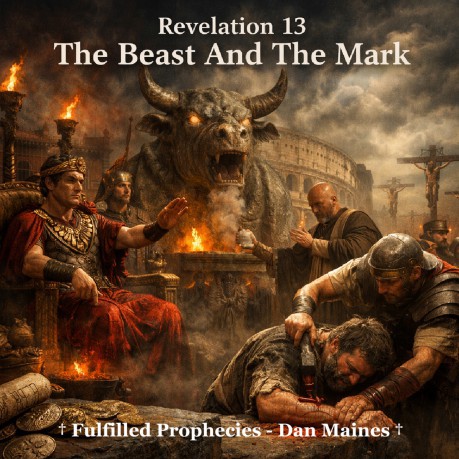
Revelation 13 The Beast And
The Mark Introduction † Revelation 13 reveals the political and
religious powers that opposed Christ and persecuted the early church
during the first century. John was not writing about distant future
events, he was revealing the forces that the seven churches in Asia
were facing in their own lifetime. † The imagery of beasts and crowns comes
directly from Daniel's prophecy. Daniel saw beasts representing
empires that ruled over God's people. John now shows the final form
of that imperial power during the time of Rome (Daniel 7:3). † The chapter exposes the spiritual reality
behind the Roman Empire. What looked like political power was
actually energized by the dragon, Satan, who used imperial authority
to persecute believers. † Understanding this chapter requires
remembering the time statements already given in Revelation. The
prophecy concerned things that would happen soon and that were near
for the original audience (Revelation 1:1, 3). Revelation 13:1-2 And the dragon stood on the sand of the seashore. Then I saw a
beast coming up out of the sea, having ten horns and seven heads, and
on his horns were ten crowns, and on his heads were blasphemous
names. And the beast that I saw was like a leopard, and his feet were
like those of a bear, and his mouth like the mouth of a lion. And the
dragon gave him his power and his throne and great authority. † The beast rising from the sea recalls
Daniel's vision where beasts represented kingdoms rising from the
nations. The sea symbolizes the Gentile world from which imperial
power arises (Daniel 7:2-3). † The combination of leopard, bear, and lion
imagery shows that Rome inherited the character of the earlier
empires described by Daniel. Babylon, Medo-Persia, and Greece all led
to the rise of Rome as the dominant world power (Daniel 7:4-6). † The dragon giving power shows that Satan was
influencing the political system of Rome. Earthly empires often
operate as instruments of spiritual opposition to God's kingdom
(Revelation 12:9). † The seven heads correspond with the line of
Roman Caesars. These rulers accepted divine titles and demanded
worship, which explains the blasphemous names written on the heads. † Revelation later explains that the seven
heads represent kings, confirming that the beast imagery refers to
rulers rather than a future global government (Revelation 17:9-10). † The Roman imperial line beginning with Julius
Caesar fits this description and shows that the prophecy is
describing the first century imperial system. Revelation 13:3-4 I saw one of his heads as if it had been fatally wounded, and his
fatal wound was healed. And the whole earth was amazed and followed
after the beast. They worshiped the dragon because he gave his
authority to the beast, and they worshiped the beast, saying, Who is
like the beast, and who is able to wage war with him? † The wounded head refers to Nero. His death in
AD 68 caused a political crisis across the Roman Empire and triggered
a civil war. † Although Nero died, the imperial system
recovered under Vespasian. The restoration of stability made it
appear as if the wounded head had come back to life. † Many people in the Roman world believed Nero
would return from the east. This belief became known as the Nero
redivivus myth and spread widely across the empire. † Ancient sources such as Suetonius record the
widespread expectation of Nero's return, explaining why the world
marveled at the beast. Revelation 13:5-7 A mouth was given to him speaking arrogant words and blasphemies,
and authority to act for forty-two months was given to him. And he
opened his mouth in blasphemies against God, to blaspheme His name
and His tabernacle, that is, those who dwell in heaven. It was also
given to him to make war with the saints and to overcome them, and
authority was given to him over every tribe, people, language, and
nation. † Nero ruled with arrogance and demanded divine
honors. Roman emperors frequently accepted titles that belonged only
to God. † The forty-two months corresponds to the
period of persecution following the great fire of Rome in AD 64 when
Nero blamed Christians. † Tacitus records how Christians were tortured,
crucified, and burned alive during Nero's persecution. † This persecution lasted about three and a
half years, which matches the forty-two months described in the
prophecy. † Jesus warned His disciples that persecution
would occur within their generation, and Nero's persecution fulfills
that warning (Matthew 24:9, 34). Revelation 13:8 All who live on the earth will worship him, everyone whose name
has not been written since the foundation of the world in the book of
life of the Lamb who has been slaughtered. † Worshiping the beast represents allegiance to
the Roman imperial cult. Citizens throughout the empire were expected
to acknowledge Caesar as divine. † Temples dedicated to Caesar existed
throughout Asia Minor, and citizens were pressured to participate in
imperial worship. † Christians refused these practices because
they confessed that Jesus alone is Lord. † The book of life reminds believers that God
preserves His people even when the world opposes them. Revelation 13:9-10 If anyone has an ear, let him hear. If anyone is destined for
captivity, to captivity he goes; if anyone kills with the sword, with
the sword he must be killed. Here is the perseverance and the faith
of the saints. † This is a call for endurance during
persecution. Believers were not called to overthrow Rome but to
remain faithful to Christ. † Jesus had warned that His followers would
face persecution during that generation (Matthew 24:9). † The strength of the early church was its
faithfulness even in suffering. † Through endurance the saints demonstrated
that God's kingdom cannot be destroyed by earthly power. Revelation 13:11-12 Then I saw another beast coming up out of the earth; and he had
two horns like a lamb, and he spoke like a dragon. He exercises all
the authority of the first beast in his presence. And he makes the
earth and those who live on it worship the first beast, whose fatal
wound was healed. † The second beast rises from the land,
pointing to Judea. This beast represents the religious leadership
that cooperated with Roman authority. † The lamb-like appearance suggests religious
authority, but the dragon-like voice reveals deception. † The leaders of Jerusalem publicly aligned
themselves with Rome when they declared, We have no king but Caesar
(John 19:15). † This alliance between religious leadership
and imperial power strengthened the persecution of believers. Revelation 13:13-14 He performs great signs, so that he even makes fire come down out
of the sky to the earth in the presence of people. And he deceives
those who live on the earth because of the signs which it was given
him to perform in the presence of the beast, telling those who live
on the earth to make an image to the beast who had the wound of the
sword and has come to life. † These signs represent deceptive religious
influence that encouraged loyalty to the Roman system. † False prophets in Judea misled the population
during the years leading up to the destruction of Jerusalem. † Josephus recorded how many people trusted
these false prophets instead of listening to warnings about the
coming judgment. † Their deception kept many people inside the
city during the Roman siege. Revelation 13:15-17 And it was given to him to give breath to the image of the beast,
so that the image of the beast would even speak and cause all who do
not worship the image of the beast to be killed. And he decrees that
no one will be able to buy or to sell, except the one who has the
mark, either the name of the beast or the number of his name. † The mark represents allegiance to the Roman
emperor and participation in the imperial system. † Roman coins carried the image and titles of
Caesar, declaring his authority throughout the empire. † Participation in trade guilds throughout the
Roman world often required offerings to patron gods and to the
emperor. † Christians who refused emperor worship were
frequently excluded from commerce and civic life. † Archaeological evidence from Asia Minor shows
inscriptions honoring the emperor in marketplaces and guild halls,
confirming the economic pressure connected to emperor worship. † The mark language also reflects covenant
symbolism. God's people were said to have His law on their hand and
forehead, representing loyalty and obedience (Deuteronomy 6:6-8). † In the same way, the beast's mark represents
allegiance to the imperial system rather than a literal physical
brand. Revelation 13:18 Here is wisdom. Let the one who has understanding calculate the
number of the beast, for the number is that of a man, and his number
is six hundred and sixty-six. † The number 666 corresponds to Nero Caesar
when written in Hebrew letters and calculated through gematria. † This numerical method was common in the
ancient world and would have been understood by the original
audience. † The calculation identifies Nero as the man
associated with the beastly power persecuting the church. † Early Christian writers recognized this
connection between Nero and the number 666. Historical References † Tacitus described Nero's persecution of
Christians following the fire of Rome in AD 64. † Suetonius recorded the arrogance of Roman
emperors and the belief that Nero might return after his death. † Josephus documented the influence of false
prophets in Jerusalem before its destruction. † Irenaeus acknowledged that many early
Christians associated the number 666 with Nero. How It Applies To Us Today † Revelation 13 shows that political systems
can become instruments of spiritual opposition when they demand the
worship that belongs to God. † The early church demonstrates that
faithfulness to Christ matters more than acceptance by society. † Believers today must remain loyal to Christ
rather than compromising with worldly systems that oppose God's
truth. † The Lamb's book of life assures us that our
ultimate security is found in Christ, not in earthly governments or
economies. Q And A Appendix Q Who was the beast described in this chapter? A The beast represents the Roman imperial system
centered around Nero Caesar, whose persecution of Christians
fulfilled the prophecy of war against the saints (Revelation 13:5-7;
Revelation 13:18). Q What does the mark of the beast represent? A The mark symbolizes allegiance to the Roman
emperor and participation in the imperial cult that required citizens
to honor Caesar as divine (Revelation 13:16-17). Q Why does the prophecy say the whole earth
followed the beast? A In prophetic language the word earth often
refers to the land or the Roman world rather than the entire planet.
The Roman Empire dominated the known world of the first century,
which explains the description of universal influence (Luke 2:1; Acts
11:28). Q Does the number 666 prove the beast must be a
future individual? A No. The text says the number is the number of a
man, and when Nero Caesar's name is written in Hebrew letters it
equals 666 through gematria. This fits the first century persecution
of the church and the historical context of the Roman Empire
(Revelation 13:18). Q Why would John expect his readers to calculate
the number? A John said let the one who has understanding
calculate the number, meaning the original readers had the
information needed to recognize the identity. The churches in Asia
lived under Roman rule and knew the emperor who was persecuting
believers (Revelation 13:18; Revelation 1:1, 3). Q What does the phrase the whole earth mean in
Revelation? A In biblical prophetic language earth often
refers to the land or the Roman world rather than the entire planet.
The Roman Empire dominated the known world of that time, which
explains the description of universal influence (Luke 2:1; Acts
11:28). Q Why is the beast described as both political
and religious? A The Roman Empire combined political authority
with emperor worship. Citizens were expected to honor Caesar as
divine, which turned political loyalty into religious devotion. This
is why Revelation describes worship of the beast as allegiance to
imperial power (Revelation 13:4, 8). Q How does Revelation 13 connect with the fall of
Jerusalem? A The alliance between Roman power and the
religious leadership of Judea led to the persecution of believers and
ultimately to the destruction of Jerusalem in AD 70, exactly as Jesus
warned would happen within that generation (Matthew 24:2, 34; John
19:15). † This is the fulfilled perspective we proclaim at
Fulfilled Prophecies † © Fulfilled Prophecies - Dan Maines. Source Index † Revelation 13; Daniel 7:2-7; Deuteronomy
6:6-8; Matthew 24:9, 34; Luke 2:1; John 19:15; Acts 11:28 † Tacitus Annals 15.44; Suetonius Nero 57;
Josephus Wars 6.5.3; Irenaeus Against Heresies 5.30.3
By Dan Maines
Links