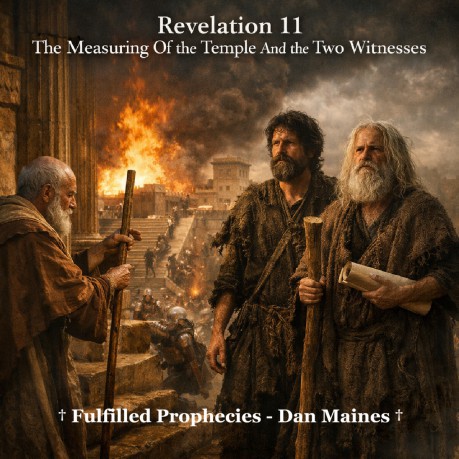
Revelation 11 The Measuring
Of The Temple And The Two Witnesses Introduction † Revelation 11 continues the unfolding of
covenant judgment that Jesus said would come upon that generation.
The chapter shows God's protection over the faithful, the testimony
of His witnesses, the persecution of the church, and the final
declaration that Christ now reigns. † Jesus warned that the temple would be
destroyed and that judgment would fall on Jerusalem within that
generation (Matthew 23:36; Matthew 24:2, 34). Revelation is
describing those same events using prophetic imagery drawn from the
Old Testament. † The imagery John records comes directly from
the language of the prophets. When understood through that prophetic
background, the meaning becomes clear. † The measuring of the temple, the ministry of
the witnesses, and the sounding of the seventh trumpet all point to
the end of the Old Covenant system and the public vindication of
Christ's kingdom. † The prophecy also reveals how God preserved
His faithful people while judgment was falling on the city that
rejected His Son. Revelation 11:1-2 Then there was given to me a measuring rod like a staff; and
someone said, Get up and measure the temple of God, and the altar,
and those who worship in it. Leave out the courtyard which is outside
the temple, and do not measure it, because it has been given to the
nations; and they will trample the holy city for forty-two months. † Measuring symbolizes ownership and
preservation. John is told to measure the true worshipers, not the
outer court, meaning the faithful are preserved while the outward
religious system is left to judgment (Revelation 11:1-2). † The same imagery appears in Ezekiel where the
temple is measured to show God's dwelling among His people (Ezekiel
40-43). The act of measuring marks what belongs to God. † The temple language reflects the covenant
people. By the first century believers were already called God's
temple (1 Corinthians 3:16; Ephesians 2:19-22). The measuring
therefore shows God's protection over His faithful remnant. † The outer court being given to the nations
represents the Roman invasion. Jesus warned Jerusalem would be
surrounded by armies and trampled by the nations (Luke 21:20-24). † The forty-two months equals three and a half
years, corresponding closely to the Roman war against Jerusalem from
AD 67 to AD 70. † Josephus records that Roman armies surrounded
the city, trampled the temple courts, and ultimately destroyed the
sanctuary during that time (Josephus, Wars 6.2.1). † Jesus told believers to flee Jerusalem when
they saw the city surrounded by armies, showing that God would
preserve His faithful remnant even while judgment fell on the city
(Luke 21:20-21). Revelation 11:3-4 And I will grant authority to My two witnesses, and they will
prophesy for twelve hundred and sixty days, clothed in sackcloth.
These are the two olive trees and the two lampstands that stand
before the Lord of the earth. † The two witnesses symbolize the faithful
prophetic testimony of the church during the final years before
Jerusalem's destruction (Revelation 11:3-4). † Two witnesses represent valid testimony
according to the law (Deuteronomy 19:15). God is presenting a
confirmed witness against covenant-breaking Israel. † Sackcloth represents mourning and warning.
The church was calling Jerusalem to repentance just as the prophets
had done before earlier judgments. † The olive trees and lampstands come directly
from Zechariah's vision where Joshua and Zerubbabel represented God's
anointed leadership (Zechariah 4:2-3). † In Revelation the imagery expands to
represent the church standing as God's prophetic witness before the
world. † Earlier in Revelation the churches themselves
were identified as lampstands, confirming that the witness in this
vision represents the testimony of the church (Revelation 1:20). Revelation 11:5-6 And if anyone wants to harm them, fire flows out of their mouth
and devours their enemies; so if anyone wants to harm them, he must
be killed in this way. These have the power to shut up the sky, so
that rain will not fall during the days of their prophesying; and
they have power over the waters to turn them into blood, and to
strike the earth with every plague, as often as they desire. † The imagery recalls the ministries of Elijah
and Moses, two of the greatest prophetic witnesses in Israel's
history. † Elijah called fire from heaven and shut the
rain (1 Kings 17:1; 2 Kings 1:10). † Moses turned water into blood and brought
plagues upon Egypt (Exodus 7:20). † These connections show that the church
carries forward the prophetic role of confronting rebellion and
declaring God's judgment. † Jesus promised His disciples that God would
give them words and wisdom that none of their adversaries could
resist (Luke 21:15). Revelation 11:7-10 When they have finished their testimony, the beast that comes up
out of the abyss will make war with them, and overcome them, and kill
them. And their dead bodies will lie on the street of the great city,
which spiritually is called Sodom and Egypt, where also their Lord
was crucified. Those from the peoples, tribes, languages, and nations
will look at their dead bodies for three and a half days, and will
not allow their dead bodies to be laid in a tomb. And those who live
on the earth will rejoice over them and celebrate; and they will send
gifts to one another, because these two prophets tormented those who
live on the earth. † The beast that rises from the abyss
represents Roman power that persecutes the church (Revelation
11:7-10). † The great city is clearly Jerusalem because
it is identified as the place where the Lord was crucified. † Jerusalem is spiritually called Sodom and
Egypt because of its corruption and rebellion against God. † The prophets used the same language when
condemning Israel's apostasy (Isaiah 1:10; Ezekiel 16:46). † Josephus described the moral collapse and
violence inside Jerusalem during the Roman siege, including murders
within the temple itself (Josephus, Wars 4.5.2). † The rejoicing over the death of the witnesses
reflects Israel's long history of persecuting the prophets (Matthew
23:29-31). † The beast making war against the witnesses
reflects Roman persecution of believers during the reign of Nero and
the growing hostility that culminated in the destruction of
Jerusalem. Revelation 11:11-13 But after the three and a half days, the breath of life from God
came into them, and they stood on their feet; and great fear fell
upon those who were watching them. And they heard a loud voice from
heaven saying to them, Come up here. And they went up into heaven in
the cloud, and their enemies watched them. And at that time there was
a great earthquake, and a tenth of the city fell; seven thousand
people were killed in the earthquake, and the rest were terrified and
gave glory to the God of heaven. † The resurrection imagery represents the
vindication of God's witnesses (Revelation 11:11-13). † Though the church was persecuted, their
testimony was proven true when the city that rejected them was
judged. † Earthquakes often symbolize divine judgment
and covenant upheaval in prophetic language (Isaiah 29:6). † Josephus records earthquakes, strange signs,
and fearful events reported in Jerusalem before its destruction
(Josephus, Wars 4.4.5; 6.5.3). † The number seven thousand recalls the
faithful remnant preserved in Elijah's day (1 Kings 19:18). Revelation 11:14-15 The second woe has passed; behold, the third woe is coming
quickly. Then the seventh angel sounded; and there were loud voices
in heaven, saying, The kingdom of the world has become the kingdom of
our Lord and of His Christ, and He will reign forever and ever. † The seventh trumpet announces the full
establishment of Christ's kingdom (Revelation 11:15). † This fulfills Daniel's prophecy that God's
kingdom would replace all earthly kingdoms (Daniel 2:44). † The destruction of Jerusalem marked the end
of the Old Covenant order and the complete transition to Christ's
reign. † Paul connects the trumpet with the
resurrection and the transformation associated with the kingdom (1
Corinthians 15:52). † With the destruction of the temple in AD 70
the Old Covenant system ended and Christ's kingdom stood openly
without the temple-centered system that had defined Israel's national
life. Revelation 11:16-18 And the twenty-four elders, who sit on their thrones before God,
fell on their faces and worshiped God, saying, We give You thanks,
Lord God, the Almighty, the One who is and who was, because You have
taken Your great power and have begun to reign. And the nations were
enraged, and Your wrath came, and the time came for the dead to be
judged, and the time to reward Your bond-servants the prophets and
the saints and those who fear Your name, the small and the great, and
to destroy those who destroy the earth. † This passage declares that God's judgment has
arrived and His kingdom authority is established (Revelation
11:16-18). † Daniel foretold that judgment would be given
to the saints and they would possess the kingdom (Daniel 7:22). † Jesus said this judgment would occur within
that generation (Matthew 16:27-28; Matthew 24:30-34). Revelation 11:19 And the temple of God which is in heaven was opened, and the ark
of His covenant appeared in His temple, and flashes of lightning,
sounds, peals of thunder, an earthquake, and great hail. † The heavenly temple is revealed as the true
dwelling place of God (Revelation 11:19). † The ark of the covenant had been absent from
the earthly temple for centuries. † Josephus confirmed the ark was not present in
Herod's temple (Josephus, Wars 5.5.5). † Its appearance in heaven shows that God's
covenant presence is no longer tied to the earthly temple. Historical References † Josephus recorded the Roman siege of
Jerusalem and the trampling of the temple courts during the war of AD
67-70. † Josephus described corruption, violence, and
murder inside Jerusalem during the siege. † Josephus also reported earthquakes, signs,
and fearful wonders before the city's destruction. † Tacitus recorded the destruction of Jerusalem
and the temple by the Roman armies under Titus (Tacitus, Histories
5.12-13). † Eusebius recorded that Christians fled
Jerusalem before the destruction after remembering Jesus' warning. How it applies to us today † God preserves His faithful even when
religious systems collapse. † The testimony of God's people cannot be
silenced. † Christ reigns now and His kingdom is
everlasting. † God's true temple is His people, not earthly
buildings. Q & A Appendix Q Who are the two witnesses in Revelation 11? Q Why is Jerusalem called Sodom and Egypt? Q What does the forty-two months represent? Q What does the seventh trumpet announce? Q Why does Revelation use symbolic prophetic
language? Q Why are the witnesses described as two instead
of many? Q What is the significance of the 1,260 days? Q Why are the witnesses described with powers
like Moses and Elijah? Q What does the resurrection of the witnesses
represent? Q Why does the vision end with the temple in
heaven being opened? † This is the fulfilled perspective we proclaim at
Fulfilled Prophecies † Source Index † Revelation 11:1-19; Ezekiel 40-43; Daniel
2:44; Daniel 7:22, 25; Isaiah 1:10; Isaiah 13:10; Isaiah 29:6;
Ezekiel 16:46; Ezekiel 32:7-8; Zechariah 4:2-3; Deuteronomy 19:15; 1
Kings 17:1; 1 Kings 19:18; 2 Kings 1:10; Exodus 7:20; Luke 1:16-17;
Luke 21:15, 20-24; Matthew 16:27-28; Matthew 23:29-31; Matthew 24:2,
30-34; 1 Corinthians 3:16; 1 Corinthians 15:52; Ephesians 2:19-22 † Josephus, Wars 4.4.5; 4.5.2; 5.5.5; 6.2.1;
6.5.3; Tacitus, Histories 5.12-13; Eusebius, Ecclesiastical History
3.5
By Dan Maines
A
They represent the faithful prophetic testimony of the church during
the years leading up to Jerusalem's destruction (Deuteronomy 19:15;
Revelation 11:3-4).
A
These names describe spiritual corruption and rebellion against God
(Isaiah 1:10; Ezekiel 16:46; Revelation 11:8).
A
It corresponds to the Roman war against Jerusalem from AD 67 to AD 70
(Daniel 7:25; Revelation 11:2).
A
It announces the establishment of Christ's kingdom and the end of the
Old Covenant system (Daniel 2:44; Revelation 11:15).
A Revelation follows the style of the
Old Testament prophets, using symbolic imagery to describe covenant
judgment and historical events (Isaiah 13:10; Ezekiel 32:7-8;
Revelation 1:1).
A Scripture required two witnesses to
establish a matter as legally valid testimony (Deuteronomy 19:15).
The two witnesses represent the confirmed prophetic testimony of
God's people against covenant-breaking Jerusalem (Revelation 11:3-4).
A
The 1,260 days equal forty-two months or three and a half years. This
period matches the length of the Roman war against Jerusalem from AD
67 to AD 70 and corresponds with Daniel's time, times, and half a
time prophecy (Daniel 7:25; Daniel 12:7; Revelation 11:2-3).
A Moses and Elijah
represent the law and the prophets. Their imagery shows that the
church continued the prophetic mission of confronting Israel's
rebellion and declaring God's covenant judgment (1 Kings 17:1; Exodus
7:20; Revelation 11:5-6).
A It represents the vindication of
the church's testimony. Though persecuted and seemingly defeated, God
confirmed that their message was true when Jerusalem was judged
exactly as the prophets and apostles had warned (Revelation 11:11-13;
Matthew 24:30-34).
A The opening of the
heavenly temple shows that God's true covenant presence is no longer
tied to the earthly temple. With the destruction of Jerusalem in AD
70, the Old Covenant system ended and the reality of God's presence
in heaven was fully revealed (Revelation 11:19; Hebrews 8:13; Hebrews
9:24).
© Fulfilled Prophecies - Dan
Maines.
Links