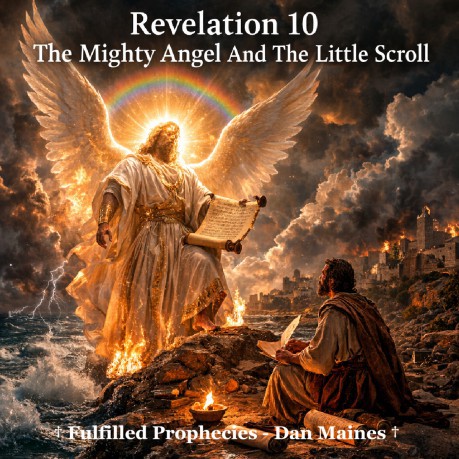
Revelation 10 The Mighty
Angel And The Little Scroll Introduction † Revelation 10 pauses the trumpet judgments to
reveal a powerful message about the completion of God's plan. Just as
prophets in the Old Testament were given messages to proclaim before
major judgment events, John is given a prophetic commission in the
middle of the unfolding vision (Ezekiel 2:8-10). † The scene emphasizes that the coming judgment
was not random destruction. It was the fulfillment of God's
long-declared plan through the prophets. What was about to occur had
been foretold for centuries. † This chapter also shows that God's mystery
was reaching its completion. The events leading to the fall of
Jerusalem were not merely political events. They were the climax of
the covenant transition that Jesus had foretold during His ministry
(Matthew 24:34). Revelation 10:1-2 Then I saw another strong angel coming down from heaven, clothed
with a cloud; and the rainbow was upon his head, and his face was
like the sun, and his feet like pillars of fire; and he had in his
hand a little scroll which was open. He placed his right foot on the
sea and his left on the land. † The imagery surrounding this mighty angel
reflects divine authority. Clouds, fire, and radiant brightness often
accompany heavenly messengers sent with God's authority (Daniel
10:5-6). † The rainbow recalls God's covenant
faithfulness. Even in judgment, God remains faithful to His promises
and purposes (Genesis 9:13). † The angel standing on sea and land shows
universal authority over the entire region involved in the coming
judgment. Revelation 10:3-4 And he cried out with a loud voice, as when a lion roars; and when
he had cried out, the seven peals of thunder spoke. When the seven
peals of thunder had spoken, I was about to write; and I heard a
voice from heaven saying, Seal up the things which the seven peals of
thunder have spoken and do not write them. † The roaring voice echoes prophetic language
where God's voice is described as a lion's roar announcing judgment
(Amos 3:8). † Thunder often represents the powerful voice
of God declaring judgment or authority (Psalm 29:3-4). † The command to seal the message shows that
not every detail of God's plan was revealed, reminding us that some
aspects of prophecy remain hidden until the proper time. † Daniel was also told to seal parts of his
prophecy until the time of fulfillment (Daniel 12:4, 9). In contrast,
Revelation reveals that the time of fulfillment had now arrived. Revelation 10:5-7 Then the angel whom I saw standing on the sea and on the land
raised his right hand to heaven, and swore by Him who lives forever
and ever, who created heaven and the things in it, and the earth and
the things in it, and the sea and the things in it, that there will
be no more delay, but in the days of the voice of the seventh angel,
when he is about to sound, then the mystery of God is finished, just
as He preached to His servants the prophets. † The declaration that there will be no more
delay signals that the long-awaited fulfillment of prophecy had
arrived. † The mystery of God refers to the fulfillment
of the redemptive plan revealed through the prophets, now reaching
completion in Christ and the establishment of the New Covenant
(Ephesians 3:3-6). † The prophets had long warned that covenant
judgment would come upon Jerusalem for rejecting the Messiah (Daniel
9:26-27; Matthew 23:36). † The declaration that there will be no more
delay matches the repeated statement in Revelation that the events
were about to take place quickly (Revelation 1:1; Revelation 22:6). Revelation 10:8-9 Then the voice which I heard from heaven, I heard again speaking
with me, and saying, Go, take the scroll which is open in the hand of
the angel who stands on the sea and on the land. So I went to the
angel, telling him to give me the little scroll. And he said to me,
Take it and eat it; it will make your stomach bitter, but in your
mouth it will be sweet as honey. † This scene directly parallels Ezekiel's
prophetic commission, where the prophet was commanded to eat the
scroll containing God's message (Ezekiel 3:1-3). † The sweetness represents the joy of receiving
God's truth, while the bitterness reflects the sorrow of delivering a
message of judgment. † Prophets often experienced this same tension,
proclaiming truth while grieving the coming destruction upon their
people. † The scroll being already open shows that the
message was ready to be proclaimed immediately, unlike Daniel's
sealed prophecy which awaited a later fulfillment (Daniel 12:4). Revelation 10:10 I took the little scroll out of the angel's hand and ate it, and
in my mouth it was sweet as honey; and when I had eaten it, my
stomach was made bitter. † The sweetness of God's word is a common
biblical theme. Psalm 119:103 describes God's word as sweeter than
honey. † Yet the bitterness reflects the painful
reality that the message involved devastating judgment upon
Jerusalem. † This moment prepares John to continue
proclaiming the message of what must soon take place. Revelation 10:11 And they said to me, You must prophesy again concerning many
peoples and nations and languages and kings. † John's prophetic mission continues because
the message of the gospel and the testimony of judgment must be
proclaimed to the nations. † The fall of Jerusalem would mark a major
turning point in redemptive history, demonstrating that the old
covenant system had come to its end (Hebrews 8:13). † The gospel would now go forward fully to the
nations without the temple-centered system that once defined Israel's
covenant life. † Jesus had already declared that the judgment
upon Jerusalem would come within that generation, confirming that the
events John was prophesying were near at hand (Matthew 24:34). Historical References † Josephus recorded the growing turmoil and
prophetic warnings that circulated during the years leading up to the
Jewish War. † Eusebius recorded that early Christians
understood Jesus' warnings and fled Jerusalem before the final
destruction came (Eusebius, Ecclesiastical History 3.5). † Tacitus confirmed that the events surrounding
the Jewish War shocked the Roman world and marked a significant
turning point in the region (Tacitus, Histories 5.13). How It Applies To Us Today † God's plans unfold exactly as He declares.
Nothing in history happens outside His sovereign authority. † The gospel message is both sweet and bitter.
It brings life to those who believe, but it also exposes judgment for
those who reject it. † The fulfillment of prophecy reminds us that
Christ reigns over history and that every promise of God will be
completed. † We are called to faithfully proclaim the
truth of the gospel just as John was commanded to continue
prophesying. Q And A Appendix Q: What is the little scroll in Revelation 10? Q: Why was the scroll sweet in the mouth but
bitter in the stomach? Q: What is the mystery of God mentioned in verse
7? Q: Why was John told to prophesy again? Q: Why was part of the thunder message sealed and
not written? Q: Why is the angel described with cloud, fire,
and radiant brightness? Q: Why does the angel stand with one foot on the
sea and one on the land? Q: Why is the message both sweet and bitter for
the prophet? Q: Why does Revelation emphasize that prophecy
must continue to be proclaimed? † This is the fulfilled perspective we proclaim at
Fulfilled Prophecies † Source Index † Revelation 10; Genesis 9:13; Psalm 29:3-4;
Psalm 119:103; Amos 3:8; Daniel 9:26-27; Daniel 12:4, 9; Matthew
23:36; Matthew 24:34; Matthew 28:18-20; Hebrews 8:13; Ephesians
3:3-6; Ezekiel 2:8-10; Ezekiel 3:1-3; Revelation 1:1; Revelation 22:6 † Josephus, Wars of the Jews; Eusebius,
Ecclesiastical History 3.5; Tacitus, Histories 5.13
By Dan Maines
A:
The little scroll represents the prophetic message John was given to
proclaim. It parallels the scroll given to Ezekiel, symbolizing the
reception of God's message (Ezekiel 2:8-10; Ezekiel 3:1-3).
A: God's word is joyful
because it reveals truth and salvation, but the message also
contained judgment upon Jerusalem, which brought sorrow and grief
(Psalm 119:103).
A: The mystery refers to the fulfillment of
God's redemptive plan revealed through the prophets and completed
through Christ and the New Covenant (Ephesians 3:3-6).
A:
The message of the gospel and the testimony of God's fulfilled
judgment needed to be proclaimed to the nations as the covenant
transition unfolded (Matthew 28:18-20).
A: Scripture shows that God
sometimes reveals only part of His plan. Daniel 12:9 shows a similar
example where parts of prophecy remained sealed until the appointed
time.
A: These are common
signs of divine authority and heavenly commission. Similar
descriptions appear when heavenly messengers are sent with important
revelation. Daniel 10:5-6 describes a messenger with shining face and
fiery appearance, showing the authority of the message being
delivered.
A: This shows the
authority of the message over the entire region. In Scripture the sea
and the land often represent the whole world or the full scope of
human territory under God's authority (Psalm 24:1; Exodus 20:11).
A: God's word brings joy because
it reveals truth and salvation, but it also brings sorrow when it
announces judgment. Jeremiah experienced the same tension when he
proclaimed God's message to a rebellious nation (Jeremiah 15:16).
A: God's truth
must always be declared to the nations. Even after the destruction of
Jerusalem, the gospel continued spreading throughout the Roman world
just as Jesus commanded (Matthew 24:14; Matthew 28:18-20).
© Fulfilled Prophecies - Dan
Maines.
Links