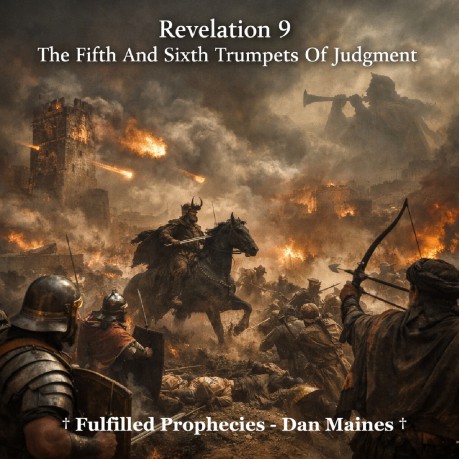
Revelation 9 The Fifth And
Sixth Trumpets Of Judgment Introduction † Revelation continues to unfold the judgment
that came upon Jerusalem in the first century. The trumpets reveal
increasing levels of warning and destruction, just as the prophets of
the Old Testament warned Israel that covenant rebellion would bring
national catastrophe (Deuteronomy 28:49-52). † The imagery in this chapter is not describing
modern warfare or some distant future event. It describes the
terrifying conditions surrounding the Roman invasion and the siege of
Jerusalem leading to AD 70. The language draws heavily from the
prophets, who often used cosmic and symbolic imagery to describe
national judgment (Isaiah 13:10; Joel 2:10). † Revelation 9 shows two major realities.
First, torment and devastation unleashed upon the rebellious nation.
Second, the stubborn refusal of many to repent even while judgment
was falling around them. This proves that the warnings Jesus gave in
Matthew 24 were fulfilled within that generation. Revelation 9:1-2 Then the fifth angel sounded, and I saw a star from heaven which
had fallen to the earth; and the key to the shaft of the abyss was
given to him. He opened the shaft of the abyss, and smoke ascended
out of the shaft like the smoke of a great furnace; and the sun and
the air were darkened from the smoke of the shaft. † The fallen star represents a fallen ruler or
angelic power. Stars symbolize leaders in Scripture, Isaiah 14:12;
Revelation 1:20. This star is not Christ but one cast down. † The abyss imagery recalls Isaiah 24:21-22,
where rebellious powers are imprisoned. The smoke darkening the sky
shows spiritual deception and chaos covering the land. † The darkening of the sun and air echoes
prophetic judgment language used against nations, Isaiah 13:10;
Ezekiel 32:7. This signals the collapse of Israel's covenant world. Revelation 9:3-4 Then out of the smoke came locusts onto the earth, and power was
given to them, as the scorpions of the earth have power. They were
told not to harm the grass of the earth, nor any green thing, nor any
tree, but only the people who do not have the seal of God on their
foreheads. † Unlike literal locusts, these harm people,
not vegetation. Their symbolic nature is clear. They represent
invading forces unleashed in judgment. † Joel 2 describes locusts as an army advancing
in ranks, a prophetic image of invading armies sweeping across the
land. † The sealed represent the faithful remnant
preserved by God. Revelation 7 already showed that God marked His
people for protection during the coming destruction. Revelation 9:5-6 And they were not permitted to kill anyone, but to torment for
five months; and their torment was like the torment of a scorpion
when it stings a person. And in those days people will seek death and
will not find it; they will long to die, and death flees from them. † Five months corresponds with the natural
season of locust activity, showing that the torment was intense but
limited. † The siege of Jerusalem created exactly this
kind of suffering. Starvation, disease, and violence filled the city. † Josephus records that people inside Jerusalem
experienced such misery that many wished for death but could not
escape the horrors of famine and internal violence (Josephus, Wars
5.12.3). † Josephus also records that famine and
suffering became so severe that people fought each other for scraps
of food and many died slowly in agony during the siege, showing the
torment described in the vision (Josephus, Wars 5.10.3). Revelation 9:7-10 The appearance of the locusts was like horses prepared for battle;
and on their heads appeared to be crowns like gold, and their faces
were like human faces. They had hair like the hair of women, and
their teeth were like the teeth of lions. They had breastplates like
breastplates of iron; and the sound of their wings was like the sound
of chariots of many horses rushing to battle. They have tails like
scorpions, and stings; and in their tails is their power to hurt
people for five months. † The description blends animal and human
features to portray terrifying military forces. † Horses prepared for battle reflects cavalry
formations, which were a major part of Roman and allied forces. † The sound of chariots rushing into battle
captures the thunder of advancing armies approaching Jerusalem during
the war (Josephus, Wars 3.4.2). † The prophet Nahum also described invading
armies using lion imagery and overwhelming military power,
reinforcing the symbolic war language used here (Nahum 2:11-13). Revelation 9:11 They have as king over them, the angel of the abyss; his name in
Hebrew is Abaddon, and in the Greek he has the name Apollyon. † Abaddon and Apollyon both mean destroyer. The
name emphasizes the destructive purpose of the forces unleashed. † Proverbs 30:27 says locusts have no king,
which proves the locusts in Revelation are symbolic organized forces. † These armies ultimately served God's purpose
of judgment, even though they operated under destructive powers. Revelation 9:12-15 The first woe has passed; behold, two woes are still coming after
these things. Then the sixth angel sounded, and I heard a voice from
the four horns of the golden altar which is before God, one saying to
the sixth angel who had the trumpet, Release the four angels who are
bound at the great river Euphrates. And the four angels, who had been
prepared for the hour and day and month and year, were released, so
that they would kill a third of mankind. † The Euphrates marked the historic boundary
from which invading empires came against Israel. † Assyria and Babylon both crossed this
boundary when they invaded the land (Isaiah 8:7). † Rome's eastern legions and allied forces also
moved from this region toward Judea during the Jewish War (Josephus,
Wars 3.4.2). Revelation 9:16 The number of the armies of the horsemen was two hundred million;
I heard the number of them. † The number represents overwhelming and
unstoppable force rather than a literal count. † Apocalyptic literature regularly uses
enormous numbers to portray massive armies (Daniel 7:10). † Josephus described the armies surrounding
Jerusalem as an innumerable multitude, emphasizing the same
overwhelming presence (Josephus, Wars 6.9.3). Revelation 9:17-19 And this is how I saw in the vision the horses and those who sat
on them: the riders had breastplates the color of fire, of hyacinth,
and of brimstone; and the heads of the horses are like the heads of
lions; and out of their mouths came fire, smoke, and brimstone. A
third of mankind was killed by these three plagues, by the fire, the
smoke, and the brimstone which came out of their mouths. For the
power of the horses is in their mouths and in their tails; for their
tails are like serpents, and have heads, and with them they do harm. † The imagery reflects the fiery destruction
brought by Roman siege warfare. † Roman catapults and siege engines hurled
burning projectiles into the city, igniting fires across Jerusalem. † Josephus describes how entire sections of the
city were set ablaze by these attacks (Josephus, Wars 5.6.3). Revelation 9:20-21 The rest of mankind, who were not killed by these plagues, did not
repent of the works of their hands, so as not to worship demons, and
the idols of gold, silver, brass, stone, and wood, which can neither
see, nor hear, nor walk; and they did not repent of their murders,
nor of their witchcraft, nor of their sexual immorality, nor of their
thefts. † Even under devastation, the survivors refused
to repent. This reveals the hardness of heart that had long
characterized the nation. † The prophets repeatedly warned Israel about
idolatry and moral corruption, yet the people continued in rebellion
(Jeremiah 7:9-11). † Josephus wrote that even during the siege,
violence and corruption continued inside the city and even within the
temple itself (Josephus, Wars 5.13.6). † Jesus warned Jerusalem that judgment would
come because the nation refused to repent even after receiving the
prophets and the Messiah Himself (Matthew 23:37-38; Luke 13:34-35). Historical References † Josephus recorded the horrors of the Jewish
War in great detail, describing famine, internal violence, and
overwhelming Roman armies surrounding Jerusalem. † Eusebius later confirmed that the Christian
believers remembered Jesus' warnings and fled Jerusalem before the
destruction came (Eusebius, Ecclesiastical History 3.5). † Tacitus, the Roman historian, also wrote
about the massive armies involved in the siege and the devastation
that followed (Tacitus, Histories 5.13). How It Applies To Us Today † God's judgments are just and measured. Even
when they come through earthly powers, they fulfill His righteous
purposes (Romans 12:19). † God always knows how to preserve His faithful
people in times of judgment and crisis (2 Peter 2:9). † Hard hearts do not change simply because
suffering appears. Only the transforming power of Christ can produce
true repentance. † The Lamb reigns over history. Even the
darkest moments of judgment ultimately reveal His authority and
justice. Q And A Appendix Q: Were the locusts literal insects? Q: Why were the sealed people protected? Q: Did people really experience this level of
suffering during the siege of Jerusalem? Q: Why didn't the survivors repent? Q: Why does Revelation use such terrifying
imagery? Q: What is the abyss mentioned in Revelation
9? Q: Why are the invading forces described with
such strange features like lion teeth and scorpion tails? Q: What does the phrase a third of mankind mean
in this chapter? Q: Why does Revelation emphasize that people
still did not repent? † This is the fulfilled perspective we proclaim at
Fulfilled Prophecies † Source Index † Revelation 9; Isaiah 14:12; Isaiah 24:21-22;
Isaiah 13:10; Ezekiel 32:7; Joel 2:1-11; Nahum 2:11-13; Proverbs
30:27; Daniel 7:10; Jeremiah 7:9-11; Matthew 23:37-38; Luke 13:34-35;
Romans 12:19; 2 Peter 2:9; Revelation 1:20; Revelation 7:3 † Josephus, Wars 3.4.2; Wars 5.6.3; Wars
5.10.3; Wars 5.12.3; Wars 5.13.6; Wars 6.9.3; Eusebius,
Ecclesiastical History 3.5; Tacitus, Histories 5.13
By Dan Maines
A:
No. Their description shows they are symbolic of invading armies.
Joel 2:1-11 uses the same imagery to describe a military invasion.
A:
God marks and preserves His faithful people. Revelation 7:3 shows
that the servants of God were sealed before the judgment began.
A:
Yes. Josephus describes famine, internal violence, and desperation so
severe that people longed for death but could not escape the horrors
of the siege (Josephus, Wars 5.12.3).
A:
Scripture shows that many hardened their hearts despite clear
warnings. Jeremiah 5:3 shows the same pattern of refusing correction
even under discipline.
A: Revelation uses prophetic
apocalyptic language. The prophets used dramatic imagery to describe
national judgment and war. Isaiah 13:10 and Joel 2:1-11 use the same
style when describing the fall of nations.
A: The abyss represents the place of
restraint for destructive spiritual powers. Scripture connects it
with judgment and imprisonment of rebellious forces. Luke 8:31 shows
demons begging not to be sent into the abyss, and Revelation 20:1-3
shows it as a place where Satan is bound.
A:
Prophetic literature often combines animal imagery to describe the
character of armies. Lion imagery represents ferocity and
destruction, while scorpion stings represent torment. Similar
symbolic language appears in Daniel 7:4-7 where beasts represent
powerful kingdoms.
A: In prophetic judgment
language a third represents a large but partial destruction rather
than total annihilation. Ezekiel used the same proportion when
describing judgment on Jerusalem, showing that a portion of the
people would perish while others survived (Ezekiel 5:1-12).
A: This shows the deep
spiritual blindness of the nation at that time. Even while judgment
was unfolding around them, many continued in idolatry and violence.
This fulfills the pattern described by the prophets, where repeated
warnings were ignored until destruction finally came (Jeremiah 5:3;
Amos 4:6-11).
© Fulfilled Prophecies - Dan
Maines.
Links