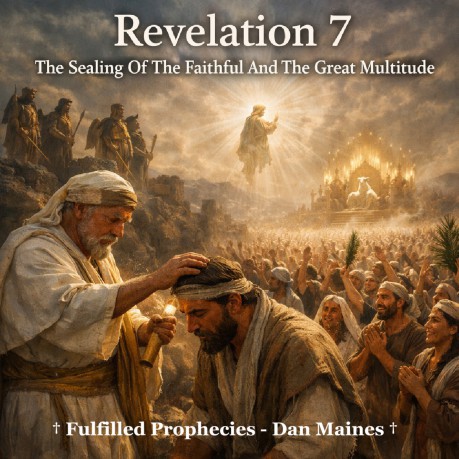
Revelation 7 The Sealing Of
The Faithful And The Great Multitude Introduction † Revelation 7 comes between the sixth and
seventh seals, and that pause matters. It answers the question raised
at the end of Revelation 6, who is able to stand. Revelation 7:1-3 † This pause between the sixth and seventh
seals shows God's mercy. Judgment is restrained until His servants
are marked for protection. Revelation 7:4 † The number 144,000 is symbolic, 12 x 12 x
1000, the fullness of covenant people. Revelation 7:5-8 † The listing is deliberate. Judah, the tribe
of Christ, comes first. Revelation 7:9-10 † The vision widens from the sealed remnant of
Israel to an innumerable multitude of Gentiles, showing covenant
expansion. Revelation 7:11-12 † The sevenfold doxology demonstrates fullness
of praise, as all creation joins in honoring God for salvation. Revelation 7:13-14 † The multitude came out of the great
tribulation, not a future one, but the tribulation of the first
century, which Jesus predicted would come upon that generation in
Matthew 24:21, 34. Revelation 7:15-17 † The promise is covenantal and realized in
Christ. The faithful are made His temple, as Paul says in 2
Corinthians 6:16. Historical References † Josephus recorded the horrific suffering in
Jerusalem during the Roman siege, confirming the severity of the
tribulation that fell on that generation (Josephus, Wars 6.9.4). How It Applies To Us Today † God knows His own and seals them. Our
security is in His ownership, not in worldly strength. Q & A Appendix Q Who are the 144,000 in Revelation 7? Q Is the great tribulation still future? Q Why does John first hear the number 144,000 but
then see a countless multitude? Q What do the white robes represent? Q Why are palm branches in their hands? Q Why are the servants of God sealed on their
foreheads? A The seal represents ownership and protection.
Just as the righteous were marked before Jerusalem's earlier judgment
in Ezekiel 9:4-6, God's servants in Revelation are identified as
belonging to Him before judgment falls. This shows that the Lord
preserves His faithful people even when covenant judgment unfolds. Q Why are there two groups mentioned, the 144,000
and the great multitude? A The vision presents the same redeemed people
from two perspectives. John first hears the numbered remnant of
Israel, then sees the countless multitude from every nation. This
reflects the fulfillment of God's promise that the gospel would go
first to Israel and then to the nations (Romans 1:16; Acts 13:46). Q What does it mean that the Lamb will shepherd
them? A This fulfills Jesus' own promise that He is the
good shepherd who leads His sheep to life (John 10:11, 27-28). The
Lamb who was sacrificed now rules and guides His people, bringing
them to the springs of the water of life. Q Why is the throne of God central in this
vision? A The throne emphasizes that God reigns over both
judgment and redemption. Even while Jerusalem was facing destruction,
heaven's throne remained the center of authority and salvation (Psalm
103:19; Revelation 4:2-3). The redeemed stand before that throne
because Christ has brought them into God's presence. Q Are the 144,000 a literal group of Jews that
will appear in the future? A No. The number is symbolic and represents the
fullness of God's covenant people. Revelation consistently uses
symbolic numbers. The 144,000 is twelve times twelve times one
thousand, showing the complete people of God. John first hears the
number of the sealed remnant from Israel and then sees the great
multitude from every nation, showing the expansion of the covenant
people through Christ (Revelation 7:4, 9; Galatians 3:29). The vision
demonstrates that the true Israel of God is defined by faith in the
Messiah, not by physical descent (Romans 9:6-8). † This is the fulfilled perspective we proclaim at
Fulfilled Prophecies † Source Index † Revelation 7:1-17; Ezekiel 9:4-6; Matthew
24:21-22, 34; Romans 9:6-8; Romans 11:5; Galatians 3:29; Genesis
22:18; Leviticus 23:40; Zechariah 14:16; Isaiah 25:8; Isaiah 49:10;
Ezekiel 37:26-28; John 10:11; 2 Corinthians 6:16; Exodus 12:13;
Matthew 21:43 † Josephus, Wars 6.9.4; Tacitus, Histories
5.13; Eusebius, Ecclesiastical History 3.5; Chrysostom, Homilies on
Revelation
By Dan Maines
†
Before the next stage of judgment unfolds, God shows that His people
are known, marked, and preserved.
† This
chapter reveals both the faithful remnant of Israel and the great
multitude from the nations, showing the full reach of redemption in
Christ.
† From the fulfilled perspective,
this wasn't pointing to a distant future thousands of years later. It
was showing what God was doing in the first-century tribulation that
came upon that generation.
After this I saw four
angels standing at the four corners of the earth, holding back the
four winds of the earth, so that no wind would blow on the earth, or
on the sea, or on any tree. And I saw another angel ascending from
the rising of the sun, holding the seal of the living God, and he
called out with a loud voice to the four angels to whom it was
granted to harm the earth and the sea, saying, Do not harm the earth,
or the sea, or the trees until we have sealed the bond-servants of
our God on their foreheads.
† The imagery
recalls Ezekiel 9:4-6, where a mark protected the righteous in
Jerusalem before Babylon's judgment.
† This
seal wasn't physical but covenantal, showing ownership by God. The
sealing guaranteed preservation of the faithful remnant in the
first-century tribulation, consistent with Jesus' promise in Matthew
24:22 that for the sake of the elect those days will be cut short.
†
The winds being held back show that judgment never moves outside
God's authority. He controls its timing, scope, and purpose.
†
The bond-servants of God are identified before wrath is released,
proving that divine judgment never loses sight of divine mercy.
†
The language of sealing parallels the protection of Israel during the
Passover when the blood marked the houses so judgment would pass over
them (Exodus 12:13).
† This reinforces the
covenant pattern, God marks His people before judgment falls on the
rebellious system.
And I heard the number of
those who were sealed: 144,000, sealed from every tribe of the sons
of Israel.
† They
represent the faithful remnant of Israel preserved through the
judgment.
† Paul affirmed that not all Israel
is Israel, but only the remnant according to grace, Romans 9:6-8 and
Romans 11:5.
† This fits John's vision, which
identifies true Israel by faith in Christ, not by bloodline.
†
John heard the number, which stresses order, purpose, and divine
knowledge. God knew exactly who belonged to Him.
†
The fact that John heard the number but later saw an innumerable
multitude mirrors the pattern in Revelation 5 where John heard about
the Lion but saw the Lamb.
† This shows that
the sealed remnant and the great multitude are two perspectives of
the same redeemed covenant people.
From the tribe of Judah,
twelve thousand were sealed, from the tribe of Reuben twelve
thousand, from the tribe of Gad twelve thousand, from the tribe of
Asher twelve thousand, from the tribe of Naphtali twelve thousand,
from the tribe of Manasseh twelve thousand, from the tribe of Simeon
twelve thousand, from the tribe of Levi twelve thousand, from the
tribe of Issachar twelve thousand, from the tribe of Zebulun twelve
thousand, from the tribe of Joseph twelve thousand, from the tribe of
Benjamin twelve thousand were sealed.
† Dan is omitted,
likely because of its association with idolatry in Judges 18.
†
Ephraim is replaced by Joseph, yet Manasseh remains, showing
rearrangement of tribal identity in Christ.
†
The arrangement itself demonstrates this isn't about literal
genealogy but covenant representation.
† The
remnant Israel is redefined around the Messiah, a reality affirmed by
the apostles in Galatians 3:29.
† This tribal
order isn't accidental. It shows that covenant identity is now
centered in Christ and not merely in old tribal descent.
After these things I
looked, and behold, a great multitude which no one could count, from
every nation and all tribes, peoples, and languages, standing before
the throne and before the Lamb, clothed in white robes, and palm
branches were in their hands. And they cried out with a loud voice,
saying, Salvation belongs to our God who sits on the throne, and to
the Lamb.
† Both groups together fulfill
God's promise to Abraham, that all nations would be blessed in his
seed, Genesis 22:18.
† Palm branches
symbolize victory and celebration, recalling the Feast of Booths in
Leviticus 23:40.
† Zechariah 14:16 foresaw
the nations coming to worship the Lord, and here that covenant hope
is shown fulfilled in Christ.
† The white
robes show purity, acceptance, and victory before God.
†
Salvation belongs to God and to the Lamb, which means redemption is
entirely His work from beginning to end.
†
This multitude fulfills the promise that the kingdom would be taken
from unbelieving Israel and given to a people producing its fruit
(Matthew 21:43).
† The nations now stand
before the throne because the Messiah's kingdom has been established.
And all the angels were
standing around the throne and around the elders and the four living
creatures, and they fell on their faces before the throne and
worshiped God, saying, Amen, blessing, glory, wisdom, thanksgiving,
honor, power, and might, be to our God forever and ever. Amen.
†
Heaven responds to redemption with worship because the victory of the
Lamb is the center of God's revealed glory.
†
The angels, elders, and living creatures all fall before the throne,
showing that no creature stands above God's majesty.
†
Chrysostom observed that heaven's worship reveals God's universal
reign, not confined to Israel but extended to all nations in
Christ.
† The scene makes it clear that the
redemption of the saints is no small event. It is celebrated in
heaven itself.
Then one of the elders
responded, saying to me, These who are clothed in the white robes,
who are they, and where have they come from? I said to him, My lord,
you know. And he said to me, These are the ones who come out of the
great tribulation, and they have washed their robes and made them
white in the blood of the Lamb.
† Josephus records
unparalleled suffering in Jerusalem during AD 66-70 in Wars 6.9.4,
aligning with Jesus' prophecy of the great tribulation.
†
Tacitus also recorded the devastation of Judea during the Roman war,
confirming the catastrophic nature of that conflict (Tacitus,
Histories 5.13).
† Their robes are white, not
from personal works, but through the cleansing blood of Christ.
†
This is proof of justification by grace. The Lamb's sacrifice is what
made them clean.
† The elder's question draws
attention to the identity of the redeemed so the reader understands
that tribulation did not defeat them, it brought them through into
victory.
For this reason they are
before the throne of God, and they serve Him day and night in His
temple, and He who sits on the throne will spread His tabernacle over
them. They will no longer hunger nor thirst, nor will the sun beat
down on them, nor any scorching heat, for the Lamb in the center of
the throne will be their shepherd, and will guide them to springs of
the water of life, and God will wipe every tear from their eyes.
† He spreads His tabernacle
over them, fulfilling the Feast of Tabernacles in its spiritual
sense.
† This language echoes Isaiah 49:10
and Isaiah 25:8, promises of restoration for God's people, which find
their fulfillment in Christ and His church.
†
The Lamb as Shepherd fulfills John 10:11, guiding His flock to living
waters.
† The wiping of tears isn't deferred
for thousands of years, but begins in the new covenant relationship,
fully realized in the overthrow of the old system that persecuted the
saints.
† The promise that God would dwell
with His people fulfills the prophetic expectation that the Lord
would return to dwell among His people after judgment and restoration
(Ezekiel 37:26-28).
† In Christ, God's
presence is no longer confined to a physical temple but resides with
His people.
†
Tacitus described the devastation of Judea during the Roman campaign,
confirming the historical reality of the tribulation surrounding
Jerusalem's fall (Tacitus, Histories 5.13).
†
Eusebius wrote that the believers fled Jerusalem before its
destruction, showing that Christ preserved His people just as He
promised.
† Chrysostom emphasized the
universal worship of God, showing that the praise surrounding the
throne belongs to the full redeemed people of God in Christ.
†
The remnant of Israel and the multitude of Gentiles together form the
one people of God, proof that the promises are fulfilled in Christ.
†
The great tribulation already proved God's word true, and now we live
in the age of His tabernacle presence.
† We
are called to serve as His temple, to worship in victory, and to
trust the Lamb who shepherds us to living waters.
†
Revelation 7 reminds us that judgment doesn't overturn God's
promises. It confirms them.
† We don't live
waiting for God to gather His people. In Christ, He already has, and
He continues to bring His people into the blessing of the fulfilled
kingdom.
A
They represent the symbolic fullness of the faithful remnant of
Israel preserved by God during the time of judgment. Paul explained
that there is a remnant according to grace and that not all who are
descended from Israel belong to Israel (Romans 9:6-8; Romans 11:5).
A
No. Jesus said it would occur in that generation (Matthew 24:21, 34).
The destruction of Jerusalem in AD 70 matches that prophecy and is
recorded by historians like Josephus and Tacitus.
A Revelation
often presents a truth in two ways. John hears the number of the
covenant remnant and then sees the full redeemed people from all
nations, showing the fulfillment of God's promise to gather His
people through Christ.
A
They represent the righteousness given through the sacrifice of
Christ. The redeemed stand before God because they have been washed
in the blood of the Lamb (Revelation 7:14; Romans 5:9).
A
Palm branches symbolize victory and covenant celebration. They
connect to the Feast of Booths and reflect the triumph of God's
redeemed people before His throne (Leviticus 23:40).
© Fulfilled Prophecies - Dan
Maines.
Links