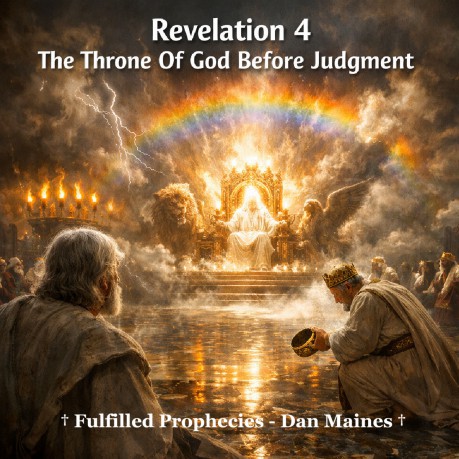
Revelation 4 The Throne Of
God Before Judgment Introduction † Revelation 4 shifts the scene from the
churches on earth to the throne of God in heaven. The purpose of this
vision wasn't to show believers escaping history, it was to show that
the coming judgment against Jerusalem and the old covenant order was
under God's authority (Revelation 1:1; Matthew 24:34). † The persecuted churches in Asia were about to
face intense turmoil. Christ opened heaven to John so the church
could see that God was still ruling. No empire, priesthood, or
persecutor could stop what God had already decreed. † Everything John sees in this chapter prepares
us for the judgments that unfold in the following chapters. Before
the seals are opened and before the trumpets sound, we are shown the
throne. Judgment in Revelation never comes from chaos, it comes from
the throne of God. † The fulfilled perspective recognizes that
these visions were written to real churches facing real events that
would unfold in their generation (Revelation 22:6, 10). † Revelation itself emphasizes the nearness of
these events. The prophecy was about things that must soon take place
and the time was near for those who first received the book
(Revelation 1:1, 3). Revelation 4:1 After these things I looked, and behold, a door standing open in
heaven, and the first voice which I had heard, like the sound of a
trumpet speaking with me, said, Come up here, and I will show you
what must take place after these things. † The phrase after these things connects this
vision to the letters of Revelation chapters 2 and 3. After
addressing the churches, Christ now reveals the heavenly courtroom
where the coming judgments are authorized. † The open door in heaven shows that John was
allowed to see God's perspective on events about to unfold. Heaven
isn't distant from earthly events, it governs them (Daniel 7:9-10). † The trumpet voice recalls Sinai where God
spoke with thunder and trumpet sounds. The same covenant God who
spoke at Sinai is now announcing the end of the covenant age (Exodus
19:16). † The statement what must take place shows
divine necessity. These events weren't symbolic of distant ages, they
were decreed by God and were about to unfold soon (Revelation 1:1). Revelation 4:2-3 Immediately I was in the Spirit; and behold, a throne was standing
in heaven, and someone was sitting on the throne. And He who was
sitting was like a jasper stone and a sardius in appearance; and
there was a rainbow around the throne, like an emerald in appearance. † Being in the Spirit means John was carried
into a prophetic vision similar to Isaiah and Ezekiel when they saw
God's throne (Isaiah 6:1; Ezekiel 1:26-28). † The throne is the central feature of the
vision. Before anything else is described, John sees the throne. This
emphasizes that God rules over history and judgment. † Jasper and sardius were precious stones
associated with brilliance and fire. They symbolize both the glory
and holiness of God. † The rainbow surrounding the throne recalls
the covenant promise after the flood. Even when judgment comes, God's
covenant mercy remains (Genesis 9:13). Revelation 4:4 Around the throne were twenty-four thrones; and upon the thrones I
saw twenty-four elders sitting, clothed in white garments, and golden
crowns on their heads. † The twenty-four elders represent the fullness
of God's covenant people. The number reflects the twelve tribes of
Israel and the twelve apostles (Matthew 19:28). † Their white garments symbolize righteousness
and victory given by God (Revelation 3:5). † The golden crowns show that the saints share
in Christ's reign, yet their authority ultimately comes from God. † Victorinus of Pettau identified the elders as
the patriarchs and apostles together, showing the completeness of
God's redeemed people. Revelation 4:5 Out from the throne came flashes of lightning and sounds and peals
of thunder. And there were seven lamps of fire burning before the
throne, which are the seven Spirits of God. † Lightning and thunder echo the appearance of
God at Mount Sinai when the covenant was given (Exodus 19:16). † The imagery shows that the coming judgments
originate from the same covenant God who established Israel. † The seven lamps represent the fullness and
perfection of the Holy Spirit (Isaiah 11:2). † The heavenly lampstand reminds us that the
earthly temple was only a shadow of the true heavenly reality
(Hebrews 8:5). Revelation 4:6-7 And before the throne there was something like a sea of glass,
like crystal; and in the center and around the throne, four living
creatures full of eyes in front and behind. The first creature was
like a lion, and the second creature like a calf, and the third
creature had a face like that of a man, and the fourth creature was
like a flying eagle. † The sea of glass reflects the bronze sea in
Solomon's temple which symbolized purification before approaching God
(1 Kings 7:23). † In heaven the sea appears calm and crystal
clear, showing that God's presence is perfect order and holiness. † The four living creatures resemble the
cherubim in Ezekiel's vision who guarded the presence of God (Ezekiel
1:5-10). † The four forms represent the fullness of
creation, wild animals, domesticated animals, humanity, and birds,
all acknowledging God's authority. † Jewish writings from the Second Temple period
and the Dead Sea Scrolls describe similar heavenly beings, showing
that this imagery was familiar to the first-century audience. Revelation 4:8 And the four living creatures, each one of them having six wings,
are full of eyes around and within; and day and night they do not
cease to say, Holy, holy, holy is the Lord God, the Almighty, who was
and who is and who is to come. † The six wings connect these creatures to the
seraphim described in Isaiah's throne vision (Isaiah 6:2-3). † The repeated declaration holy, holy, holy
emphasizes the absolute purity and perfection of God. † The phrase who was and who is and who is to
come proclaims God's eternal nature. † While empires rise and fall, God remains the
same sovereign ruler over all creation (Psalm 90:2). Revelation 4:9-11 And when the living creatures give glory, honor, and thanks to Him
who sits on the throne, to Him who lives forever and ever, the
twenty-four elders will fall down before Him who sits on the throne,
and they will worship Him who lives forever and ever, and they will
throw their crowns before the throne, saying, Worthy are You, our
Lord and our God, to receive glory and honor and power; for You
created all things, and because of Your will they existed, and were
created. † The elders casting their crowns shows that
all authority ultimately belongs to God. † Even those who reign with Christ acknowledge
that their authority comes from Him (Romans 11:36). † The declaration worthy are You affirms that
God alone deserves worship because He is the Creator of all things. † Chrysostom observed that the worship
described in heaven reveals the pattern for worship on earth. Historical References † Victorinus of Pettau wrote that the
twenty-four elders represent the patriarchs and apostles together,
showing the unity of God's covenant people. † Irenaeus explained that John's heavenly
visions reveal the divine order behind earthly events. † Eusebius recorded that early Christians saw
the fall of Jerusalem as fulfillment of Christ's prophetic warnings. † Tertullian wrote that Christ reigns from the
heavenly throne even while earthly kingdoms rage. † Clement of Alexandria wrote that Revelation
reveals divine realities governing earthly history and the judgment
of the old covenant order. † Lactantius explained that the heavenly
worship scenes demonstrate God's authority over kings and nations. How It Applies To Us Today † The throne in heaven reminds us that God
still rules over history. Nations rise and fall, but God's throne
remains (Psalm 103:19). † Worship connects earth with heaven. When
believers gather to worship, we join the same praise that fills
heaven. † The elders casting their crowns reminds us
that every success and blessing ultimately belongs to God. † The holiness of God calls us to live lives of
reverence, knowing the One who sits on the throne is the One who
redeemed us. Q & A Appendix Q: What does the open door in heaven represent in
Revelation 4:1? Q: Who are the twenty-four elders described in
Revelation 4:4? Q: Why are lightning and thunder seen around
God's throne? Q: Why do the elders cast their crowns before the
throne? Q: Why does Revelation begin with a throne scene
before the judgments unfold? Q: What does the sea of glass before the throne
represent? Q: Why was John told to come up into heaven to
see the vision? Q: Why do the living creatures constantly
proclaim God's holiness? Q: Why is God called the One who was and who is
and who is to come? Q: Why is the throne the first thing John sees in
heaven? Q: Does Revelation 4:1 teach a future rapture of
the church? Q: Why are the twenty-four elders already crowned
and seated before the judgments begin? Q: Do the twenty-four elders prove the church is
already in heaven after Revelation 4? † This is the fulfilled perspective we proclaim at
Fulfilled Prophecies † Source Index † Revelation 4; Genesis 9:13; Exodus 19:16;
Isaiah 6:1-3; Ezekiel 1:5-10; Daniel 7:9-10; Matthew 19:28; Romans
11:36; Psalm 103:19; Revelation 1:1, 3; Revelation 3:5; Revelation
22:6, 10 † Victorinus of Pettau, Commentary on the
Apocalypse; Irenaeus, Against Heresies; Eusebius, Ecclesiastical
History; Tertullian, Against Marcion; Clement of Alexandria,
Stromata; Lactantius, Divine Institutes; Chrysostom, Homilies on
Revelation
By Dan Maines
A: The open door shows that
John was allowed to see the heavenly perspective behind earthly
events that were about to unfold in his generation (Revelation 1:1;
Revelation 22:6).
A: They represent the complete
covenant people of God, the twelve tribes of Israel and the twelve
apostles, symbolizing the unity of God's redeemed people (Matthew
19:28; Ephesians 2:19-20).
A: These signs echo God's
appearance at Mount Sinai when the covenant was established, showing
that the same God who gave the covenant was bringing its judgment
(Exodus 19:16; Hebrews 12:18-24).
A: The crowns represent authority and
victory given by God. Casting them before the throne acknowledges
that all authority belongs to Him alone (Romans 11:36; 1 Corinthians
8:6).
A: The throne
vision establishes that all judgments come from God's authority.
Nothing in Revelation happens outside His sovereign rule (Daniel
7:9-10; Revelation 5:1).
A: It reflects temple imagery of
purification and separation before approaching God. Through Christ
believers now approach God's presence with confidence (1 Kings 7:23;
Hebrews 10:19-22).
A: John wasn't physically taken
to heaven. He was shown the heavenly perspective behind earthly
events. God was revealing that the coming judgments were decreed from
His throne (Revelation 4:1-2; Daniel 7:9-10).
A: The repeated
declaration holy, holy, holy emphasizes the absolute purity and
authority of God. Creation continually acknowledges the holiness of
the One who sits on the throne (Isaiah 6:3; Revelation 4:8).
A: This phrase emphasizes
God's eternal nature. While earthly kingdoms change and pass away,
God remains the unchanging ruler over all history (Psalm 90:2;
Revelation 1:8).
A: The throne shows that God is
sovereign over everything that follows in the book. The seals,
trumpets, and judgments all proceed from the authority of the One
seated on the throne (Revelation 4:2; Revelation 5:1).
A: No. The command Come up here was
given to John alone so he could see the heavenly vision. The text
never says the church was raptured. John was simply shown the
heavenly perspective behind events that were about to happen in his
generation (Revelation 1:1; Revelation 4:1-2; Revelation 22:6).
A: The
elders represent the completed covenant people of God, the twelve
tribes and the twelve apostles. Their crowns and thrones show that
God's redeemed people already share in Christ's reign before the
judgment of the old covenant system (Matthew 19:28; Ephesians
2:19-20; Revelation 3:21).
A: No.
The elders symbolize the complete covenant people of God, represented
by the twelve tribes of Israel and the twelve apostles. Their
presence around the throne reflects the unity of God's redeemed
people, not a secret removal of the church from earth. The churches
are still addressed throughout Revelation and believers are still
seen suffering persecution on earth during the visions (Revelation
7:14; Revelation 13:7; Revelation 14:12).
© Fulfilled Prophecies - Dan
Maines.
Links