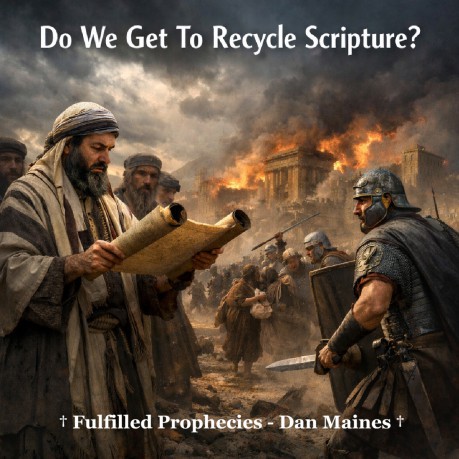
Do
We Get To Recycle Scripture? Introduction † Many people
approach the Bible as if prophecy is something that must keep
repeating itself generation after generation. If a prophecy sounds
dramatic or frightening, many assume it must apply to their own time.
But that approach ignores the most basic rule of interpretation,
audience relevance. When God spoke to people in scripture, He spoke
to real people who were alive at that time. † If the Bible
clearly records a prophecy and then history confirms its fulfillment,
we don't have the right to recycle that prophecy and assign it to
another future generation. When we do that, we turn fulfilled
prophecy into endless speculation. Scripture wasn't written to be
recycled. It was written to be fulfilled. † The apostles
and prophets consistently taught that the events they were describing
were near in their own generation. History recorded by writers like
Josephus, Tacitus, and Eusebius confirms that these things actually
happened. When scripture and history agree, the responsible thing to
do is accept the fulfillment rather than invent a future repetition. † The question
we must ask is simple. When Jesus spoke about events happening soon,
near, and within that generation, did He mean what He said? Or are we
supposed to reinterpret those words to mean thousands of years later? 1 Corinthians 10:11
Now these things happened to them as an example, and they were
written for our instruction, upon whom the ends of the ages have
come.
† Paul plainly
told the Corinthians that they were living at the end of the ages. He
didn't say the end of the ages would come thousands of years later.
He said it had come upon them. This shows that the transition between
the Old Covenant age and the New Covenant age was happening during
the lifetime of the first century church (1 Corinthians 10:11). † The phrase
ends of the ages refers to the conclusion of the Old Covenant system
centered on the temple, priesthood, and sacrifices. That system was
still standing when Paul wrote these words, but it was about to pass
away in the coming judgment upon Jerusalem (Hebrews 8:13). † This is why
the New Testament repeatedly speaks of the time being short and the
end being near. The writers weren't mistaken. They were describing
events that would climax in the destruction of Jerusalem in AD 70
(James 5:8; 1 Peter 4:7). Revelation 1:1 The Revelation of Jesus Christ, which
God gave Him to show to His bond-servants, the things which must soon
take place; and He sent and communicated it by His angel to His
bond-servant John,
† The book of
Revelation opens by declaring that the events in the vision would
shortly come to pass. Shortly cannot honestly mean thousands of years
later. It meant what it said to the original audience. † The servants
who were being shown these things were the believers living at that
time. They were the ones who needed to understand the events that
were about to unfold. † The language
of imminence is repeated throughout Revelation, confirming that the
prophecy concerned events near to the time when John wrote the book
(Revelation 22:6, 10). Matthew 24:34
Truly I say to you, this generation will not pass away until all
these things take place.
† Jesus
couldn't have been clearer. He told His disciples that their
generation would not pass away until all the things He had just
described were fulfilled. The audience He was speaking to was
standing right in front of Him. † Many people
attempt to redefine the word generation so they can push the prophecy
thousands of years into the future. But throughout the Gospels the
word generation always refers to the people living at that time
(Matthew 23:36; Luke 11:50-51). † When
Jerusalem and the temple were destroyed in AD 70, that event
fulfilled the warnings Jesus gave in the Olivet Discourse. The
disciples asked when these things would happen, what would be the
sign of His coming, and the end of the age. Jesus answered their
question directly, and history confirms that it happened within that
generation (Matthew 24:3). Matthew 16:27-28 For the Son
of Man is going to come in the glory of His Father with His angels,
and will then repay every
person according to his deeds. "Truly I say to you, there are
some of those who are standing here who will not taste death until
they see the Son of Man coming in His kingdom." † Jesus told
the men standing there that some of them would still be alive when
His coming took place. That statement cannot be stretched thousands
of years into the future. † This proves
that the coming Jesus was referring to was something that would
happen within the lifetime of His disciples. † This
statement agrees perfectly with His words in the Olivet Discourse
that their generation would not pass away until those events were
fulfilled (Matthew 24:34). Luke 21:20-22 "But when you
see Jerusalem surrounded by armies, then recognize that her
desolation is near. Then those who are in Judea must flee to the
mountains, and those who are inside the city must leave, and those
who are in the country must not enter the city; because these are
days of punishment, so that all things which have been written will
be fulfilled.
† Jesus gave a
very specific warning. When the disciples saw Jerusalem surrounded by
armies, they were to flee to the mountains. This instruction only
makes sense for people living in the first century. † The Roman
armies under General Titus surrounded Jerusalem in AD 70 exactly as
Jesus described. The Jewish historian Josephus recorded the siege,
the famine, and the destruction of the temple in great detail. † Jesus also
said that during this war all things which are written would be
fulfilled. That means the prophecies concerning judgment upon Old
Covenant Jerusalem reached their climax in that generation (Daniel
9:26-27). Colossians 1:23
if indeed you continue in the faith firmly established and steadfast,
and not shifting from the hope of the gospel that you have heard,
which was proclaimed in all creation under heaven, and of which I,
Paul, was made a minister.
† Many modern
teachers claim the end cannot come until the gospel is preached
throughout the entire planet. But Paul said that in his own lifetime
the gospel had already been proclaimed in all creation under heaven. † The word
world in the New Testament often referred to the Roman Empire, the
known world of that time. Luke uses this same language when he
described the decree from Caesar Augustus that all the world should
be registered (Luke 2:1). † The apostles
understood that their mission had spread throughout the Roman world
before the destruction of Jerusalem. Romans 10:18 But I say,
surely they have never heard, have they? On the contrary: "Their
voice has gone out into all the earth, † Paul again
confirms that the gospel message had already spread throughout the
world of that time. † This
fulfills the statement Jesus made that the gospel would be preached
in the whole world before the end of the age came (Matthew 24:14). † The end of
the age therefore refers to the end of the Old Covenant age, not the
destruction of the physical planet. Hebrews 8:13
When He said, "A new covenant," He has made the first
obsolete. But whatever is becoming obsolete and growing old is about
to disappear.
† When the
book of Hebrews was written, the Old Covenant system was still
standing but it was about to disappear. † The temple,
priesthood, and sacrifices were about to vanish when Jerusalem was
destroyed in AD 70. † This
confirms that the transition between the Old Covenant age and the New
Covenant age was happening in the first century. Ecclesiastes 1:4
A generation goes and a generation comes, † Scripture
clearly states that the earth remains forever. This contradicts the
modern idea that the physical planet will be destroyed at the end of
time. † When the
Bible speaks about heaven and earth passing away, it often refers to
the removal of a covenantal system rather than the destruction of the
physical universe (Isaiah 51:15-16). † Understanding
the symbolic language of scripture prevents us from creating
imaginary future disasters that the Bible never intended to describe. Revelation 11:8
And their dead bodies will lie on the street of the great city which
spiritually is called Sodom and Egypt, where also their Lord was
crucified.
† Revelation
identifies the great city symbolically as Sodom and Egypt, the place
where the Lord was crucified. That location can only be Jerusalem. † The prophets
had long used the name Sodom to describe the corruption of Jerusalem
because of its rebellion against God (Isaiah 1:9-10). † When
Revelation later describes the fall of Babylon, it is describing the
judgment of Old Covenant Jerusalem for rejecting Christ and
persecuting the prophets and apostles (Revelation 18:24). Luke 13:33
Nevertheless I must go on My journey today and tomorrow and the next
day; for it cannot be that a prophet would perish outside Jerusalem.
† Jesus
clearly said that prophets are killed in Jerusalem. † Revelation
later says Babylon was guilty of the blood of prophets and saints
(Revelation 18:24). † That
connection makes it clear that the judgment described in Revelation
concerns Jerusalem. Revelation 22:6
And he said to me, "These words are faithful and true"; and
the Lord, the God of the spirits of the prophets, sent His angel to
show His bond-servants the things which must soon take place.
† The book of
Revelation closes the same way it begins, by declaring that the
events would shortly take place. † Shortly come
to pass cannot honestly be stretched into thousands of years. † The
consistent time statements throughout the New Testament confirm that
the prophetic events were approaching in the first century. Historical References † Josephus
recorded the siege of Jerusalem and the destruction of the temple in
AD 70 in Wars of the Jews. † Tacitus
described the devastation of Judea and the destruction of Jerusalem
during the Jewish War. † Eusebius
recorded that the Christians in Jerusalem fled to the mountains
before the destruction of the city, remembering the warning of Jesus. How It Applies To Us
Today † Understanding
fulfilled prophecy frees believers from the constant fear that the
world is about to end. † Christ's
kingdom isn't waiting to begin. It was established when the Old
Covenant age came to its end. † Fulfilled
prophecy strengthens our confidence in scripture because God
fulfilled His promises exactly when He said He would. Q & A Appendix Q:
Didn't Jesus say the gospel must be preached to the whole world
before the end? A:
Yes, and the apostles said that had already happened in their
lifetime (Colossians 1:23; Romans 10:18). Q:
What does Jesus mean when He says this generation will not pass away? A:
The word generation refers to the people living at that time. Jesus
was speaking about the generation of His disciples (Matthew 24:34;
Matthew 23:36). Q:
Does the Bible teach that the earth will be destroyed? A:
No. Scripture repeatedly says the earth remains forever (Ecclesiastes
1:4; Psalm 104:5). Q:
If the Olivet Discourse was fulfilled in the first century, why do
people still believe it is future? A:
Because many teachers ignore the audience Jesus was speaking to. The
disciples asked when these things would happen, and Jesus answered
them directly. He said their generation would not pass away until all
these things were fulfilled (Matthew 24:3, 34). When interpreters
ignore audience relevance, prophecy gets pushed into future centuries
where it was never intended to go. Q:
What about the phrase heaven and earth will pass away? A:
That phrase is covenant language used throughout the Old Testament.
It often refers to the passing of a covenantal order, not the
destruction of the physical universe. The Old Covenant system
centered on the temple was about to pass away in the first century
(Hebrews 8:13; Isaiah 51:15-16). Q:
If the end of the age happened in AD 70, what age ended? A:
The Old Covenant age ended. That age was centered on the temple,
sacrifices, and the Levitical priesthood. When the temple was
destroyed in AD 70, that system came to its final end exactly as
Jesus warned (Matthew 24:1-3; Hebrews 9:8-10). Q:
Why do many churches keep teaching that the end of the world is near? A:
Many traditions reinterpret the time statements of scripture. Words
like soon, near, quickly, and generation are often redefined to mean
thousands of years. But the original readers understood those words
in their normal meaning, referring to events that were approaching in
their lifetime (Revelation 1:1; James 5:8). Q:
If prophecy was fulfilled, why does the Bible still matter today? A:
Fulfilled prophecy proves the reliability of scripture. God said
certain things would happen within that generation, and they did.
Instead of waiting for repeated fulfillments, we can see the
faithfulness of God in keeping His word exactly as promised (Luke
21:22; Matthew 24:34). Q:
What about 2 Peter 3 where people say the world will be burned up? A:
Peter was warning about the coming judgment that was approaching in
his own generation. He said the last days mockers were already
present and questioning the promise of His coming (2 Peter 3:3-4).
Peter also said the day of the Lord would come like a thief, the same
language Jesus used when speaking about the judgment on Jerusalem
(Matthew 24:42-43). The passing of the heavens and earth refers to
the removal of the Old Covenant system, just as the prophets used the
same language when describing covenant judgments in the Old Testament
(Isaiah 34:4; Hebrews 12:26-28). Q:
What about the Mark of the Beast, isn't that something in our future? A:
The mark of the beast belonged to the first century Roman world. The
beast represents the Roman Caesar, and the mark refers to allegiance
to the imperial system that controlled buying and selling. During the
reign of Nero and the Roman persecutions, citizens often had to show
loyalty to Caesar in order to participate in commerce. Revelation
itself says these events concerned things that were about to take
place soon (Revelation 1:1; Revelation 13:16-18). The mark was part
of the first century conflict between the Roman Empire and the early
church. † This is the fulfilled
perspective we proclaim at Fulfilled Prophecies † Source Index † 1
Corinthians 10:11; Revelation 1:1; Matthew 24:3, 34; Matthew
16:27-28; Luke 21:20-22; Colossians 1:23; Romans 10:18; Hebrews 8:13;
Ecclesiastes 1:4; Revelation 11:8; Luke 13:33; Revelation 22:6 † Josephus,
Wars of the Jews Book 6; Tacitus, Histories 5.13; Eusebius,
Ecclesiastical History 3.5
By Dan Maines
And
their words to the ends of the world."
But the earth remains
forever.
©
Fulfilled Prophecies - Dan Maines.
Links