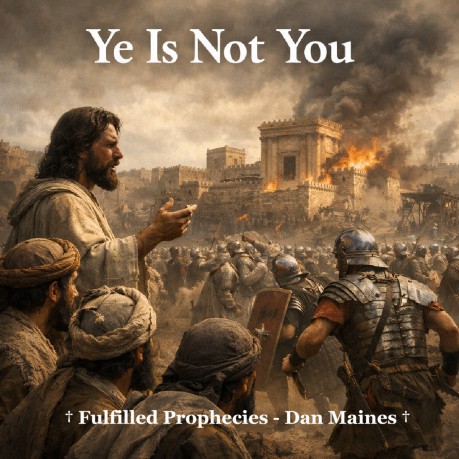
Ye Is Not You Introduction † One of the biggest mistakes people make when
reading the Bible is assuming every statement is spoken directly to
them personally. When we ignore the language used in the text, we can
easily misunderstand who the audience actually was. † The English language used to distinguish
between singular and plural pronouns. Today modern English mostly
uses the single word you for both one person and a group, but older
English translations preserved an important distinction. † Words like thou, thee, thy referred to one
individual, while ye referred to more than one person. That
distinction helps us understand who Jesus was speaking to in many
passages. † When Jesus spoke about events that would
happen, He often used plural language directed at the people standing
in front of Him. If we erase that audience and replace them with
ourselves thousands of years later, we change the meaning of the
passage. † Understanding who ye refers to becomes
extremely important in passages like Matthew 24, where Jesus was
answering a direct question from His disciples about the destruction
of the temple. Matthew 5:14 Ye are the light of the world. A city set on a hill cannot be hid. † Jesus was speaking to the disciples gathered
around Him during the Sermon on the Mount. † The word ye clearly refers to the group
sitting there listening to Him. † No one reading this passage today thinks
Jesus was directly addressing them personally in that moment. † This shows how the word ye functions in
scripture, it points to the audience present when the words were
spoken. Matthew 13:11 And he answered and said unto them, Unto you it is given to know
the mysteries of the kingdom of heaven, but to them it is not given. † Jesus distinguishes between two groups, His
disciples and the crowds. † The pronoun you here represents the same
plural audience idea found in ye. † The disciples standing there were the ones
receiving the explanation. † This again shows that the language of the
Gospels constantly identifies the immediate audience. Matthew 23:29-31 Woe unto you, scribes and Pharisees, hypocrites! for ye build the
tombs of the prophets, and garnish the sepulchres of the righteous,
and say, If we had been in the days of our fathers, we should not
have been partakers with them in the blood of the prophets. Wherefore
ye witness to yourselves, that ye are sons of them that slew the
prophets. † Jesus repeatedly used ye while speaking
directly to the Pharisees standing before Him. † The audience is obvious and immediate. † No one assumes that Jesus was speaking to
people living thousands of years later in this rebuke. † This demonstrates that the pronoun ye
identifies the people being addressed at that moment. Matthew 26:31 Then saith Jesus unto them, All ye shall be offended in me this
night: for it is written, I will smite the shepherd, and the sheep of
the flock shall be scattered abroad. † Jesus said this directly to the disciples on
the night of His arrest. † The word ye refers to that group of men
sitting with Him. † The prophecy came true within hours when the
disciples fled. † This shows again that ye consistently refers
to the people present when Jesus was speaking. Luke 11:47-48 Woe unto you! for ye build the tombs of the prophets; and your
fathers killed them. So ye are witnesses and consent unto the works
of your fathers: for they killed them, and ye build their tombs. † Jesus used ye again when confronting the
religious leaders of His day. † The rebuke is directed toward the leaders
standing in front of Him. † This language would make no sense if it were
meant for some distant future audience. † The word ye always anchors the statement to
the people hearing it. Acts 1:11 Ye men of Galilee, why stand ye looking into heaven? this Jesus,
who was received up from you into heaven, shall so come in like
manner as ye beheld him going into heaven. † The angels addressed the men standing there
after Jesus ascended. † The phrase ye men of Galilee clearly refers
to the group physically present. † This is another example showing how ye
identifies a specific audience. † Scripture consistently uses ye when speaking
to a group standing in the scene. Matthew 24:15 When ye therefore shall see the abomination of desolation, which
was spoken of through Daniel the prophet, standing in the holy place
(let him that readeth understand) † Jesus did not say when someone in the distant
future sees it. He said when ye see it. † Ye refers directly to the group He was
speaking to, the disciples who asked the question. (Matthew 24:1-3) † The disciples had just pointed out the temple
buildings, and Jesus told them those buildings would be destroyed.
(Matthew 24:2) † The entire discussion centers on their temple
and their generation. † When Jesus said when ye see the abomination
of desolation, He was speaking to the same disciples standing there
listening. Matthew 24:16 then let them that are in Judaea flee unto the mountains † Jesus told them that when they saw these
events they were to flee Judea. † That instruction only makes sense to people
living in Judea at that time. † If the prophecy were about a distant future
antichrist, the command to flee Judea would make no sense. † The warning was meant for the people living
in that region in that generation. Luke 21:20 But when ye see Jerusalem compassed with armies, then know that
her desolation is at hand. † Luke explains the same prophecy using clearer
language. † The abomination of desolation is connected
with Jerusalem surrounded by armies. † Once again Jesus says ye see, meaning the
people He was speaking to would witness it. † The Roman siege of Jerusalem fulfilled
exactly what Jesus warned about. Luke 21:21-22 Then let them that are in Judaea flee unto the mountains, and let
them that are in the midst of her depart out, and let not them that
are in the country enter therein. For these are days of vengeance,
that all things which are written may be fulfilled. † Jesus again gives instructions to those
living in Judea. † The judgment was directed toward Jerusalem
and the surrounding region. † These were days of vengeance connected with
the fulfillment of prophecy. † The destruction of Jerusalem in AD 70 matched
these warnings precisely. Matthew 23:36 Verily I say unto you, All these things shall come upon this
generation. † Jesus clearly placed the coming judgment on
the generation He was speaking to. † This statement comes directly before the
prophecy of Matthew 24. † The context never changes the audience. † The same generation warned in Matthew 23 is
the generation that would see the events of Matthew 24. Matthew 24:34 Verily I say unto you, This generation shall not pass away, till
all these things be accomplished. † Jesus set a clear time limit for the
prophecy. † The generation living at that time would see
the fulfillment. † The repeated use of ye and this generation
connects the prophecy directly to the first century audience. † The destruction of Jerusalem in AD 70
fulfilled these words. Daniel 9:26 And after the threescore and two weeks shall the anointed one be
cut off, and shall have nothing, and the people of the prince that
shall come shall destroy the city and the sanctuary † Daniel foretold the destruction of Jerusalem
and the sanctuary. † Jesus referenced Daniel when warning about
the coming desolation. † The Roman armies were the people who
destroyed the city and the temple. † This prophecy was fulfilled when Jerusalem
fell in AD 70. Historical References † Josephus recorded the Roman siege of
Jerusalem and the destruction of the temple in great detail in The
Wars of the Jews. † His writings describe famine, internal
fighting, and the final burning of the temple. † Eusebius recorded that believers fled
Jerusalem before the destruction because they remembered Jesus
warning. † He explains that the Christians escaped to
Pella before the Roman armies destroyed the city. † Tacitus, the Roman historian, also recorded
the destruction of Jerusalem by the Roman armies. How It Applies To Us Today † Understanding the meaning of ye helps us read
scripture in its proper context. † It reminds us that many prophecies were
directed toward specific audiences in history. † Jesus words were fulfilled exactly as He said
they would be. † This strengthens our confidence in the
reliability of scripture. † When we read the Bible carefully and respect
its language, the meaning becomes much clearer. Q & A Appendix Q What does the word ye mean in the Bible? Q Why is this important for Matthew 24? Q Did those events actually happen in their
generation? Q Does this mean the prophecy has already been
fulfilled? Q Does the word ye ever refer to a single person
in the Bible? Q Why do modern readers often miss this
distinction? Q Does the word ye appear throughout the New
Testament? Q Why does this matter for interpreting
prophecy? † This is the fulfilled perspective we proclaim at
Fulfilled Prophecies † Source Index † Matthew 5:14; Matthew 13:11; Matthew
23:29-31, 36; Matthew 24:15-16, 34; Matthew 26:31; Luke 11:47-48;
Luke 21:20-22; Acts 1:11; Daniel 9:26
By Dan Maines
A
Ye is a plural pronoun that refers to more than one person. It
identifies the group being addressed in the conversation.
A
Because Jesus told the disciples that they would see the events He
described. The repeated use of ye shows the prophecy was directed
toward them.
A Yes. The Roman armies destroyed
Jerusalem and the temple in AD 70, fulfilling the warnings Jesus
gave.
A The destruction of Jerusalem
fulfilled the warnings Jesus gave to that generation about the coming
judgment on the city.
A No. In the language used by the
translators, ye always refers to more than one person. When the Bible
refers to one individual it uses thou, thee, thy, or thine. This
distinction helps identify who is being addressed. (Matthew 5:14;
Matthew 26:31)
A Because modern English uses the
word you for both singular and plural. Older English preserved the
difference, which helps us understand who the original audience was.
Recognizing this difference can clarify many passages in the Gospels.
A Yes. It appears repeatedly when
Jesus or others are addressing groups of people. Examples include the
disciples, religious leaders, or crowds listening to a teaching.
(Matthew 5:14; Luke 11:47; Acts 1:11)
A Because it helps identify the
intended audience. When Jesus said ye will see these things, He was
speaking to the people standing there. Ignoring that audience can
lead readers to move prophecies into a distant future even when the
text clearly identifies who would witness the events. (Matthew 24:15,
34)
© Fulfilled Prophecies - Dan
Maines.
†
Josephus, The Wars of the Jews, Book 6; Eusebius, Ecclesiastical
History 3.5; Tacitus, Histories 5.13
Links