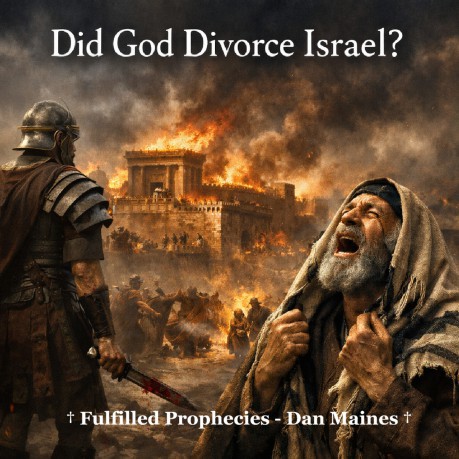
Did God Divorce Israel? Introduction † Many people read the Bible and assume that
God would never separate Himself from Israel under any circumstances.
But the scriptures themselves tell a different story. The prophets
warned repeatedly that covenant unfaithfulness would bring judgment,
separation, and even divorce. † The language of marriage between God and
Israel appears throughout the Old Testament. Israel was called the
bride of the LORD. But when she broke the covenant, worshiped idols,
persecuted the righteous, and rejected the Messiah, God declared that
the covenant relationship would come to an end. † This was not an emotional reaction. It was
covenant law. The Law of Moses already warned Israel what would
happen if she broke the covenant. The destruction of Jerusalem in AD
70 was not a random tragedy. It was the final covenant judgment that
ended the old covenant world. Jeremiah 3:8 Then I saw that for all the causes for which backsliding Israel
had committed adultery, I had put her away and given her a
certificate of divorce; yet her treacherous sister Judah did not
fear, but went and played the harlot also. † God Himself says He gave Israel a certificate
of divorce. This language comes directly from covenant law and
marriage law in Israel (Deuteronomy 24:1-4). It shows that the
relationship between God and Israel was structured like a covenant
marriage. † Israel committed spiritual adultery by
worshiping idols and rejecting God's commandments. The prophets
repeatedly called this adultery and harlotry (Isaiah 1:21; Ezekiel
16:15; Hosea 9:1). † Judah saw what happened to Israel in earlier
judgments but continued the same rebellion. Instead of learning from
Israel's fall, Judah followed the same path and would eventually face
the same covenant consequences. Isaiah 1:2 Hear, O heavens, and give ear, O earth! For the Lord has spoken: I
have nourished and brought up children, And they have rebelled
against Me † The phrase heavens and earth here is covenant
language. God was calling the covenant world of Israel to witness the
charges against His people. This same language appears in Deuteronomy
when God called heaven and earth as witnesses against Israel's
covenant violations (Deuteronomy 31:28). † This wasn't talking about the physical
universe being judged. It was the covenant world of Israel, the
temple system, the priesthood, and the law order that defined their
relationship with God. † When Jesus later spoke about heaven and earth
passing away, He was speaking about the end of that covenant world,
not the destruction of the physical planet (Matthew 24:34-35). Matthew 21:43 Therefore I say to you, the kingdom of God will be taken away from
you and given to a people producing its fruit. † Jesus said this directly to the religious
leaders of Israel. They were the caretakers of the covenant kingdom,
but they rejected the Son of God. † Because of that rejection, Jesus declared
that the kingdom would be taken away from them. This meant the temple
system, the priesthood authority, and the covenant privileges that
Israel had enjoyed. † The kingdom would instead be given to a new
covenant people, those who believed in Christ. This new covenant
community is the church, the body of Christ (Ephesians 2:19-22). Matthew 23:37-38 Jerusalem, Jerusalem, who kills the prophets and stones those who
have been sent to her! How often I wanted to gather your children
together, the way a hen gathers her chicks under her wings, and you
were unwilling. Behold, your house is being left to you desolate! † This statement is one of the clearest moments
where Jesus announces the coming covenant judgment on Jerusalem. The
city that once represented the dwelling place of God had become the
place that murdered the prophets and rejected the Messiah. † When Jesus says your house is being left to
you desolate, He is referring to the temple and the covenant system
centered in Jerusalem. The temple was called the house of God, but
because of Israel's rejection of Him, Jesus declared that it would be
abandoned and destroyed (Matthew 24:1-2). † This is the moment where the divorce language
of the prophets reaches its climax. God had already declared in
Jeremiah 3:8 that Israel would receive a certificate of divorce. Now
Jesus declares that the house of Israel is abandoned and about to be
judged. † Within one generation this prophecy was
fulfilled when the Roman armies destroyed Jerusalem and the temple in
AD 70, ending the old covenant order exactly as Jesus predicted (Luke
21:20-22). Luke 21:20-22 But when you see Jerusalem surrounded by armies, then recognize
that her desolation is near. † Jesus directly predicted the military
destruction of Jerusalem. This was not symbolic language. It was a
literal siege that would happen to that generation (Luke 21:32). † The phrase days of vengeance is covenant
judgment language that comes directly from the Law of Moses where God
warned Israel that rebellion would bring national destruction
(Deuteronomy 28:49-52). † Jesus said these events would fulfill all
things which are written. That includes the warnings of Moses, the
prophets, and Daniel's prophecy about the shattering of the power of
the holy people (Daniel 12:7). † The Roman armies surrounding Jerusalem in AD
66-70 were the historical fulfillment of this prophecy, exactly as
Jesus said it would happen. Hebrews 8:13 In that He says, A new covenant, He has made the first obsolete.
But whatever is becoming obsolete and growing old is ready to
disappear. † The writer of Hebrews clearly explains that
the old covenant was already obsolete in the first century. It was
aging and ready to disappear. † The temple was still standing when Hebrews
was written, but its days were numbered. Within a few years Jerusalem
and the temple would be destroyed in AD 70. † This disappearance was the visible end of the
covenant system that had governed Israel for centuries. Hebrews 9:26-28 Otherwise, He would have needed to suffer often since the
foundation of the world; but now once at the consummation of the ages
He has been revealed to put away sin by the sacrifice of Himself. † The writer says Christ appeared once at the
consummation of the ages. This refers to the end of the old covenant
age, the age governed by the Law of Moses. † The word once comes from the Greek word
hapax, which means once for all time. Christ's sacrifice was a
single, final act that would never need to be repeated (1 Peter 3:18;
Jude 3). † The second appearing mentioned here was
connected with salvation for those waiting for Him. Jesus had already
promised that this would happen within that generation (Matthew
16:27-28; Matthew 24:34). † That appearing in judgment during the
destruction of Jerusalem completed the transition from the old
covenant system into the fully revealed new covenant kingdom. Daniel 12:7 I heard the man dressed in linen, who was above the waters of the
river, as he raised his right hand and his left toward heaven, and
swore by Him who lives forever that it would be for a time, times,
and half a time; and as soon as they finish shattering the power of
the holy people, all these events will be completed. † Daniel was told that the fulfillment would
come when the power of the holy people was shattered. The power of
Israel was never military strength or political influence. † Their true power was their covenant
relationship with God through the Law of Moses and the temple system. † When the temple was destroyed in AD 70, that
covenant system ended permanently. The power of the old covenant
people was shattered exactly as Daniel was told. Revelation 21:1-3 Then I saw a new heaven and a new earth; for the first heaven and
the first earth passed away, and there is no longer any sea. † The new heaven and new earth represents the
new covenant order that replaced the old covenant world. The first
heaven and earth passed away when the temple system and covenant
order of Israel ended. † The New Jerusalem is clearly identified as a
bride prepared for her husband. This shows that the city is symbolic
of the covenant people of God, the church (Galatians 4:26; Hebrews
12:22-23). † God's dwelling place is now with His people
directly. No temple building is required because Christ Himself
brings God's presence to His people. Revelation 21:22 I saw no temple in it, for the Lord God the Almighty and the Lamb
are its temple. † This confirms that the new covenant order
does not operate through a physical temple system. † Under the old covenant, God's presence was
tied to the temple in Jerusalem. Under the new covenant, God's
presence is found in Christ and His people. † When the old temple was destroyed in AD 70,
it confirmed that the new covenant system had fully replaced the old
covenant temple order. Historical References † Josephus recorded that Jerusalem and the
temple were completely destroyed in AD 70, fulfilling the warnings
spoken by Jesus about that generation. † Eusebius recorded that Christians fled
Jerusalem before the destruction, recognizing that Jesus' prophecy
was being fulfilled. † Tertullian wrote that the old Jewish order
had passed away and the new covenant kingdom of Christ had taken its
place. How It Applies To Us Today † The end of the old covenant reminds us that
God keeps His promises and His warnings. When God says something will
happen, it will happen exactly as He said. † Salvation is not found in buildings, rituals,
or religious systems. It is found only in Christ. † We also learn something important about
judgment. Many people look down on others who have experienced
divorce, yet scripture itself shows that God divorced Israel because
of covenant unfaithfulness. † That should remind us not to judge others
harshly. Every situation has a story, and God Himself demonstrated
that divorce can occur when covenant faithfulness is broken. Q & A Appendix Q: Did God actually divorce Israel? Q: When did the final covenant judgment
happen? Q: Who is the bride of Christ now? Q: Does the church replace the temple? † This is the fulfilled perspective we proclaim at
Fulfilled Prophecies † Source Index † Jeremiah 3:8; Isaiah 1:2; Matthew 21:43;
Matthew 23:37-38; Luke 21:20-22; Hebrews 8:13; Hebrews 9:26-28;
Daniel 12:7; Revelation 21:1-3; Revelation 21:22 † Josephus, Wars of the Jews, Book 6; Eusebius,
Ecclesiastical History, Book 3, Chapter 5; Tertullian, Against the
Jews
By Dan Maines
Then those who are in Judea must
flee to the mountains, and those who are inside the city must leave,
and those who are in the country must not enter the city;
because
these are days of vengeance, so that all things which are written
will be fulfilled.
And
just as it is destined for people to die once, and after this comes
judgment,
so Christ also, having been offered once to bear the
sins of many, will appear a second time for salvation without
reference to sin, to those who eagerly await Him.
And
I saw the holy city, new Jerusalem, coming down out of heaven from
God, prepared as a bride adorned for her husband.
And I heard a
loud voice from the throne, saying, Behold, the tabernacle of God is
among the people, and He will dwell among them, and they shall be His
people, and God Himself will be among them
A:
Yes. Jeremiah 3:8 states that God gave Israel a certificate of
divorce because of covenant unfaithfulness.
A: The destruction of Jerusalem in AD
70 fulfilled the covenant warnings and ended the old covenant system
(Matthew 24:34; Daniel 12:7).
A:
The New Jerusalem, which represents the church, the people of God
under the new covenant (Revelation 21:2; Ephesians 5:25-27).
A:
Yes. The presence of God now dwells with His people through Christ,
not in a physical temple (Revelation 21:22; Ephesians 2:19-22).
© Fulfilled Prophecies - Dan
Maines.
Links