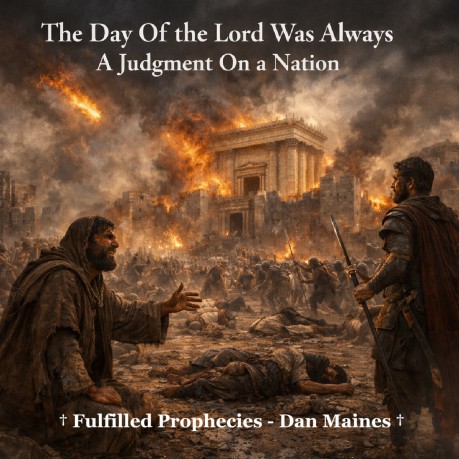
The
Day Of The Lord Was Always A Judgment On A Nation Introduction † If
we're going to settle this issue honestly, we must examine every
major Day of the Lord reference and identify who it was against and
when it occurred. Amos
5:18, 20
Woe to you who are longing for the day of the Lord, † This
Day of the Lord was against the northern kingdom of Israel. Zephaniah
1:14-15
The great day of the Lord
is near, † This
warning was against Judah and Jerusalem. Isaiah
13:6, 9-10
Wail, for the day of the Lord
is near! † This
Day of the Lord was against Babylon. Jeremiah
46:10
For that day belongs to the Lord God
of armies, † This
Day of the Lord was against Egypt. Ezekiel
30:3-4
For the day is near, † Ezekiel
confirms Egypt's Day of the Lord. Obadiah
1:15 "For the day
of the Lord is near for
all the nations. † This
refers specifically to Edom. Isaiah
34:4, 6
And all the heavenly lights will wear away,
The sword of the Lord
is filled with blood, † Here
the heavens are rolled together as a scroll. Genesis
37:9-10
Then he had yet another dream, and informed his brothers of it, and
said, "Behold, I have had yet another dream; and behold, the sun
and the moon, and eleven stars were bowing down to me." He also
told it to his father as well as to his brothers; and his father
rebuked him and said to him, "What is this dream that you have
had? Am I and your mother and your brothers actually going to come to
bow down to the ground before you?"
† Here
the sun, moon, and stars clearly represent Jacob, Rachel, and the
twelve tribes. Isaiah
14:12
How you have fallen from heaven, † Babylon's
king is described as falling from heaven. Matthew
24:29-30 "But
immediately after the tribulation of those days the
sun will be darkened,
and
the moon will not give its light,
and
the
stars will fall
from the sky, and the powers of the heavens will be shaken. And then
the sign of the Son of Man will appear in the sky, and then all the
tribes of the earth will mourn, and they will see the Son
of Man coming on the clouds of the sky
with power and great glory. † Jesus
uses the same prophetic language Isaiah used about Babylon and
Edom. Acts
2:20
The sun will be turned into
darkness † Peter
quotes Joel and applies it in the first century. 1
Thessalonians 5:2-3
For you yourselves know full well that the day of the Lord is coming
just like a thief in the night. While they are saying, "Peace
and safety!" then sudden destruction will come upon them like
labor pains upon a pregnant woman, and they will not escape.
† Paul
told them the Day of the Lord would come suddenly. 2
Peter 3:10 But the day of
the Lord will come like a thief, in which the heavens will pass away
with a roar and the elements will be destroyed with intense heat, and
the earth and its works will be discovered.
† Peter
wrote to first century believers. Matthew
24:34
Truly I say to you, this generation will not pass away until all
these things take place.
† Jesus
gave the time boundary. Historical
References † Samaria
fell to Assyria in 722 BC. How
It Applies To Us Today † It
teaches us to interpret prophetic language consistently. Q
& A Appendix Q
Did
any Old Testament Day of the Lord end the physical universe? Q
Did
the New Testament writers expect the Day of the Lord in their time? Q
Did
the sun, moon, and stars ever literally fall? Q
If
the Day of the Lord language is symbolic, why does it sound so
catastrophic? Q
What
about the heavens passing away in 2 Peter 3:10? Q
By Dan Maines
†
When
we do that, a consistent historical pattern emerges.
†
The
Day of the Lord was covenant judgment upon nations, not the end of
the physical universe.
†
The
prophetic language is dramatic, but the fulfillment was always
historical and identifiable.
For
what purpose will the day of the Lord
be to you?
It will be darkness and not light; Will the day of
the Lord not be
darkness instead of light,
Even gloom with no brightness in it?
†
It
was fulfilled in 722 BC when Assyria destroyed Samaria and carried
Israel into captivity.
†
The
language of darkness described national collapse, not cosmic
extinction.
Near and coming very quickly;
Listen, the day of
the Lord!
In it
the warrior cries out bitterly.
That day is a day of anger,
A
day of trouble and distress,
A day of destruction and
desolation,
A day of darkness and gloom,
A day of clouds
and thick darkness,
†
It
was fulfilled in 586 BC, sometimes dated 587 BC depending on
accession reckoning, when Babylon destroyed Jerusalem and the
temple.
†
Near
meant near, and history confirms it.
It will come as destruction from the Almighty.
Behold,
the day of the Lord is
coming,
Cruel, with fury and burning anger,
To make the
land a desolation;
And He will exterminate its sinners from
it.
For the stars of heaven and their constellations
Will
not flash their light;
The sun will be dark when it rises
And
the moon will not shed its light.
†
It
was fulfilled in 539 BC when Cyrus the Persian captured Babylon.
†
The
sun darkened and stars not shining described the fall of a kingdom,
not the destruction of the universe.
A day of vengeance, so as to avenge Himself on His
foes;
And the sword will devour and be satisfied,
And drink
its fill of their blood;
For there will be a slaughter for the
Lord God of armies,
In
the land of the north at the river Euphrates.
†
It
was fulfilled at the Battle of Carchemish in 605 BC when
Nebuchadnezzar defeated Pharaoh Necho II.
†
Later
Babylonian campaigns into Egypt occurred around 568 to 567 BC,
further confirming the judgment.
†
Again,
this was national devastation, not planetary destruction.
Indeed, the day of the Lord
is near;
It will be a day of clouds,
A time of doom for the
nations.
A sword will come upon Egypt,
And there will be
trembling in Cush;
When the slain fall in Egypt,
They will
take away her wealth,
And her foundations will be torn down.
†
It
unfolded during Babylon's later invasions around 568 to 567 BC.
†
The
prophetic imagery remained consistent with other national judgments.
Just as you have done, it will be done to
you.
Your dealings will return on your own head.
†
Edom's
downfall began in the 6th century BC following Babylon's destruction
of Jerusalem in 586 BC.
†
Their
power declined progressively and they were later absorbed
historically by surrounding peoples in the 5th to 4th centuries BC.
†
The
Day of the Lord here was retributive national judgment.
And the sky will be
rolled up like a scroll;
All its lights will also wither away
As
a leaf withers from the vine,
Or as one withers from the fig
tree.
It drips with fat, with the blood of lambs
and goats,
With the fat of the kidneys of rams.
For the
Lord has a sacrifice in
Bozrah,
And a great slaughter in the land of Edom.
†
Yet
the context clearly identifies Edom.
†
Even
universal sounding cosmic language was applied to specific historical
judgment.
†
This
confirms the prophetic pattern.
†
They
symbolize ruling authority within Israel.
†
The
imagery is political and covenantal, not astronomical.
†
Notice
the sun, moon, and stars never literally fell in Israel's history,
yet their national authority structures collapsed.
You star of the morning, son of
the dawn!
You have been cut down to the earth,
You who
defeated the nations!
†
This
is symbolic language for the fall of a ruler, not a literal star
falling from space.
†
Heaven
language consistently describes authority and covenant standing.
†
He
applies it to Jerusalem.
†
This
Day of the Lord was fulfilled in AD 70 when Rome destroyed Jerusalem
and the temple.
†
The
collapse of the covenant world of Israel is described in cosmic terms
consistent with the prophets.
And the
moon into blood,
Before
the great and glorious day of the Lord comes.
†
The
Day of the Lord expectation was active in their lifetime.
†
It
was not postponed thousands of years into the future.
†
It
involved destruction that they would not escape.
†
This
aligns with the judgment that fell upon Jerusalem within that
generation.
†
He
warned of scoffers in their last days, 2 Peter 3:3.
†
The
passing of heaven and earth echoes Jesus' words in Matthew 24:35.
†
This
was fulfilled in the covenantal collapse of Jerusalem in AD 70.
†
Every
prior Day of the Lord was national judgment within history.
†
The
New Testament Day of the Lord follows the exact same prophetic
pattern.
†
Jerusalem
fell to Babylon in 586 BC, sometimes dated 587 BC depending on
accession reckoning.
†
Babylon
fell to Cyrus the Persian in 539 BC.
†
Egypt
was decisively defeated at Carchemish in 605 BC and later invaded by
Babylon around 568 to 567 BC.
†
Edom
declined following the 6th century BC Babylonian period and was later
absorbed historically.
†
Jerusalem
and the temple were destroyed by Rome in AD 70.
†
Josephus
recorded the AD 70 destruction in Wars of the Jews Book 6.
†
Eusebius
recorded the Christian flight from Jerusalem, Ecclesiastical History
Book 3.
†
Tacitus
described the devastation of Judea, Histories 5.13.
†
It
proves that near meant near in every historical case.
†
It
confirms that Jesus kept His word within the generation He
specified.
†
It
removes fear driven speculation about the destruction of the physical
universe.
†
It
anchors us in the fulfilled kingdom reality Christ established.
A
No.
Amos 5:18, Zephaniah 1:14-15, Isaiah 13:6, Jeremiah 46:10, Ezekiel
30:3-4, Obadiah 1:15, and Isaiah 34:4, 6 all describe historical
national judgments.
A
Yes.
Acts 2:20, 1 Thessalonians 5:2-3, Matthew 24:34, and 2 Peter 3:10
place the expectation within the first century.
A
No.
Genesis 37:9-10 and Isaiah 14:12 show that this imagery represents
ruling authority and covenant standing, not literal astronomical
collapse.
A
Because
prophetic judgment language always uses cosmic imagery to describe
the fall of nations. Isaiah 13:6, 9-10 and Isaiah 34:4 use the same
catastrophic language for Babylon and Edom, yet history confirms
those were national collapses, not universal destruction.
A
Jesus
tied heaven and earth to the Law in Matthew 5:18 and said heaven and
earth would pass away in His generation in Matthew 24:34-35. Peter's
language reflects the covenantal collapse of that old order in AD 70.