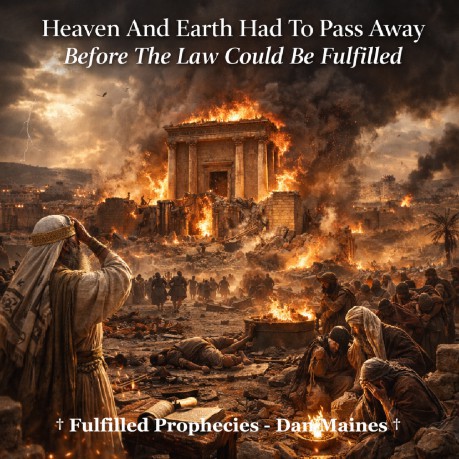
Heaven
And Earth Had To Pass Away Before The Law Could Be Fulfilled Introduction † A lot of
people don't
know what Heaven and Earth are, so we must let the Bible tell us its
definition, not a 21st century dictionary. Matthew
5:17 † Jesus said
He came to fulfill the law and the prophets, not to destroy them. Matthew
5:18 † Jesus said
the law would not pass until heaven and earth passed, and until all
things were accomplished, that connects the passing of heaven and
earth with the fulfillment of the law. Matthew
24:35 † Jesus was
speaking to first century Jews about their temple, their city, and
their generation, Matthew 24:34.
Hebrews 8:13 † The writer
explains that heaven and earth would be shaken and removed. If you want to know what a term means
in the New Testament in relation to prophecy, you need to go back to
the Old Testament and see what it meant there. If it was used a
certain way in the Old Testament, it makes sense that the New
Testament writers would use those expressions in the same way. We
must get our understanding of heaven and earth from the Old
Testament. Deuteronomy 32:1 † God was
speaking to Israel through Moses, not to literal sky and soil,
Deuteronomy 31:30. Isaiah
1:2 † God was
speaking to Judah and Jerusalem, yet He addressed them as heavens and
earth. Isaiah
51:15-16 † God says He
planted the heavens and laid the foundations of the earth when He
formed Zion. 2 Peter 3:10 † Peter was
writing to first century believers about a coming day in their
lifetime, 2 Peter 3:1-2. To the first century Jew, heaven and
earth was the temple and the whole Judaic system of sacrifices. The
Old Testament connects heaven and earth with Israel and the temple
system. Josephus confirms this understanding. † In
Antiquities of the Jews, Book 3, Chapter 7, Josephus explains that
the tabernacle represented land, sea, and heaven. Revelation 21:1 † The first
heaven and first earth to first century Jews was their temple
centered covenant world. Revelation
21:3 † The
tabernacle of God is now with men, not confined to a physical
structure. 1
Corinthians 3:16 † The dwelling
place of God is no longer in stone buildings but in His people. We are now in a new covenant, with a
new Adam, Jesus Christ. We are the bride, the Lamb's wife. We are the
new Jerusalem, the church of the firstborn. We are the temple of the
living God. Literal heaven and earth are not going
anywhere. The covenantal heaven and earth passed in the first
century, and the law has been completely fulfilled. Historical References † Josephus,
Antiquities of the Jews, Book 3, Chapter 7, describes the tabernacle
as symbolic of heaven, earth, and sea. How It Applies To Us
Today † We do not
need to fear the end of the world, because the covenant world Jesus
spoke of has already passed. Q & A Appendix Q
Did literal heaven and earth pass away? Q
When did heaven and earth pass away? Q
What is the new heaven and new earth? Q
Were the last days future to us? Q
If heaven and earth passed away in AD 70, why are we still here? Q
Does 2 Peter 3 teach the end of the physical universe? Q
What are the elements in 2 Peter 3:10? Q
Was Jesus speaking to a future generation in Matthew 24? Q
If the law was fulfilled, why do some still try to bind it? Q
What does it mean that there is no more sea in Revelation 21:1? Q
Are we still waiting for a future new heaven and new earth? Q
Did the apostles expect these things in their lifetime? † This is the fulfilled
perspective we proclaim at Fulfilled Prophecies † Source Index † Matthew
5:17-18; Matthew 24:35; Hebrews 8:13; Hebrews 12:26-28; Deuteronomy
32:1; Isaiah 1:2; Isaiah 51:15-16; 2 Peter 3:10; Revelation 21:1, 3;
1 Corinthians 3:16; Galatians 4:3; Colossians 2:8, 20 † Josephus,
Antiquities of the Jews, Book 3, Chapter 7; Eusebius, Ecclesiastical
History Book 3; Tacitus, Histories 5.13
By Dan Maines
†
Heaven and Earth had to pass away before the law could be fulfilled,
and Scripture must interpret Scripture.
†
If we misunderstand Heaven and Earth, we will misunderstand prophecy,
and if we misunderstand prophecy, we'll live in unnecessary fear.
†
Knowing what Heaven and Earth are eliminates all the scary, so
called, end times teachings.
Do not
presume that I came to abolish the Law or the Prophets; I did not
come to abolish, but to fulfill.
†
The fulfillment of the law is directly connected to the passing of
heaven and earth in the very next verse.
†
This proves He was speaking about covenant completion, not planetary
destruction.
For truly
I say to you, until heaven and earth pass away, not the smallest
letter or stroke of a letter shall pass from the Law, until all is
accomplished!
†
If heaven and earth are still standing in the same covenantal sense
Jesus meant, then the law would still be standing, but Hebrews tells
us it was ready to vanish away.
†
Christ fulfilled the law, and the covenantal heaven and earth that
upheld that law had to pass with it, Matthew 5:17-18.
Heaven
and earth will pass away, but My words will not pass away.
†
To them, heaven and earth was not planets exploding, it was their
covenant world centered in the temple system.
†
When that temple fell in AD 70, their heaven and earth passed, just
as He said.
When He said, A new covenant, He has made the first obsolete. But whatever is becoming obsolete and growing old is about to disappear.
He has promised, saying, "Yet
once more I will shake not only the earth,
but
also the heaven."
This expression, "Yet once more," denotes the removing of
those things which can be shaken, as of created things, so that those
things which cannot be shaken may remain. Therefore, since we receive
a kingdom which cannot be shaken, let's show gratitude, by which we
may offer to God an acceptable service with reverence and aw
†
This shaking refers to covenant removal, not cosmic collapse.
†
The unshakable kingdom remains, proving a covenant transition.
"Listen,
you heavens, and I will speak;
And let the earth hear the words
of my mouth!
†
He calls Israel heavens and earth, proving the phrase can refer to
covenant people.
†
Scripture defines its own symbolic language.
Listen,
heavens, and hear, earth;
For the Lord
has spoken:
"Sons I have raised and brought up,
But
they have revolted against Me.
†
In biblical apocalyptic language, heavens often refer to rulers and
governing authorities, earth refers to the covenant people.
†
This is consistent Old Testament language.
For I
am the Lord
your God, who stirs up the sea so that its waves roar (the Lord
of armies is His name). And I have put My words in your mouth and
have covered you with the shadow of My hand, to establish the
heavens, to found the earth, and to say to Zion, 'You are My
people.'"
†
This is covenant creation language applied to Israel.
†
This proves heaven and earth can refer to the establishment of a
covenant people.
But
the day of the Lord will come like a thief, in which the heavens will
pass away with a roar and the elements will be destroyed with intense
heat, and the earth and its works will be discovered.
†
The language matches Old Testament covenant judgment imagery, Isaiah
13:10; Isaiah 34:4.
†
The destruction of the earth by fire was fulfilled in the destruction
of Israel during the Jewish War.
†
The word elements refers to stoicheia, the elementary principles of
the old covenant system, Galatians 4:3; Colossians 2:8, 20.
†
The holy of holies represented heaven where God dwells.
†
The outer court was associated with the sea, and the inner court with
the earth.
Then
I saw a new heaven and a new earth; for the first heaven and the
first earth passed away, and there is no longer any sea.
†
There is no more sea, meaning no more outer court, no more
sacrificial system.
†
The new heaven and new earth is the new covenant order.
And I
heard a loud voice from the throne, saying, "Behold, the
tabernacle of God is among the people, and He will dwell among them,
and they shall be His people, and God Himself will be among them,
†
This fulfills the promise of God's dwelling among His people.
†
The temple reality is now fulfilled in Christ and His body.
Do
you not know that you are a temple of God and that the Spirit of God
dwells in you?
†
The old temple fell, the new temple stands forever.
†
We are the tabernacle of God among men.
†
Eusebius records the destruction of Jerusalem as the fulfillment of
the Lord's prophecy concerning that generation.
†
Tacitus, Histories 5.13, documents the burning of the temple and
city.
†
We are the dwelling place of God, and He desires to be at rest in
us.
†
Our focus is not on escaping earth, but living as the new covenant
temple of the living God.
†
Heaven has invaded earth in Christ, and we live in that fulfilled
reality now.
A
No. The passing refers to the covenantal heaven and earth connected
to the law, Matthew 5:18; Hebrews 8:13.
A
In AD 70 when the temple and sacrificial system were destroyed,
Matthew 24:34-35.
A
The new covenant order in Christ, Revelation 21:1; 2 Corinthians 5:1.
A
No. The last days were the last days of the old covenant world,
Hebrews 1:1-2; 1 Peter 1:20.
A
Because the passing of heaven and earth referred to the covenantal
world of Israel, not the physical planet, Matthew 24:34-35; Hebrews
8:13.
A
No. Peter uses Old Testament covenant judgment language, Isaiah
13:10; Isaiah 34:4, and applies it to his generation, 2 Peter 3:1-2.
A
The elements are the stoicheia, the elementary principles of the old
covenant system, Galatians 4:3; Colossians 2:8, 20.
A
No. He said all these things would come upon this generation, Matthew
23:36; Matthew 24:34.
A
Because they don't understand that the old covenant vanished away,
Hebrews 8:13, and that Christ is the end of the law unto
righteousness, Romans 10:4.
A
It signifies the removal of the old covenant temple structure and
sacrificial system, Revelation 21:1; Hebrews 9:8.
A
No. We have received a kingdom that cannot be shaken, Hebrews 12:28,
and we are the temple of God now, 1 Corinthians 3:16.
A
Yes. The old covenant was near vanishing, Hebrews 8:13, and the end
of all things was at hand, 1 Peter 4:7.
©
Fulfilled Prophecies - Dan Maines.
Links