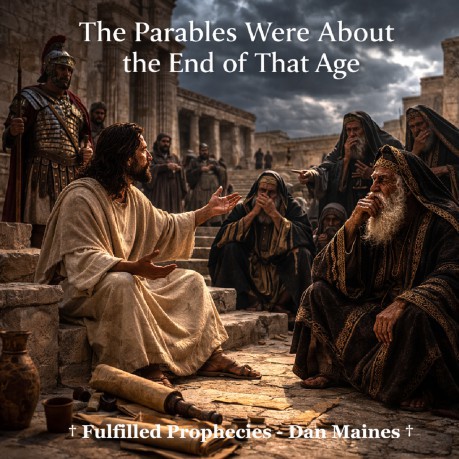
The Parables Were About the
End of That Age Introduction † Many read the parables of Jesus as timeless
moral stories detached from historical fulfillment. Matthew 21:33-41 Listen to another parable. There was a landowner who planted a
vineyard and put a wall around it and dug a wine press in it, and
built a tower, and rented it out to vine growers and went on a
journey. Now when the harvest time approached, he sent his slaves to
the vine growers to receive his produce. And the vine growers took
his slaves and beat one, and killed another, and stoned a third.
Again he sent another group of slaves larger than the first, and they
did the same thing to them. But afterward he sent his son to them,
saying, They will respect my son. But when the vine growers saw the
son, they said among themselves, This is the heir, come, let us kill
him and take possession of his inheritance. And they took him, and
threw him out of the vineyard and killed him. Therefore when the
owner of the vineyard comes, what will he do to those vine growers?
They said to Him, He will bring those wretches to a wretched end, and
will rent out the vineyard to other vine growers who will pay him the
proceeds at the proper seasons. † The vineyard is Israel, drawn directly from
Isaiah 5. Matthew 22:7 But the king was enraged, and he sent his armies and destroyed
those murderers and set their city on fire. † Jesus says the king sent his armies. Luke 19:41-44 When He approached Jerusalem, He saw the city and wept over it,
saying, If you had known on this day, even you, the things which make
for peace! But now they have been hidden from your eyes. For the days
will come upon you when your enemies will throw up a barricade
against you, and surround you and hem you in on every side, and they
will level you to the ground, and your children within you, and they
will not leave in you one stone upon another, because you did not
recognize the time of your visitation. † Jesus explicitly predicted Jerusalem being
surrounded and leveled. Matthew 13:39-40 and the enemy who sowed them is the devil, and the harvest is the
end of the age, and the reapers are angels. So just as the weeds are
gathered up and burned with fire, so shall it be at the end of the
age. † Jesus defined the timing as the end of the
age. Matthew 23:36-38 Truly I say to you, all these things will come upon this
generation. Jerusalem, Jerusalem, who kills the prophets and stones
those who have been sent to her! How often I wanted to gather your
children together, the way a hen gathers her chicks under her wings,
and you were unwilling. Behold, your house is being left to you
desolate! † Jesus defines the timing as this
generation. Matthew 24:2-3 And He said to them, Do you not see all these things? Truly I say
to you, not one stone here will be left upon another, which will not
be torn down. Now as He was sitting on the Mount of Olives, the
disciples came to Him privately, saying, Tell us, when will these
things happen, and what will be the sign of Your coming, and of the
end of the age? † The disciples connected the temple
destruction with the end of the age. Matthew 25:31-34 But when the Son of Man comes in His glory, and all the angels
with Him, then He will sit on His glorious throne. And all the
nations will be gathered before Him, and He will separate them from
one another, just as the shepherd separates the sheep from the goats;
and He will put the sheep on His right, but the goats on the left.
Then the King will say to those on His right, Come, you who are
blessed of My Father, inherit the kingdom prepared for you from the
foundation of the world. † This judgment scene follows the same
discourse about the end of the age. Historical References † Josephus, Wars of the Jews, Book 6, records
the burning of Jerusalem and the temple exactly as Jesus described. How It Applies To Us Today † We are not waiting for parables to be
fulfilled, they were fulfilled in that covenant transition. Q & A Appendix Q If the parables were fulfilled in AD 70, does
that mean there is no future judgment at all? Q Why does it sound global in Matthew 25? Q Why does the church still exist if judgment
happened? Q If the parables were about AD 70, why do they
sound final and eternal? Q What about the sheep and goats, doesn't that
describe the final judgment of all humanity? Q Why would Jesus speak in parables about
something happening only forty years later? Q If the age ended in AD 70, are we still
accountable to Christ? Q If the temple was judged, what is God's
dwelling place now? Q Why does modern Christianity still teach these
parables as future? † This is the fulfilled perspective we proclaim at
Fulfilled Prophecies † Source Index † Matthew 21:33-41; Matthew 22:7; Luke
19:41-44; Matthew 13:39-40; Matthew 23:36-38; Matthew 24:2-3; Matthew
25:31-34 † Josephus, Wars of the Jews, Book 6; Eusebius,
Ecclesiastical History 3.5; Irenaeus, Against Heresies 5.25
By Dan Maines
†
But Jesus told these parables in the shadow of covenant judgment, not
in isolation from the coming destruction of Jerusalem.
†
When we let Matthew 23 and 24 frame the context, it's clear the
parables were about the end of the Old Covenant age, not the end of
the physical world.
† The slaves are the prophets,
beaten and killed across generations.
† The
Son is Christ, whom they would soon crucify.
†
The destruction of those vine growers is covenant judgment on that
leadership.
† Jesus had already said all
these things would come upon this generation in Matthew 23:36.
†
Rome was the instrument, but God was the Judge.
†
Their city was burned, not the globe.
† This
matches the historical destruction of Jerusalem in AD 70 exactly.
† This parallels
Matthew 24:2 exactly.
† The destruction
described is historical, not symbolic.
† This
strengthens the fulfillment of Matthew 22:7.
† The disciples asked about this same
end of the age in Matthew 24:3.
† Truly I say
to you, this generation will not pass away until all these things
take place.
† Hebrews 9:26 says Christ
appeared at the consummation of the ages.
† 1
Corinthians 10:11 says the ends of the ages had come upon them.
†
Hebrews 8:13 says the covenant was becoming obsolete and ready to
disappear.
† The age ending was the Mosaic
covenant age.
† He connects the killing of the
prophets to covenant guilt coming due.
† The
word desolate ties directly to Daniel 9:27.
†
Their house, the temple, was about to be left empty and judged.
† They
did not ask about the end of the planet.
†
The age ending was the covenant age centered on that temple.
†
Every parable in Matthew 21 through 25 must be read through that
question.
† The
gathering and separation language mirrors Matthew 13 harvest
language.
† Isaiah 34:4 shows cosmic language
used for covenant judgment.
† Isaiah 19:1
shows the Lord coming in judgment against a nation without ending the
world.
† This is covenant judgment and
inheritance transition, not global annihilation.
†
Eusebius, Ecclesiastical History 3.5, records that believers fled
Jerusalem before its destruction, just as Christ warned in Matthew
24.
† Irenaeus acknowledged that Jerusalem
was destroyed in fulfillment of the Lord's warnings against that
generation.
†
The kingdom has been inherited, not postponed.
†
Christ reigns now, and we live in the reality those parables
anticipated.
† Fulfillment should produce
confidence, not speculation.
† We're living
in the kingdom age that replaced the age that ended.
†
We still face physical death, but covenant death was defeated.
A
Scripture ties the end of the age to that generation, Matthew 23:36,
Matthew 24:34. The harvest language was defined as the end of the
age, Matthew 13:39-40. That age has ended. Christ reigns now, Daniel
7:13-14, Acts 2:30-36.
A
The prophets regularly used universal language for covenant judgment,
Isaiah 13:9-13, Isaiah 34:4, Ezekiel 32:7-8. Jesus used the same
prophetic pattern in describing the fall of Jerusalem.
A Because the judgment was against
the Old Covenant system, not against the New Covenant kingdom,
Hebrews 8:13, Hebrews 12:27-28.
A Because covenant
transitions are described in ultimate language. Isaiah 13:6-13
describes Babylon's fall using cosmic language. Isaiah 34:4 describes
the heavens dissolving in national judgment. That language signified
covenant collapse, not planetary destruction. Jesus used the same
prophetic vocabulary.
A
The sheep and goats scene appears inside the same discourse that
Jesus tied to this generation in Matthew 24:34. The separation
language mirrors Matthew 13:39-43, which Jesus defined as the end of
the age. The judgment was covenantal separation during the fall of
Jerusalem.
A
Because He was confronting the leaders of Israel in real time.
Matthew 21 and 22 were spoken directly to chief priests and
Pharisees. The parables exposed their rejection of the Son and warned
of imminent judgment. It was immediate to them.
A Yes. Christ reigns
now, Acts 2:30-36. His kingdom has no end, Daniel 7:14. Fulfillment
doesn't remove accountability, it confirms His authority.
A Believers are the temple,
Ephesians 2:19-22. The earthly house was left desolate, Matthew
23:38, but the spiritual house remains.
A Because many separate
Matthew 25 from Matthew 23-24. But Jesus never changed subjects. The
context is continuous from the temple judgment through the end of the
age.
© Fulfilled Prophecies - Dan
Maines.
Links