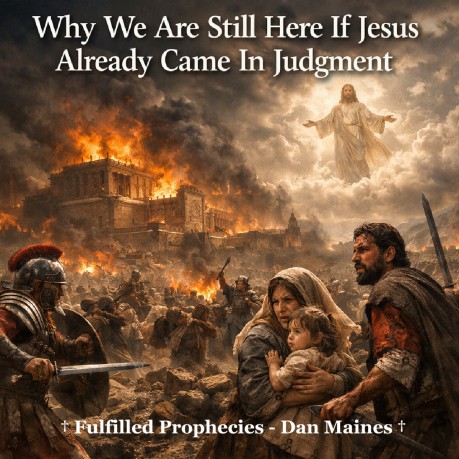
Why We Are Still Here If
Jesus Already Came In Judgment Introduction † Futurists often argue that if Jesus already
came, then we wouldn't be here, because they assume His coming had to
mean the end of the physical world. (Matthew 24:3; 2 Peter 3:10) Isaiah 19:1 † God came to Egypt in judgment, yet no one saw
Him physically riding a cloud, this is prophetic judgment language.
(Isaiah 13:1, 6; Micah 1:3-4) Matthew 24:1-3 † The discussion began with the temple, not the
planet, and Jesus answered the question they asked. (Matthew 23:38;
Luke 21:5-6) Matthew 24:34 † Jesus anchored fulfillment to that
generation, not a distant future race of people. (Matthew 23:36; Mark
13:30) Hebrews 8:13 † The Old Covenant was about to disappear in
the first century, that is a time statement. (Hebrews 10:1; Hebrews
9:9) Luke 21:22 † Jesus said all things written concerning that
judgment would be fulfilled in those days. (Matthew 24:15-21; Daniel
9:26-27) Genesis 8:21-22 † God promised the stability of the earth's
cycles, that promise still stands. (Jeremiah 33:20-21; Psalm
104:19) Psalm 104:5 † The earth is described as firmly established,
not destined for obliteration. (Psalm 93:1; Ecclesiastes 1:4) Ecclesiastes 1:4 † The earth remains, that is stated plainly
without symbolic language. (Psalm 89:36-37; Psalm 93:1) Luke 17:20-21 † The kingdom was already present in Christ's
ministry, it wasn't postponed. (Matthew 12:28; Mark 1:14-15) Matthew 16:28 † Jesus tied His coming to the lifetime of some
standing there. (Matthew 10:23; Matthew 24:34) Colossians 1:13 † Believers were already transferred into the
kingdom in the first century, present tense reality. (Revelation 1:6;
Hebrews 12:28) 1 Corinthians 15:25 † He must reign, that reign is ongoing and
active. (Psalm 110:1; Acts 2:34-36) Hebrews 12:28 † The shaking removed what could be shaken, the
Old Covenant order. (Hebrews 12:26-27; Haggai 2:6) Isaiah 9:7 † His government increases, it doesn't abruptly
terminate the earth. (Daniel 2:35; Psalm 72:17) Historical References † Josephus described the temple's fall exactly
as Jesus foretold, not one stone left upon another, confirming the
historical fulfillment. (Matthew 24:2; Luke 21:6) How It Applies To Us Today † We're not waiting for Christ to begin
reigning, He reigns now. (Colossians 1:13; 1 Corinthians 15:25) Q & A Appendix Q: If Jesus already came in judgment, why are we
still here? Q: Did Jesus predict the end of the physical
world? Q: Does the Bible teach the earth will be
destroyed? Q: Is Jesus reigning now? Q: If Jesus came in AD 70, was that His final
coming? Q: What about 2 Peter 3 and the heavens passing
away? Q: What about the resurrection? Q: What about the great tribulation? Q: If prophecy is fulfilled, is there nothing
left for us? Q: Are we living in the kingdom now? † This is the fulfilled perspective we proclaim at
Fulfilled Prophecies † Source Index † Isaiah 19:1; Matthew 24:1-3, 34; Hebrews
8:13; Luke 21:22; Genesis 8:21-22; Psalm 104:5; Ecclesiastes 1:4;
Luke 17:20-21; Matthew 16:28; Colossians 1:13; 1 Corinthians 15:25;
Hebrews 12:28; Isaiah 9:7 † Josephus, The Wars of the Jews, Book 6;
Eusebius, Ecclesiastical History, Book 3; Clement of Alexandria,
Stromata
By Dan Maines
†
That objection assumes cosmic destruction, but Scripture defines His
coming in covenantal terms tied to Jerusalem. (Matthew 23:36-38; Luke
21:20-22)
† Scripture never defines His
coming in Matthew 24 as the destruction of the planet, it defines it
as judgment on that generation. (Matthew 24:34; Matthew 26:64)
†
If we let the Bible interpret itself, the confusion disappears,
history didn't end, the Old Covenant age did. (Hebrews 8:13; Hebrews
12:26-28)
The pronouncement concerning
Egypt: Behold, the Lord is riding on a swift cloud and is about to
come to Egypt; The idols of Egypt will tremble at His presence, And
the heart of the Egyptians will melt within them.
† The coming
described is covenantal and judicial, not a bodily descent to earth.
(Psalm 18:7-15; Psalm 97:2-5)
† The Old
Testament repeatedly uses this language for national judgment,
proving coming does not automatically mean the end of history.
(Isaiah 19:1-4; Isaiah 13:9-11)
Jesus came out from the
temple and was going away when His disciples came up to point out the
temple buildings to Him.
And He said to them, Do you not see all
these things? Truly I say to you, not one stone here will be left
upon another, which will not be torn down.
And as He was sitting
on the Mount of Olives, the disciples came to Him privately, saying,
Tell us, when will these things happen, and what will be the sign of
Your coming, and of the end of the age?
† The disciples asked about the
end of the age, not the end of the world, the Greek word is age, not
cosmos. (Matthew 13:39-40; Hebrews 9:26)
†
The age in question was the Mosaic age centered in the temple system.
(Hebrews 9:8-10; Galatians 4:4-5)
† When the
temple fell in AD 70, that age ended exactly as He said. (Matthew
24:34; Luke 21:20-22)
Truly I say to you, this
generation will not pass away until all these things take place.
† All these things includes the coming
of the Son of Man in judgment within that timeframe. (Matthew
24:29-31; Matthew 26:64)
† If this generation
meant thousands of years later, His words would lose their plain
force. (Matthew 16:27-28; Revelation 1:1-3)
When He said, A new covenant,
He has made the first obsolete. But whatever is becoming obsolete and
growing old is about to disappear.
† The writer said it was near vanishing,
not thousands of years away. (Hebrews 1:2; Hebrews 9:26)
†
AD 70 marked that disappearance when the temple and sacrifices
ceased. (Daniel 9:26-27; Luke 21:22)
†
History continued because the New Covenant replaced the Old, it
didn't end humanity. (Hebrews 12:28; Colossians 2:14-15)
because these are days of
vengeance, so that all things which are written will be fulfilled.
† That places fulfillment in the
first century crisis surrounding Jerusalem. (Luke 21:20-24; Matthew
23:35-36)
† If all things were fulfilled in
that covenantal judgment, then the futurist assumption collapses.
(Matthew 5:17-18; Hebrews 9:26)
The Lord smelled the
soothing aroma; and the Lord said to Himself, I will never again
curse the ground on account of mankind, for the intent of man's heart
is evil from his youth; and I will never again destroy every living
thing, as I have done.
While the earth remains, Seedtime and
harvest, And cold and heat, And summer and winter, And day and night
Shall not cease.
† Scripture never teaches the
annihilation of the planet as the goal of redemption. (Ecclesiastes
1:4; Psalm 78:69)
† The futurist assumption
that everything must end contradicts this covenant promise. (Isaiah
45:17; Ephesians 3:21)
He established the earth upon
its foundations, So that it will not totter forever and ever.
†
Prophetic shaking language refers to covenantal change, not planetary
collapse. (Isaiah 13:13; Hebrews 12:26-27)
†
The stability of creation supports the continuity of history under
Christ's reign. (Genesis 8:22; Isaiah 9:7)
A generation goes and a
generation comes, But the earth remains forever.
†
Scripture speaks of generational change, not planetary annihilation.
(Isaiah 51:15-16; Psalm 104:5)
† The
destruction in AD 70 was covenantal, not cosmic annihilation. (Luke
21:24; Matthew 24:2)
Now having been questioned by
the Pharisees as to when the kingdom of God was coming, He answered
them and said, The kingdom of God is not coming with signs that can
be observed; nor will they say, Look, here it is! or, There it is!
For behold, the kingdom of God is in your midst.
†
It wasn't waiting for a future earthly setup, it was standing in
front of them. (John 18:36; Matthew 16:28)
†
It was established and advancing even before the temple fell. (Daniel
2:44; Daniel 7:13-14)
Truly I say to you, there are
some of those who are standing here who will not taste death until
they see the Son of Man coming in His kingdom.
†
That removes the idea of a two thousand year delay. (Revelation
1:1-3; James 5:8-9)
† His coming in kingdom
authority unfolded within that generation. (Matthew 26:64; Luke
21:27)
For He rescued us from the
domain of darkness, and transferred us to the kingdom of His beloved
Son.
† The kingdom wasn't future
only, it was active and functioning. (Romans 14:17; Daniel 2:35)
†
We're still here because His kingdom continues to grow and expand.
(Isaiah 2:2-3; Habakkuk 2:14)
For He must reign until
He has put all His enemies under His feet.
† His
reign began at His ascension, not at a future earthly return.
(Ephesians 1:20-22; Matthew 28:18)
† The
destruction of Jerusalem removed the covenantal enemy that rejected
Him. (Matthew 23:38; Luke 19:41-44)
† His
reign continues, which explains why history continues. (Isaiah 9:7;
Daniel 7:27)
Therefore, since we receive a
kingdom which cannot be shaken, let's show gratitude, by which we may
offer to God an acceptable service with reverence and awe.
†
What remains is the unshakable kingdom under Christ's rule. (Daniel
7:14; Colossians 1:13)
† That is why history
continues under a kingdom that cannot be shaken. (Isaiah 9:7;
Ephesians 3:21)
There will be no end to the
increase of His government or of peace, On the throne of David and
over his kingdom, To establish it and to uphold it with justice and
righteousness From then on and forevermore. The zeal of the Lord of
armies will accomplish this.
†
The prophecy describes expansion, not annihilation. (Daniel 7:14;
Micah 4:1-2)
† The New Covenant age continues
indefinitely under His rule. (Hebrews 12:28; Ephesians 3:21)
†
Eusebius connected the destruction of Jerusalem to the fulfillment of
the Lord's prophecy concerning that generation. (Matthew 24:34; Luke
21:22)
† Clement of Alexandria spoke of the
passing of the old system and the establishment of the new covenant
order. (Hebrews 8:13; Hebrews 10:9)
† Early
Christian writers consistently tied Matthew 24 to Jerusalem's
destruction, not the end of the planet. (Matthew 23:36; Matthew
24:1-3)
†
We're not bracing for the end of the world, we're participating in
the growth of His kingdom. (Matthew 28:18-20; Acts 1:8)
†
Our mission isn't fear of destruction, it's faithfulness in
proclamation. (2 Timothy 4:2; Romans 1:16)
†
We live in the fulfilled New Covenant reality. (Hebrews 12:22-24;
Hebrews 12:28)
† The question isn't when
history ends, it's how faithfully we serve the reigning King today.
(Romans 14:9; Ephesians 2:19-22)
A: Because His coming in AD 70
ended the Old Covenant age, not human history, Matthew 24:1-3,
Hebrews 8:13.
A: No, He spoke of the end of the age
connected to the temple system, Matthew 24:3.
A: No, Scripture says the earth
remains, Genesis 8:21-22, Ecclesiastes 1:4.
A:
Yes, believers were transferred into His kingdom and He must reign,
Colossians 1:13, 1 Corinthians 15:25.
A: It was His coming in judgment
against Jerusalem just as He promised to that generation, Matthew
24:29-34, Luke 21:20-22.
A: Peter was using covenantal destruction
language drawn from the prophets, just like Isaiah 13 and Isaiah 34,
describing the passing of the Old Covenant order, not the end of the
planet, 2 Peter 3:7-13, Hebrews 12:26-28.
A:
The resurrection Paul described was the transition from the Old
Covenant body to the New Covenant body, a spiritual resurrection life
in Christ, 1 Corinthians 15:44-46, Romans 7:4-6.
A:
Jesus said it would happen in that generation and connected it to the
siege of Jerusalem, Matthew 24:21, Matthew 24:34, Luke 21:20-24.
A: Prophecy concerning the Old
Covenant judgment is fulfilled, but the kingdom continues to increase
without end, Isaiah 9:7, Daniel 2:44.
A:
Yes, believers have been transferred into it and receive a kingdom
that cannot be shaken, Colossians 1:13, Hebrews 12:28.
© Fulfilled Prophecies - Dan
Maines.
Links