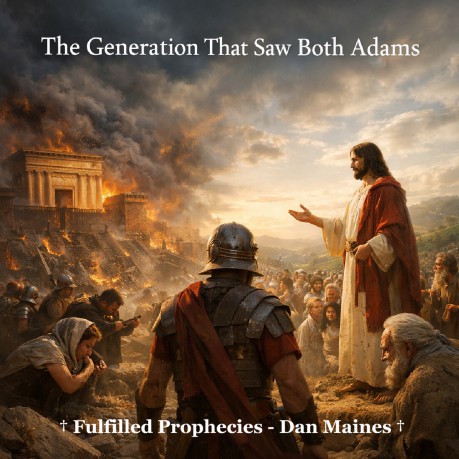
The Generation That Saw Both
Adams Introduction † Most believers are taught about the first
Adam and the last Adam, but almost no one asks when the transition
between those two heads was completed in history. Romans 5:12 Therefore, just as through one man sin entered into the world, and
death through sin, and so death spread to all mankind, because all
sinned † Paul identifies Adam as the historical entry
point of sin and death. Romans 5:18-19 18 So then, as through one wrongdoing the result was condemnation
to all mankind, so also through one act of righteousness the result
was justification of life to all mankind. † Two representative acts stand in contrast. 1 Corinthians 15:22 For as in Adam all die, so also in Christ all will be made alive. † In Adam describes solidarity with fallen
humanity. 1 Corinthians 15:45-46 45 So also it is written: The first man, Adam, became a living
person. The last Adam became a life-giving spirit. † The natural order came first in redemptive
history. Matthew 24:34 Truly I say to you, this generation will not pass away until all
these things take place. † Jesus placed the fulfillment of covenant
judgment within His own generation. Galatians 4:4-5 4 But when the fullness of the time came, God sent His Son, born
of a woman, born under the Law, † Christ entered the Law administration
intentionally. Hebrews 8:13 When He said, A new covenant, He has made the first obsolete. But
whatever is becoming obsolete and growing old is about to disappear. † The first covenant was already obsolete. Hebrews 12:27-28 27 And this expression, Yet once more, denotes the removal of
those things which can be shaken, as of created things, so that those
things which cannot be shaken may remain. † The shaken things refer to the Sinai covenant
structures. Historical References † Josephus records the destruction of Jerusalem
and the temple in Wars of the Jews, Book 6. How It Applies To Us Today † We're not living between Adam and Christ. Q & A Appendix Q: Was Adam in a covenant with God? Q: What covenant was removed in the first
century? Q: Are we still waiting for the last Adam to
reign? Q: Does this mean physical death ended in AD
70? Q: If Christ defeated death, why do people still
die physically? Q: How do we know Matthew 24:34 refers to the
first century and not a future race? Q: If the Sinai covenant ended in AD 70, what
governs believers today? † This is the fulfilled perspective we proclaim at
Fulfilled Prophecies † Source Index † Romans 5:12, 18-19; 1 Corinthians 15:22,
45-46; Matthew 24:34; Galatians 4:4-5; Hebrews 8:13; Hebrews
12:27-28
By Dan Maines
†
The New Testament does not leave that timing vague.
†
It repeatedly anchors the climax of redemptive change within a
specific generation.
† If we ignore those
time statements, we distort the structure of fulfillment.
†
The first century generation stood at the turning point.
† Death entered
through one representative man.
† This is
headship language, not covenant language.
†
Humanity shares in Adam's fallen condition.
†
The Law later exposed that condition, but it did not create it.
19 For as through the
one man's disobedience the many were made sinners, so also through
the obedience of the One the many will be made righteous.
†
Adam's act brought condemnation.
† Christ's
act brought justification.
† The issue is
headship and identity.
† The covenant that
required removal was the one given at Sinai, not something made with
Adam.
† In Christ describes union with
the risen head.
† These are two realms of
existence.
† The Sinai covenant functioned
within a humanity already under Adamic death.
†
Christ both fulfills the Law and overcomes the death introduced
through Adam.
46 However,
the spiritual is not first, but the natural, then the spiritual.
† Adam was the natural head of
fallen humanity.
† Christ is the life-giving
head of redeemed humanity.
† The Law world
stood temporarily between those realities.
†
Its removal cleared the way for the full manifestation of the last
Adam's reign.
† He did
not project it thousands of years forward.
†
The destruction of Jerusalem marked the end of the Sinai covenant
order.
† That event ended the temple system
permanently.
† The generation that heard
Jesus speak witnessed the closing of that age.
5 so that He might redeem those
who were under the Law, that we might receive the adoption as sons
and daughters.
† His mission was directed at
those under that covenant structure.
† The
cross secured redemption legally.
† The
removal of the temple system confirmed it historically.
†
After AD 70, the Sinai covenant no longer functioned in the world.
†
It was about to disappear in the writer's lifetime.
†
That disappearance corresponds with AD 70.
†
The old covenant did not linger beyond that generation.
28 Therefore, since we
receive a kingdom which cannot be shaken, let's show gratitude, by
which we may offer to God an acceptable service with reverence and
awe;
† Their removal was decisive and
historical.
† What remains is the unshaken
kingdom of Christ.
† That kingdom belongs to
the last Adam.
† The transition was completed
in the first century.
†
Tacitus confirms the devastation of the Jewish temple system in
Histories 5.
† Eusebius records the flight of
believers before the city's destruction in Ecclesiastical History,
Book 3.
† Justin Martyr identifies the fall
of Jerusalem as divine judgment on that generation.
†
Irenaeus writes that Christ brought the ages to their fulfillment in
Against Heresies.
†
We're not under the Sinai covenant.
† We're
not waiting for the kingdom to arrive.
†
We're living under the established reign of the last Adam.
†
The old order ended.
† Christ's kingdom
remains unshaken.
A:
Scripture never states that God made a covenant with Adam in Genesis.
Adam functioned as a representative head whose sin introduced death,
Romans 5:12.
A: The Sinai covenant. Hebrews 8:13
says it was about to disappear, and Matthew 24:34 places fulfillment
within that generation.
A: No. Hebrews 12:28 says we receive a
kingdom which cannot be shaken.
A: No. Romans 5:12 explains that biological
death entered through Adam. The New Testament focus in passages like
1 Corinthians 15:22 is covenant identity, being in Adam or in Christ.
The destruction of Jerusalem ended the Sinai covenant order, not
biological mortality.
A: 1 Corinthians 15:45
identifies Christ as the life-giving spirit. His victory over death
is covenantal and redemptive, overcoming the separation introduced
through Adam. Physical death continues, but condemnation does not
remain for those in Christ, Romans 5:18-19.
A: Jesus
said this generation will not pass away until all these things take
place. The same phrase generation consistently refers to His
contemporaries in passages such as Matthew 23:36. There is no
contextual shift in Matthew 24.
A: Hebrews 12:28 says
we receive a kingdom which cannot be shaken. We live under the reign
of Christ, not under the Law of Moses. The New Covenant is not
fading, it remains.
© Fulfilled Prophecies - Dan
Maines.
† Josephus, Wars of the Jews, Book
6; Tacitus, Histories 5; Eusebius, Ecclesiastical History, Book 3;
Justin Martyr, Dialogue with Trypho; Irenaeus, Against Heresies
Links