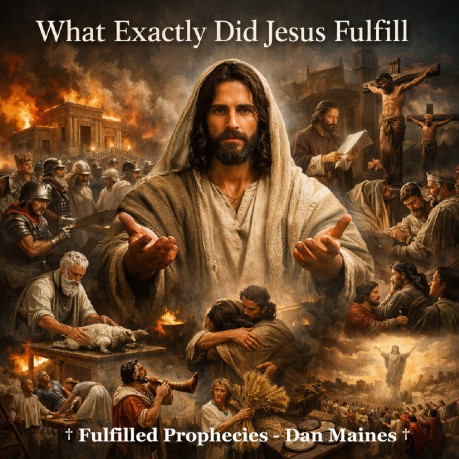
What
Exactly Did Jesus Fulfill Introduction † When Jesus
said he came to fulfill, he wasn't speaking vaguely, he was declaring
the completion of the entire Old Covenant system. † Many say he
fulfilled the Law, but they don't explain how that includes the
feasts, sacrifices, priesthood, temple, covenant curses, promises to
Israel, and the time statements tied to that generation. † We're going
to let Scripture define exactly what was fulfilled, and we'll see it
wasn't partial, it was complete. Matthew 5:17-18
"Do not presume that I came to abolish the Law or the Prophets;
I did not come to abolish, but to fulfill. For truly I say to you,
until heaven and earth pass away, not the smallest letter or stroke
of a letter shall pass from the Law, until all is accomplished! † Jesus didn't
separate the Law from the Prophets, he said he fulfilled both, that's
the entire Old Covenant revelation. (Luke 24:44) † He tied the
passing of heaven and earth to the accomplishment of all things,
which connects to covenantal language. (Isaiah 51:15-16) † If all
things were accomplished before heaven and earth passed, then heaven
and earth refers to the Old Covenant world, not the planet. (Isaiah
65:17) Luke 24:44
Now He said to them, "These are My words which I spoke to you
while I was still with you, that all the things that are written
about Me in the Law of Moses and the Prophets and the Psalms must be
fulfilled." † Jesus
expanded fulfillment to include the Law of Moses, the Prophets, and
the Psalms, that's the whole Old Covenant witness. (Matthew 5:17-18) † He said all
things written concerning him had to be fulfilled, not postponed, not
deferred, fulfilled. (Luke 24:25-27) † This
includes messianic promises, sacrificial types, priestly shadows, and
kingdom realities tied to Israel's covenant story. (Galatians 4:4-5) Colossians 2:16-17
Therefore, no one is to act as your judge in regard to food and
drink, or in respect to a festival or a new moon, or a Sabbath day -
things which are only a shadow of what is to come; but the substance
belongs to Christ. † The feasts,
new moons, and sabbaths were shadows, Christ is the body, once the
substance comes, the shadow isn't binding. (Hebrews 10:1) † This reaches
into Passover, Pentecost, Tabernacles, and Jubilee themes of release
and restoration. (Leviticus 23:4-44) † If they were
shadows of things to come, and Christ came, then those shadows
reached fulfillment in him. (Hebrews 9:11-12) Luke 4:18-21 "The
Spirit of the Lord is upon Me,
And He rolled up the scroll, gave it back to the attendant, and sat
down; and the eyes of all the people in the synagogue were intently
directed at Him. Now He began to say to them, "Today this
Scripture has been fulfilled in your hearing."
† Jesus
announced Jubilee fulfillment in their hearing, not thousands of
years later. (Isaiah 61:1-2) † The
acceptable year of the Lord is Jubilee language, release,
restoration, and covenant renewal. (Leviticus 25:10) † He said it
was fulfilled that day, anchoring fulfillment in his first century
ministry. (Luke 4:21) John 2:19-21
Jesus answered them, "Destroy this temple, and in three days I
will raise it up." The Jews then said, "It took forty-six
years to build this temple, and yet You will raise it up in three
days?" But He was speaking about the temple of His body. † Jesus
identified himself as the true temple, the dwelling place of God
among men. (John 1:14) † When the
earthly temple was destroyed, the true temple remained, fulfilled in
him. (Hebrews 9:11) † This
confirms the temple system pointed forward to Christ, not forward to
another stone building. (Acts 7:48) Hebrews 8:13
When He said, "A new covenant," He has made the first
obsolete. But whatever is becoming obsolete and growing old is about
to disappear. † The writer
said the Old Covenant was already becoming obsolete in the first
century. (2 Corinthians 3:7-11) † It was
vanishing away, that vanishing occurred when the temple system was
removed. (Matthew 24:1-2) † When the
temple went, the sacrificial system, priesthood ministry, and
covenant administration went with it. (Hebrews 9:8-10) Hebrews 10:1 For the Law, since it has only a shadow
of the good things to come and not the form of those things itself,
can never, by the same sacrifices which they offer continually every
year, make those who approach perfect.
† The law was
never the image, it was the shadow pointing forward to Christ.
(Colossians 2:16-17) † The
continual sacrifices couldn't perfect, but Christ's once for all
sacrifice could. (Hebrews 10:10-14) † When the
perfect came, the shadow system had to pass because it had done its
job. (Galatians 3:24-25) Galatians 3:16
Now the promises were spoken to Abraham and to his seed. He does not
say, "And to seeds," as one would in referring to many, but
rather as in referring to one, "And to your seed," that is,
Christ. † The
Abrahamic promise was centered in Christ, not in ethnic lineage.
(Genesis 22:18) † This shows
the covenant promises were fulfilled in him. (Galatians 3:29) † Through
Christ, the blessing extends to the nations, completing the covenant
story. (Galatians 3:14) Luke 21:22
because these are days of punishment, so that all things which have
been written will be fulfilled. † Jesus said
the destruction of Jerusalem was fulfillment of what was written.
(Deuteronomy 28:49-52) † He used
fulfillment language in a covenant judgment context. (Matthew 23:36) † This ties
covenant curses directly to first century events. (Matthew 24:34) Matthew 16:27-28 For the Son
of Man is going to come in the glory of His Father with His angels,
and will then repay every
person according to his deeds. "Truly I say to you, there are
some of those who are standing here who will not taste death until
they see the Son of Man coming in His kingdom." † Jesus tied
his coming in judgment and kingdom manifestation to that generation
standing before him. (Matthew 24:34) † This is
covenant judgment language, the curses of the Law coming due on the
covenant-breaking city. (Deuteronomy 28:49-52) † Jesus said
the guilt would come upon that generation, and history shows it did.
(Matthew 23:36) 1 Corinthians 15:45-46
So also it is written: "The first man,
Adam, became a living
person." The last
Adam was a life-giving spirit. However, the spiritual is not first,
but the natural; then the spiritual. † The
resurrection transition is from natural to spiritual, covenantal
transformation, not corpse resuscitation. (2 Corinthians 5:17) † The last
Adam brought life as a life-giving spirit, fulfilling redemptive
promises. (Romans 5:18) † This
confirms fulfillment includes resurrection realities in Christ. (John
5:24) Historical References † Josephus
recorded the fall of Jerusalem and the destruction of the temple,
confirming the end of sacrifices and priestly service in history.
(War of the Jews 6.4-6) † Eusebius
linked Christ's warnings to the judgment that came upon Jerusalem,
treating the catastrophe as fulfillment of the Lord's words.
(Ecclesiastical History 3.5) † Irenaeus
argued that Christ brought the Law to its intended goal, and that the
shadow gave way to the reality in him. (Against Heresies 4.9) How It Applies To Us
Today † We're not
under a shadow system, we're in the reality of what Christ
accomplished. (Colossians 2:16-17) † We don't
live in fear of covenant curses, Christ bore the curse and brought us
into the blessing. (Galatians 3:13-14) † We don't
chase temple-based religion, we draw near through Christ with full
assurance. (Hebrews 10:19-22) † Because it's
fulfilled, our focus is faithfulness, obedience from the heart, and
living as the people of the new covenant. (Jeremiah 31:33-34) † We don't
wait for another sacrifice, another priesthood, or another temple,
Christ is the once for all sacrifice and our eternal high priest.
(Hebrews 7:24-27) † We don't
rebuild what God removed, the old system served its purpose and has
passed. (Hebrews 8:13) † We live in
the fulfilled kingdom now, not postponing it to a future age.
(Matthew 16:27-28) † The Jubilee
reality is ongoing freedom in Christ, release from debt, bondage, and
condemnation. (Luke 4:18-21) † The
Abrahamic blessing includes us by faith, not ethnicity, and that's
already accomplished in Christ. (Galatians 3:29) † The
resurrection life isn't future-only hope, it's present covenant life
in the last Adam. (1 Corinthians 15:45-46) † Fulfillment
means confidence, we're not waiting for God to finish something he
already declared finished. (John 19:30) † Because the
Law and Prophets are fulfilled, our identity isn't rooted in Sinai,
it's rooted in Christ. (Romans 10:4) Q & A Appendix Q
Did Jesus only fulfill the moral law? A
No, he fulfilled the Law and the Prophets, and he said all things
would be accomplished. (Luke 24:44) Q
Were the feasts and sabbaths temporary? A
Yes, they were shadows of things to come, Christ is the body.
(Hebrews 10:1) Q
When did the Old Covenant vanish? A
It was vanishing in their day, and the temple's destruction shows
that vanishing in history. (Matthew 24:1-2) Q
Did Jesus fulfill covenant curses and blessings too? A
Yes, he announced judgment in that generation, and he also brought
blessing to the nations in the new covenant. (Matthew 23:36) Q
Did Jesus fulfill the Jubilee? A
Yes, he declared the acceptable year of the Lord fulfilled in their
hearing, announcing release and restoration. (Luke 4:18-21) Q
Did Jesus replace the temple? A
Yes, he identified his own body as the true temple, and the earthly
temple passed away. (John 2:19-21) Q
Were the promises to Abraham fulfilled? A
Yes, the promises were spoken to Abraham and to his seed, which is
Christ, and those in Christ inherit the blessing. (Galatians 3:16) Q
What about the priesthood? A
Christ remains a priest continually, and his priesthood doesn't pass
to another. (Hebrews 7:24) Q
Did the sacrificial system continue after Christ? A
No, by one offering he perfected forever them that are sanctified.
(Hebrews 10:14) Q
What about resurrection, is that still future? A
The last Adam became a life-giving spirit, and the transition is from
natural to spiritual. (1 Corinthians 15:45-46) Q
Are we still waiting for the kingdom? A
Some standing there would not taste death until they saw the Son of
man coming in his kingdom. (Matthew 16:27-28) † This is the fulfilled
perspective we proclaim at Fulfilled Prophecies † Source Index † Matthew
5:17-18; Luke 24:44; Colossians 2:16-17; Luke 4:18-21; John 2:19-21;
Hebrews 8:13; Hebrews 10:1; Galatians 3:16; Luke 21:22; Matthew
16:27-28; 1 Corinthians 15:45-46 † Josephus,
War of the Jews 6.4-6; Eusebius, Ecclesiastical History 3.5;
Irenaeus, Against Heresies 4.9
By Dan Maines
Because
He anointed Me to bring good news to the poor.
He
has sent Me to proclaim release to captives,
And
recovery of sight to the blind,
To
set free those who are oppressed,
To
proclaim the favorable year of the Lord."
©
Fulfilled Prophecies - Dan Maines.
Links