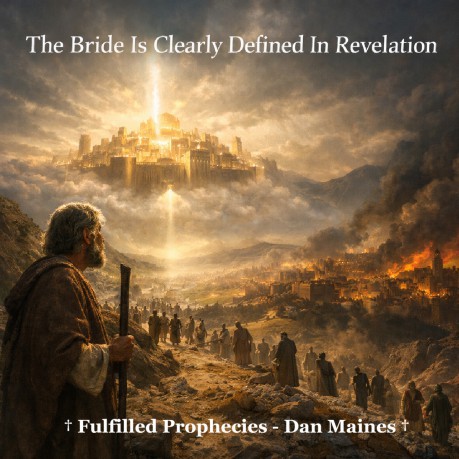
The Bride Is Clearly Defined
In Revelation Introduction † The 144,000 are never called the bride
anywhere in Revelation. The text defines the bride clearly. Revelation 21:2 I saw the Holy City, the new Jerusalem, coming down out of heaven
from God, prepared as a bride beautifully dressed for her husband. Revelation 21:9-10 Come here, I will show you the bride, the wife of the Lamb. And he
carried me away in the Spirit to a great and high mountain, and
showed me the holy city, Jerusalem, coming down out of heaven from
God. Revelation 14:4 These are the ones who have not been defiled with women, for they
have kept themselves chaste. These are the ones who follow the Lamb
wherever He goes. These have been purchased from among mankind as
first fruits to God and to the Lamb. 2 Corinthians 11:2 For I am jealous for you with a godly jealousy; for I betrothed
you to one husband, so that to Christ I might present you as a pure
virgin. Revelation 20:4 And I saw the souls of those who had been beheaded because of
their testimony of Jesus and because of the word of God. Revelation 17:18 The woman whom you saw is the great city. Hebrews 12:22-23 But you have come to Mount Zion and to the city of the living God,
the heavenly Jerusalem, and to myriads of angels, to the general
assembly and church of the firstborn who are enrolled in heaven. Galatians 4:26 But the Jerusalem above is free; she is our mother. Revelation 19:7-8 Let us rejoice and be glad and give the glory to Him, because the
marriage of the Lamb has come and His bride has prepared herself. It
was given to her to clothe herself in fine linen, bright and clean;
for the fine linen is the righteous acts of the saints. Historical References † Irenaeus described the covenant people
gathered into one in Christ. How It Applies To Us Today † We let the text define its own symbols. Q & A Appendix Q Are the 144,000 ever called the bride anywhere
in Revelation? Q What are the 144,000 called? Q What is the bride identified as? Q Does Scripture connect believers to the
heavenly Jerusalem? Q Are we the bride today? Q Did the 144,000 become the bride as well? † This is the fulfilled perspective we proclaim at
Fulfilled Prophecies † © Fulfilled Prophecies - Dan Maines. Source Index † Revelation 21:2; Revelation 21:9-10;
Revelation 14:4; 2 Corinthians 11:2; Revelation 20:4; Revelation
17:18; Hebrews 12:22-23; Galatians 4:26; Revelation 19:7-8
By Dan Maines
†
Revelation 21:9-10 says, Come here, I will show you the bride, the
wife of the Lamb. And he carried me away in the Spirit to a great and
high mountain, and showed me the holy city, Jerusalem, coming down
out of heaven from God.
† The angel does not
show John 144,000 men. He shows him the holy city, Jerusalem. The
bride is identified as a city.
† In
Revelation 14 the 144,000 are called first fruits to God and to the
Lamb. First fruits are not the entire harvest. First fruits represent
a beginning portion. That language points to a remnant.
†
The contrast is between two cities, not between heaven and earth, and
not between 144,000 individuals and the rest of believers.
†
The 144,000 are a sealed remnant described as first fruits. The bride
is the New Jerusalem. The identity of the bride is defined by the
text itself.
†
The New Jerusalem, the great city and The Bride is one. There is no
separate entity.
† The city is prepared as a
bride. The imagery defines covenant identity, not a limited numerical
group.
† The angel says he'll show John the
bride. What does he show him? The holy city, Jerusalem. That's the
Bride.
† Revelation 17:18 says the woman is
the great city.
† Revelation 21:9-10 says the
bride is the holy city.
† The contrast is
city to city.
† In
Revelation 14 the 144,000 are called first fruits to God and to the
Lamb.
† First fruits are not the entire
harvest.
† First fruits represent a beginning
portion.
† That language points to a
remnant.
† That is symbolic purity language.
† Paul uses the same imagery.
†
Virgin language describes covenant faithfulness.
†
Revelation 20 also does not identify the bride as 144,000.
†
Souls are seen reigning.
† This is covenant
vindication language.
†
Revelation defines both women.
† The identity
of the bride is defined by the text itself.
†
Believers are said to have come to the heavenly Jerusalem.
†
The city represents the covenant people of God.
†
This strengthens the identification of the bride as covenant
community, not a limited number.
†
That is identity language.
† The Jerusalem
above is described in familial covenant terms.
†
This aligns with the bride being the holy city.
†
The bride is connected with the righteous acts of the saints.
†
This shows corporate covenant identity.
† The
bride language encompasses the covenant people, not a sealed numeric
remnant alone.
† Tertullian
spoke of believers as the chaste Bride in covenant faithfulness.
†
Eusebius recorded the destruction of Jerusalem as fulfillment of
Christ's words.
† Josephus recorded the fall
of the great city.
†
We do not redefine the bride when Revelation defines her clearly.
†
We are covenant people, not defined by numerical speculation.
†
The bride is the holy city.
† The identity of
the bride is defined by the text itself.
A No. The text never calls the
144,000 the bride. The bride is identified as the holy city in
Revelation 21:9-10.
A
They are called first fruits to God and to the Lamb in Revelation
14:4.
A
The holy city, Jerusalem, coming down out of heaven from God,
Revelation 21:9-10.
A Yes. Hebrews 12:22-23 and
Galatians 4:26 connect covenant believers to the heavenly Jerusalem.
A
The bride is identified as the holy city, the New Jerusalem,
Revelation 21:9-10. Hebrews 12:22 says believers have come to the
heavenly Jerusalem. If we are in Christ, we belong to that covenant
city. The bride is not a separate physical structure, it represents
the covenant people of God.
A
The 144,000 are called first fruits to God and to the Lamb in
Revelation 14:4. First fruits are a beginning portion, not the entire
harvest. Revelation never calls the 144,000 the bride. The bride is
defined as the holy city in Revelation 21:9-10. The 144,000 were part
of the redeemed covenant people, but the text defines the bride as
the New Jerusalem, not as a numbered remnant.
†
Irenaeus, Against Heresies; Tertullian, On Modesty; Eusebius,
Ecclesiastical History; Josephus, War of the Jews
Links