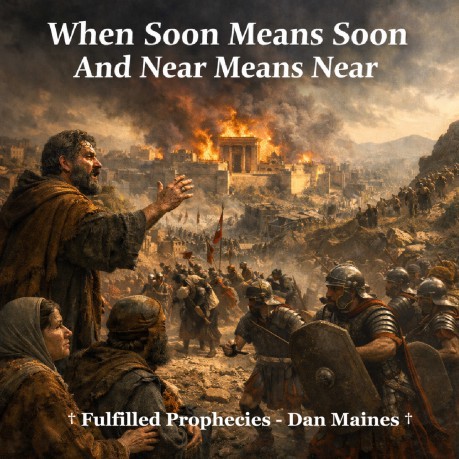
When Soon Means Soon And Near
Means Near Introduction † When people say this hasn't been fulfilled or
that hasn't been fulfilled, and they don't provide a single verse, it
tells us they're not letting Scripture interpret Scripture (2 Timothy
2:15). † Most can't get rid of their presuppositions,
because their pastor has already decided Christ must still appear in
our future (Colossians 2:8). † Because of that, they refuse to believe soon
means soon and quickly means quickly, and they treat Revelation like
it only becomes true when we read it today (Revelation 1:1, 3). Revelation 1:1 The Revelation of Jesus Christ, which God gave Him to show to His
bond-servants, the things which must soon take place, and He sent and
communicated it by His angel to His bond-servant John, † Soon means soon, and Revelation intentionally
echoes Daniel's language about what must take place, except now it's
near, not distant (Daniel 2:28-29). † The book ends the same way it begins, it
still says these things must soon take place, so we can't stretch the
timeline without overriding the text (Revelation 22:6). † John names real, first century churches, this
wasn't written to modern America (Revelation 1:4). Revelation 1:3 Blessed is the one who reads and those who hear the words of the
prophecy, and keep the things which are written in it, for the time
is near. † When God says near, He means near to the
audience receiving the message, not twenty centuries later (Habakkuk
2:3). † John is told not to seal up the words because
the time is near, that's the opposite of Daniel being told to seal
his vision for later (Revelation 22:10; Daniel 12:4). † The New Testament repeats this urgency, the
Judge is standing right at the door, that's first century imminence
(James 5:8-9). Revelation 13:7 It was also given to him to make war with the saints and to
overcome them, and authority over every tribe and people and language
and nation was given to him. † These saints were alive when John wrote, and
they were already being warned of tribulation (Revelation 2:10). † Believers were enduring fiery trials in that
generation, the persecution context is present, not future (1 Peter
4:12-13). † The martyrs were told their vindication was
about to be completed, again, that's not modern politics (Revelation
6:9-11). Revelation 13:17 and he provides that no one will be able to buy or to sell, except
the one who has the mark, either the name of the beast or the number
of his name. † Economic pressure tied to worship was real in
the first century when idolatry and commerce were linked (Acts
19:23-27). † The issue is allegiance and worship, not
technology, the warning is about worshiping the beast and his image
(Revelation 14:9-11). † The churches were already living where
Satan's throne was, under imperial pressure (Revelation 2:13). Revelation 17:10 and they are seven kings, five have fallen, one is, the other has
not yet come, and when he comes, he must remain a little while. † One is is present tense when John wrote, that
anchors the prophecy to his time (Revelation 1:19). † The text keeps using immediate time markers,
not vague future centuries (Revelation 17:12). † The judgment is described as coming in one
hour, the language is sudden and near (Revelation 18:10). Revelation 18:4 I heard another voice from heaven, saying, Come out of her, my
people, so that you will not participate in her sins and receive of
her plagues; † Jesus placed covenant guilt and desolation on
that city in that generation, Revelation echoes that covenant lawsuit
(Matthew 23:35-38). † Jesus gave a real escape warning connected to
Jerusalem's coming siege, that matches the call to come out (Luke
21:20-22). † Plagues belong to covenant curse language,
Revelation uses covenant curse imagery against covenant breaking
(Deuteronomy 28:58-61). Luke 21:22 because these are days of vengeance, so that all things which are
written will be fulfilled. † Jesus said all things written would be
fulfilled in those days of vengeance, that's a defined historical
moment (Luke 21:20-22). † He also said that generation would not pass
away until all things take place, that fixes the time frame (Luke
21:32). † Not one jot or tittle would pass until all is
accomplished, and Luke tells us when that accomplishment was coming
(Matthew 5:17-18). Matthew 24:16 then those who are in Judea must flee to the mountains. † The instruction was geographic and specific,
those in Judea, not those in Rome, America, or the entire globe
(Matthew 24:16). † This locks the tribulation to a location, not
a worldwide nuclear war scenario (Matthew 24:21). † The early church fled before the siege
exactly as Jesus warned (Ecclesiastical History, Book 3). Matthew 24:34 Truly I say to you, this generation will not pass away until all
these things take place. † The context is the temple's destruction,
that's the covenant world ending, not the physical universe (Matthew
24:2). † Jesus tied His coming in His kingdom to some
standing there not tasting death until they saw it (Matthew
16:27-28). † Revelation announces the same coming theme to
that generation, not ours (Revelation 1:7). Hebrews 8:13 When He said, A new covenant, He has made the first obsolete. But
whatever is becoming obsolete and growing old is about to disappear. † The first covenant was about to disappear in
that first century context, not two thousand years later (Hebrews
8:13). † The language of about to disappear matches
the urgency language of Revelation (Revelation 1:1). † What ended was the old covenant world, not
the physical planet (Luke 21:22). Historical References † Josephus records the siege, famine, civil
conflict, and destruction of Jerusalem in vivid detail, matching
Jesus' warnings (Matthew 24:2). † Tacitus confirms Roman persecution under
Nero, consistent with the suffering of the saints in Revelation
(Revelation 13:7). † Eusebius records that believers fled before
the war, consistent with Jesus' instruction to escape (Matthew
24:16). How It Applies To Us Today † Don't accept claims without Scripture, if
someone says it isn't fulfilled, they must show Bible, not
speculation (1 Thessalonians 5:21). † Don't let fear driven systems redefine God's
words, soon and near mean what they say (Revelation 1:3). † Read Revelation as covenant judgment and
deliverance in its historical setting, not as a news forecast (Luke
21:22). † Stop outsourcing your theology to pastors who
reinterpret time statements to protect a system (Colossians 2:8). † If a doctrine requires redefining soon, near,
at hand, and this generation, the problem isn't the Bible, it's the
system (Matthew 24:34). † Fear based eschatology keeps believers in
suspense, but fulfilled eschatology anchors us in completed
redemption (John 19:30). † The kingdom isn't waiting to arrive, Christ
reigns now, and His covenant promises have been kept (Acts 2:30-36). † When you understand that the old covenant
world ended, it removes the constant anxiety about geopolitical
headlines (Hebrews 8:13). † We live in the reality of a fulfilled
transition, not in anticipation of a catastrophic reset (Luke 21:32). † That should produce stability, confidence,
and boldness, not prophetic paranoia (Hebrews 12:28). Q & A Appendix Q: If Revelation was fulfilled, why is there still evil in the
world? Q: What about the Second Coming? Q: If the beast was first century Rome, why does Revelation use
global language? Q: What about the mark of the beast and buying and selling? Q: If the old covenant disappeared, what covenant are we under
now? Q: Why do so many pastors still teach Revelation is future? Q: Is this dangerous teaching? † This is the fulfilled perspective we proclaim at
Fulfilled Prophecies † Source Index † Revelation 1:1, 3; Revelation 13:7, 17;
Revelation 17:10; Revelation 18:4; Luke 21:22; Matthew 24:16, 34;
Hebrews 8:13
By Dan Maines
A: Revelation addresses covenant judgment and the end of
the old covenant order, not the removal of all human sin (Luke
21:22).
A: The phrase Second Coming
never appears in Scripture. Matthew 24:34 limits the coming in
judgment to that generation, and Revelation 1:7 ties it to those who
pierced Him (Matthew 24:34; Revelation 1:7).
A: Prophetic language regularly uses universal
terminology for covenant judgment, just as Isaiah 13 uses cosmic
language for Babylon's fall (Isaiah 13:10).
A:
Revelation 13:17 connects commerce to allegiance and worship,
consistent with first century imperial pressure, not modern digital
systems (Revelation 13:17).
A: Hebrews 8:13 says the first was becoming obsolete and
about to disappear. The New Covenant stands as the present covenant
reality (Hebrews 8:13).
A:
Because systems built on futurism require it. If Revelation was
fulfilled, large portions of popular prophecy frameworks collapse
(Luke 21:32).
A: No. What is dangerous is
redefining God's time statements to protect tradition. Let Scripture
speak plainly (Revelation 22:6).
© Fulfilled Prophecies - Dan
Maines.
† Josephus, Wars of the Jews,
Book 5-6; Tacitus, Annals 15.44; Eusebius, Ecclesiastical History,
Book 3
Links