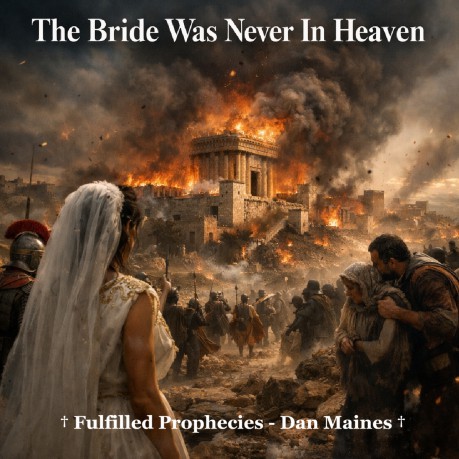
The Bride Was Never In Heaven Introduction † Most Christians have been taught that the
church goes to heaven to marry Christ. Isaiah 62:4-5 † The bride language in Scripture begins with
covenant Jerusalem, not a future heavenly relocation (Isaiah
62:4-5). Ezekiel 16:8 † God described entering into covenant with
Jerusalem as marriage (Ezekiel 16:8). Matthew 22:7 † Jesus connected the wedding feast directly to
the destruction of their city (Matthew 22:7). Revelation 1:1 † The events of Revelation were declared to
take place soon (Revelation 1:1). Revelation 17:18 † Revelation identifies a woman as a city
(Revelation 17:18). Revelation 19:7-8 † The marriage of the Lamb is announced
immediately after the fall of the harlot (Revelation 19:7-8). Revelation 21:9-10 † The angel explicitly identifies the bride as
the holy city, Jerusalem (Revelation 21:9-10). Revelation 21:2 † This is the shocking moment, the bride comes
down out of heaven (Revelation 21:2). Hebrews 12:22-23 † First century believers were told they had
already come to the heavenly Jerusalem (Hebrews 12:22-23). Historical References † Josephus recorded that Jerusalem was burned
by the Roman armies in AD 70, matching the wedding judgment imagery
of Matthew 22:7. How It Applies To Us Today † We're not waiting for a future wedding in
heaven, we're living in the reality of the New Covenant city. Q & A Appendix Q If the bride is a city, how can believers be
part of it? Q Doesn't Revelation 21 say there is no more
death? Q If the bride comes down, what does that mean
practically? Q Why use cosmic and dramatic language if this
was about Jerusalem? Q If the harlot is judged and the bride revealed,
what changed historically? Q If this was fulfilled in the first century,
what are we waiting for now? † This is the fulfilled perspective we proclaim at
Fulfilled Prophecies † Source Index † Isaiah 62:4-5; Ezekiel 16:8; Matthew 22:7;
Revelation 1:1; Revelation 17:18; Revelation 19:7-8; Revelation 21:2;
Revelation 21:9-10; Hebrews 12:22-23 † Josephus, Wars of the Jews; Eusebius,
Ecclesiastical History; Irenaeus, Against Heresies
By Dan Maines
† That
assumption sounds spiritual, but it isn't what the text says.
†
If we let Scripture interpret Scripture, we will see something
shocking.
† The bride does not go up to
heaven.
† The bride comes down out of heaven.
It will no longer be said to
you, "Forsaken,"
Nor to your land will it any longer
be said, "Desolate";
But you will be called, "My
delight is in her,"
And your land, "Married";
For
the LORD delights in you,
And to Him your land will be
married.
For as a young man marries a virgin,
So your sons
will marry you;
And as the bridegroom rejoices over the
bride,
So your God will rejoice over you.
† God called the land married,
showing covenant union, not geography change (Isaiah 62:4-5).
†
The bride is identified as covenant people, not individuals flying to
heaven (Isaiah 62:4-5).
Then I passed by you and saw
you, and behold, you were at the time for love; so I spread My
garment over you and covered your nakedness. I also swore to you and
entered into a covenant with you so that you became Mine, declares
the Lord GOD.
†
Covenant faithfulness and unfaithfulness are described as marital
faithfulness and adultery (Ezekiel 16:8).
†
Revelation's harlot imagery comes directly from this covenant
marriage language (Ezekiel 16:8).
But the king was enraged, and
he sent his armies and destroyed those murderers and set their city
on fire.
†
The wedding and the judgment are inseparable in the parable (Matthew
22:7).
† The marriage context is covenant
transition through judgment, not departure to heaven (Matthew 22:7).
The Revelation of Jesus
Christ, which God gave Him to show to His bond-servants, the things
which must soon take place; and He sent and communicated it by His
angel to His bond-servant John.
† The
marriage of the Lamb cannot be pushed thousands of years into the
future (Revelation 1:1).
† The timing
indicator anchors the wedding and the judgment in the first century
(Revelation 1:1).
The woman whom you saw is
the great city, which reigns over the kings of the earth.
† This woman is called a
harlot and judged for covenant unfaithfulness (Revelation 17:18).
†
The contrast in Revelation is between two cities, not earth and
heaven (Revelation 17:18).
Let us rejoice and be glad
and give the glory to Him, because the marriage of the Lamb has come
and His bride has made herself ready.
It was given to her to
clothe herself in fine linen, bright and clean; for the fine linen is
the righteous acts of the saints.
†
The timing shows covenant replacement, not heavenly evacuation
(Revelation 19:7-8).
† The righteous bride
stands in contrast to the judged harlot city (Revelation 19:7-8).
Then one of the seven
angels who had the seven bowls full of the seven last plagues came
and spoke with me, saying, "Come here, I will show you the
bride, the wife of the Lamb."
And he carried me away in the
Spirit to a great and high mountain, and showed me the holy city,
Jerusalem, coming down out of heaven from God.
†
The bride is not described as individuals in heaven but as a covenant
city (Revelation 21:9-10).
† The identity of
the bride is settled by the text itself (Revelation 21:9-10).
And I saw the holy city, new
Jerusalem, coming down out of heaven from God, prepared as a bride
adorned for her husband.
† The
text never says the bride went up, it says she comes down (Revelation
21:2).
† The direction destroys the rapture
assumption because the movement is downward (Revelation 21:2).
But you have come to Mount
Zion and to the city of the living God, the heavenly Jerusalem, and
to myriads of angels,
to the general assembly and church of the
firstborn who are enrolled in heaven, and to God, the Judge of all,
and to the spirits of the righteous made perfect.
†
The heavenly city was a present covenant reality, not a distant
future relocation (Hebrews 12:22-23).
† This
confirms that the New Jerusalem was revealed in their generation
(Hebrews 12:22-23).
† Eusebius documented that
the church fled Jerusalem before its destruction, showing Jesus'
warnings were fulfilled historically.
†
Irenaeus affirmed that Jerusalem's fall fulfilled the Lord's prophecy
to that generation.
†
We don't look for escape, we walk in covenant union with Christ
now.
† The bride has already been revealed,
and we belong to that kingdom that cannot be shaken.
†
Understanding this frees us from fear based futurism and anchors us
in fulfilled promise.
† We are not spiritual
refugees waiting for evacuation, we're covenant citizens of a present
kingdom.
† Our identity is not future tense,
it's established in the finished work of Christ.
†
The destruction of the harlot means the Old Covenant system is gone
forever, we are not under it and never will be.
†
We don't measure hope by headlines or geopolitical events, we measure
it by fulfilled promise.
† The bride being
revealed means access to God is open, there is no temple barrier, no
priestly gatekeeping, no waiting period.
†
Because the marriage has come, we live in union, not anticipation.
†
The New Jerusalem coming down means God's dwelling is with His people
now, not someday.
† When fear based prophecy
teaching tries to pull us back into panic, we stand in the security
of fulfillment.
† The bride was revealed
through judgment, which means covenant faithfulness always triumphs
over religious corruption.
† We don't live
looking for escape, we live proclaiming that the King has already
vindicated His people.
A Hebrews 12:22-23 says believers
have come to the heavenly Jerusalem. The city represents covenant
identity and access to God, not bricks and stone.
A Revelation 21:4 reflects Isaiah 25:8
and covenant victory over redemptive death. 1 Corinthians 15:54-57
shows death swallowed up in victory through Christ. The context is
covenant death under the Law, not biological mortality.
A Revelation 21:3 says the
tabernacle of God is among men. That echoes John 1:14 and Hebrews
12:22-23. The point is covenant presence, not geographic relocation.
A Isaiah 13:10 described
Babylon's fall with darkened sun and stars. Prophetic judgment
language consistently uses cosmic imagery for covenant collapse.
A Hebrews 8:13 says
the Old Covenant was becoming obsolete and ready to disappear. When
Jerusalem fell in AD 70, the temple system ended permanently and the
New Covenant stood alone.
A Hebrews 12:28
says we receive a kingdom which cannot be shaken. We're not waiting
for covenant completion, we're living in its reality.
© Fulfilled Prophecies - Dan
Maines.
Links