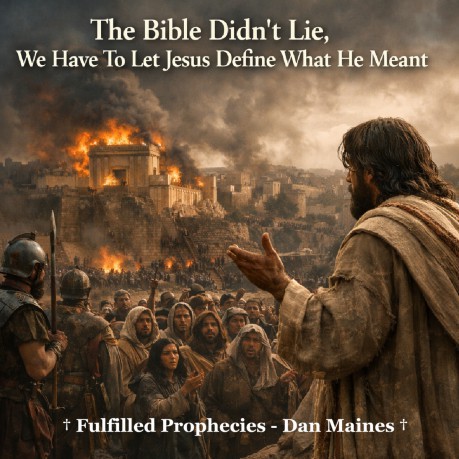
The Bible Didn't Lie, We Have
To Let Jesus Define What He Meant Introduction † First, the Bible didn't lie. We have to let
Jesus define what He meant. (John 17:17) † The issue isn't whether tribulation exists,
the issue is when and where Jesus said it would occur. (Matthew 24:3) † If we let Christ interpret His own prophecy,
the confusion disappears and the fear driven systems collapse.
(Matthew 24:34) Matthew 24:2 And He said to them, Do you not see all these things? Truly I say
to you, not one stone here will be left upon another, which will not
be torn down. † Jesus began this entire discussion by
predicting the destruction of the temple. (Luke 19:44) † The subject wasn't the end of the planet, it
was the end of that temple system. (Hebrews 8:13) † If the temple was the focus at the beginning,
it remains the focus throughout the chapter. (Matthew 24:15) Matthew 24:3 As He was sitting on the Mount of Olives, the disciples came to
Him privately, saying, Tell us, when will these things happen, and
what will be the sign of Your coming, and of the end of the age? † The disciples asked about the end of the age,
not the end of the world. (Matthew 13:39) † The age in question was the Old Covenant age
centered on that temple. (Hebrews 9:9-10) † If we redefine their question, we distort His
answer. (Mark 7:13) Matthew 24:21 For then there will be a great tribulation, such as has not
occurred since the beginning of the world until now, nor ever will. † Jesus described a great tribulation,
unparalleled in covenant history, not a vague global disaster
detached from context. (Daniel 12:1) † The language echoes covenant judgment
patterns found in the Old Testament, especially concerning Israel as
a nation. (Deuteronomy 28:52-53) † He wasn't giving a newspaper forecast for
thousands of years later, He was answering a specific question about
the temple and the end of that age. (Matthew 24:2-3) Matthew 24:16 then those who are in Judea must flee to the mountains. † Now look at the context Jesus Himself gave.
(Luke 21:20) † He geographically limited the tribulation to
Judea. (Matthew 24:20) † If this were a worldwide end of human history
event, fleeing Judea would make no sense. (Zechariah 14:2) † The command only makes sense if the judgment
was local, immediate, and tied to that land. (Deuteronomy 28:49) Luke 21:20-22 But when you see Jerusalem surrounded by armies, then recognize
that her desolation is near. Then those who are in Judea must flee to
the mountains... because these are days of vengeance, so that all
things which are written will be fulfilled. † Luke gives even more clarity. (Luke 21:32) † Jesus tied the Great Tribulation to Jerusalem
being surrounded by armies. (Matthew 24:15) † That happened in AD 70 under the Roman siege.
(Daniel 9:26) † He called those days days of vengeance,
covenantal language drawn from Deuteronomy. (Deuteronomy 32:35) † He said all things which are written would be
fulfilled, not postponed. (Matthew 5:17) Deuteronomy 28:52-53 And it shall besiege you in all your towns until your high and
fortified walls in which you trusted come down throughout your land;
and it shall besiege you in all your towns throughout your land which
the Lord your God has given you. Then you shall eat the offspring of
your own body, the flesh of your sons and of your daughters whom the
Lord your God has given you, during the siege and the distress by
which your enemy will oppress you. † Moses warned Israel centuries earlier about
siege, famine, and cannibalism as covenant curses. (Leviticus 26:29) † Jesus was invoking that covenant framework,
not inventing a new global catastrophe. (Matthew 23:36) † The horrors Josephus recorded in AD 70 match
the covenant curse language of Deuteronomy 28. (Luke 21:22) Now let's address the emotional part honestly. Are there horrible things happening today? Yes. Evil exists. But
Jesus was not making a statement about the total amount of evil on
planet earth across all centuries. He was speaking covenantally about
the judgment coming upon that nation. Matthew 23:35-36 so that upon you may fall the guilt of all the righteous blood
shed on earth... Truly I say to you, all these things will come upon
this generation. † That generation was about to bear the
accumulated covenant judgment for centuries of rejecting the prophets
and the Messiah. (1 Thessalonians 2:15-16) † The time statement is explicit, all these
things would come upon that generation. (Matthew 24:34) † If we stretch that generation into ours, we
override Jesus' own words. (Mark 8:38) Josephus, who was not a Christian, documented the horrors inside
Jerusalem during the siege. Famine was so severe that mothers ate
their own children. Internal civil war broke out. Over a million
people died according to his account. † That wasn't a small inconvenience in a tiny
corner of the world. (Luke 19:43-44) † It was the catastrophic end of Israel's
covenant world. (Hebrews 12:27) Daniel 12:1 And there will be a time of distress such as never occurred since
there was a nation until that time. † Jesus is quoting Daniel. (Matthew 24:21) † Daniel was speaking about the fate of that
nation. (Daniel 9:24) † The same unparalleled language is used about
Israel's national crisis, not the end of the physical planet.
(Jeremiah 30:7) Matthew 24:34 Truly I say to you, this generation will not pass away until all
these things take place. † If we push the tribulation into our day, we
create a contradiction with Jesus' time statement. (Matthew 16:28) † This generation means the generation He was
speaking to. (Luke 21:32) Matthew 24:14 This gospel of the kingdom shall be preached in the whole world as
a testimony to all the nations, and then the end will come. † Jesus said the gospel would be preached in
the whole world before the end came. (Romans 10:18) † The end in context is the end of that age
tied to the temple. (Hebrews 9:26) Colossians 1:6 which has come to you, just as in all the world also it is
constantly bearing fruit and increasing, even as it has been doing in
you also since the day you heard of it and understood the grace of
God in truth; Colossians 1:23 if indeed you continue in the faith firmly established and
steadfast, and not moved away from the hope of the gospel that you
have heard, which was proclaimed in all creation under heaven, and of
which I, Paul, was made a minister. † Paul says the gospel had already been
proclaimed in all creation under heaven. (Romans 16:26) † That fulfills Matthew 24:14 within the first
century framework. (Acts 2:5) Hebrews 8:13 When He said, A new covenant, He has made the first obsolete. But
whatever is becoming obsolete and growing old is about to disappear. † The old covenant was about to disappear in
the first century. (Hebrews 10:9) † The temple's destruction in AD 70 marked that
covenantal end. (Matthew 24:2) Revelation 1:1 The Revelation of Jesus Christ, which God gave Him to show to His
bond-servants, the things which must soon take place; Revelation 1:3 Blessed is he who reads and those who hear the words of the
prophecy and keep the things which are written in it; for the time is
near. † John said the things must soon take place.
(Revelation 22:6) † He said the time is near. (Revelation 22:10) † Soon and near don't mean thousands of years
later. (James 5:8) Hebrews 12:28 Therefore, since we receive a kingdom which cannot be shaken, let
us show gratitude, by which we may offer to God an acceptable service
with reverence and awe. † We receive, not we're waiting for it. (Luke
17:21) John 10:10 The thief comes only to steal and kill and destroy, I came so that
they would have life, and have it abundantly. † This is about a reigning King and a finished
work. (Acts 2:36) Historical References † Josephus, Wars of the Jews 5-6, records the
famine and destruction during the Roman siege. (Luke 21:24) † Eusebius, Ecclesiastical History 3.5, records
believers fleeing Jerusalem before its destruction. (Matthew 24:16) † Irenaeus, Against Heresies 5.35, speaks of
Jerusalem's fall as judgment. (Matthew 23:38) † Clement of Alexandria, Stromata 1.21,
acknowledges the destruction of Jerusalem in the apostolic age. (Luke
19:41-44) How It Applies To Us Today † We're not living under the shadow of
impending covenant wrath. (Romans 8:1) † We're not waiting for prophetic doom to
unfold. (Hebrews 9:28) † The redemptive plan isn't unfinished. (John
19:30) † The unshakable kingdom stands now. (Daniel
7:14) † That replaces fear with stability and
confidence. (2 Timothy 1:7) Q & A Appendix Q: Was the Great Tribulation a future global
event? Q: If it was limited to Judea, why does Jesus use
global language? Q: What about nor ever will in Matthew 24:21? Q: Did the gospel really reach the whole world
before AD 70? Q: What does all things which are written will be
fulfilled mean? Q: Does this mean Revelation is already
fulfilled? Q: If the old covenant passed away, what
remains? Q: Are we minimizing evil in the world today? Q: If this is true, why do so many churches still
teach a future tribulation? Q: Does this view remove urgency from the
Christian life? Q: What about the abomination of desolation? Q: If the tribulation is past, what are we
waiting for? † This is the fulfilled perspective we proclaim at
Fulfilled Prophecies † Source Index † Matthew 24:2-3, 14, 16, 21, 34; Luke
21:20-22; Matthew 23:35-36; Deuteronomy 28:52-53; Daniel 12:1;
Colossians 1:6, 23; Hebrews 8:13; Revelation 1:1, 3; Hebrews 12:28;
John 10:10 † Josephus, Wars of the Jews 5-6; Eusebius,
Ecclesiastical History 3.5; Irenaeus, Against Heresies 5.35; Clement
of Alexandria, Stromata 1.21
By Dan Maines
A: No.
† Jesus
limited it to Judea and tied it to that generation. (Luke 21:20-22)
†
He tied the judgment to the temple's end, not the end of the planet.
(Matthew 24:2)
† The time limit is explicit
and can't be stretched without contradiction. (Matthew 24:34)
A: It's covenantal judgment
language.
† The prophets used universal
imagery for judgment on nations. (Isaiah 13:10)
†
The same kind of language is used against Egypt in covenant style
prophecy. (Ezekiel 32:7-8)
† This is how
Scripture communicates covenant collapse, not astronomical
destruction. (Deuteronomy 32:35)
A:
It's about the unparalleled covenant collapse of Israel's system.
†
Daniel used the same unparalleled language about that nation's
crisis. (Daniel 12:1)
† Jeremiah also uses
unique distress language for Jacob's trouble, covenantally. (Jeremiah
30:7)
† Jesus tied that distress to
Jerusalem's desolation, not a worldwide event. (Luke 21:20)
A: Yes.
†
Paul said the gospel was proclaimed in all creation under heaven.
(Colossians 1:23)
† Paul also says the
message went out to all the earth. (Romans 10:18)
†
That satisfies the Matthew 24:14 prerequisite within their
generation. (Matthew 16:28)
A: It means completion, not
postponement.
† Luke ties fulfillment to the
days of vengeance around Jerusalem's fall. (Luke 21:22)
†
Jesus said He came to fulfill, not delay, the Law and the Prophets.
(Matthew 5:17)
† The covenant was aging and
about to disappear, which places fulfillment in that time. (Hebrews
8:13)
A: Revelation's own time statements
demand nearness.
† The things must soon take
place. (Revelation 1:1)
† The time is near.
(Revelation 1:3)
† James uses the same
nearness language for the Lord's coming. (James 5:8)
A: The unshakable kingdom.
†
We receive a kingdom which cannot be shaken. (Hebrews 12:28)
†
The shaken things were removed so the unshakable would remain.
(Hebrews 12:27)
† Jesus said the kingdom was
in their midst, present reality. (Luke 17:21)
A:
No.
† Evil is real and spiritual conflict is
real. (Ephesians 6:12)
† But there's no
condemnation in Christ. (Romans 8:1)
† God
didn't give us a spirit of fear. (2 Timothy 1:7)
A: Because they
ignore the time statements and the audience.
†
When this generation is removed, everything gets pushed forward.
(Matthew 24:34)
† Scripture warns against
nullifying God's word through tradition. (Mark 7:13)
†
The apostles spoke of nearness, not delay. (1 Peter 4:7)
A: No, it removes fear based
urgency.
† We're called to gratitude and
reverence in the kingdom we receive. (Hebrews 12:28)
†
Perfect love casts out fear. (1 John 4:18)
†
Faith works through love, not panic. (Galatians 5:6)
A:
Luke interprets it plainly.
† Jerusalem
surrounded by armies is the interpretive key. (Luke 21:20)
†
Daniel also links desolation to the city's destruction. (Daniel
9:26-27)
† Jesus told those in Judea to flee,
which fits siege conditions. (Matthew 24:16)
A: We're living in the reign and
mission of Christ.
† Christ has all authority
now. (Matthew 28:18)
† He must reign until
all enemies are put under His feet. (1 Corinthians 15:25)
†
The kingdom advances through disciple making, not end times panic.
(Matthew 28:19-20)
© Fulfilled Prophecies - Dan
Maines.
Links