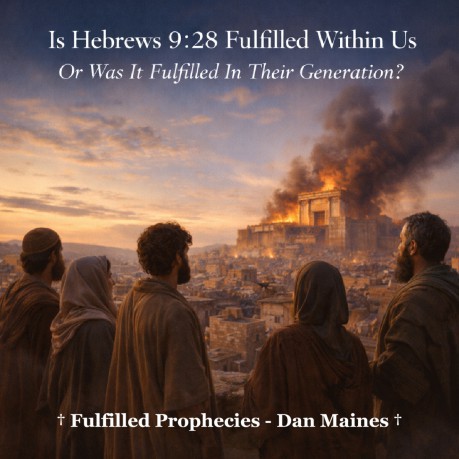
Is Hebrews 9:28 Fulfilled
Within Us Or Was It Fulfilled In Their Generation? Introduction † The issue isn't whether Jesus died for sins,
it's what Hebrews 9:28 is actually saying. (Hebrews 10:12) Hebrews 9:28 † This verse separates His offering from His
appearing, it doesn't treat them as the same event. (Hebrews 9:26) Matthew 24:34 † Jesus fixed the timeline, this generation
means the generation He was speaking to, not a future one. (Matthew
24:33) 1 Peter 1:5 † Peter said salvation was ready to be
revealed, meaning it was near in their time, not delayed for
millennia. (1 Peter 4:7) Hebrews 10:25-27 † The audience could see the day drawing near,
that places the judgment in their visible horizon. (Hebrews 10:37) Romans 16:20 † Paul told them Satan would be crushed soon,
not thousands of years later. (Revelation 1:1) Historical References † Josephus records the temple's destruction and
the end of the sacrificial system in AD 70, that historical reality
is exactly what Hebrews said was about to disappear. (Hebrews 8:13) How It Applies To Us Today † We aren't waiting for Hebrews 9:28, we live
in the accomplished reality it pointed to. (Hebrews 10:14) Q & A Appendix Q Does Hebrews 9:28 mean Christ appears every
time someone gets saved? Q If salvation was ready to be revealed, what was
being revealed? Q If we already have salvation, how can we be
waiting for it? Q Why does it feel like we're still waiting for
something? Q Does Hebrews 9:28 teach a visible bodily return
to earth? Q If Christ already appeared the second time, why
did people still die after AD 70? Q If this was fulfilled in AD 70, why does the
church still preach the cross? Q Does this mean there is nothing future at
all? Q Are we denying salvation by saying it was
fulfilled? Q What about personal conversion? † This is the fulfilled perspective we proclaim at
Fulfilled Prophecies † Source Index † Hebrews 9:28; Matthew 24:34; 1 Peter 1:5;
Hebrews 10:25-27; Romans 16:20
By Dan Maines
†
If Hebrews 9:28 is only about what happens inside an individual at
conversion, then it stops being a timed promise to a waiting
audience. (Romans 13:11)
† Scripture shows
people were waiting for something that was near, not something pushed
out thousands of years. (James 5:8)
so Christ also, having been
offered once to bear the sins of many, will appear a second time for
salvation without reference to sin, to those who eagerly await Him.
†
To those who eagerly await Him identifies the original audience as
living people who were actively waiting at that time. (Hebrews
10:37)
† The second time language matches the
high priest pattern, he entered, then he reappeared to the waiting
people, Hebrews is applying that fulfilled pattern to Christ.
(Leviticus 16:17)
† For salvation here is the
revealed, completed deliverance tied to the passing away of the Old
Covenant system, not a personal feeling inside a believer. (1 Peter
1:5)
† The Holy Spirit signified that the way
into the holy place had not yet been revealed while the outer
tabernacle was still standing, meaning the full manifestation
required its removal. (Hebrews 9:8)
† Hebrews
says what is becoming obsolete and growing old is about to disappear,
placing the fulfillment within their lifetime. (Hebrews 8:13)
Truly I say to you, this
generation will not pass away until all these things take place.
† All these things includes the
judgment and end of the age context of Matthew 24:3, it doesn't allow
a 2000 year delay. (Matthew 24:3)
† If Jesus
said it would happen in their generation, then a doctrine that
postpones it denies His plain time statement. (Luke 21:32)
who are protected by the power
of God through faith for a salvation ready to be revealed in the last
time.
† The last time is
last days language tied to covenantal transition, not the end of the
physical planet. (Hebrews 1:1-2)
† This
matches the Hebrews audience, they were waiting for the completion
and public removal of the Old Covenant order. (Hebrews 8:13)
not abandoning our own
meeting together, as is the habit of some people, but encouraging one
another, and all the more as you see the day drawing near.
For
if we go on sinning willfully after receiving the knowledge of the
truth, there no longer remains a sacrifice for sins,
but a
terrifying expectation of judgment and the fury of a fire which will
consume the adversaries.
†
The terrifying expectation of judgment connects directly with the
covenantal fire language used by Jesus concerning Jerusalem. (Matthew
23:36-38)
† This reinforces that Hebrews 9:28
was not a distant mystical event, it was tied to a near covenantal
day. (Romans 13:11)
The God of peace will soon
crush Satan under your feet.
†
This is Genesis 3:15 fulfillment language applied to first century
believers. (Genesis 3:15)
† The apostolic
expectation was imminence, not delay. (Philippians 4:5)
†
Eusebius says the believers in Jerusalem fled before the city's
destruction, showing they took Jesus' warnings as near, local, and
real. (Matthew 24:16)
† Tacitus also records
the devastation of Judea under Rome, confirming this wasn't a myth,
it was a dated historical catastrophe. (Luke 21:20)
†
We receive Christ and walk in salvation, but our receiving doesn't
create the fulfillment, it receives what was completed. (Ephesians
2:8)
† If someone says we're still waiting
for what the New Testament said was near, they turn living hope into
perpetual delay. (Romans 13:11)
† This
fulfilled perspective produces peace and steadiness, not fear and
countdown charts. (Colossians 2:16-17)
† We
live in the confirmed New Covenant age, not in suspense, not in
anticipation of covenant closure. (Hebrews 12:28)
A No, the verse speaks
of a second appearing to a waiting audience, and Hebrews places that
expectation as near. (Hebrews 10:37)
A The completed transition into
the New Covenant reality, confirmed when the Old Covenant system was
removed. (Hebrews 8:13)
A We can't. The New Testament
calls believers to stand in what Christ finished, not wait for a
promise Scripture said was near. (Hebrews 10:12)
A Because tradition trained many to
expect a future event, but Scripture says For yet in a very little
while, He who is coming will come, and will not delay. (Hebrews
10:37)
A The verse connects His appearing to
the high priest pattern and to a waiting first century audience.
Hebrews 9:8 and Hebrews 10:37 tie that appearing to the removal of
the Old Covenant system, not to a future bodily descent thousands of
years later.
A Hebrews
9:28 is about covenantal salvation, not biological immortality. The
salvation in view is deliverance from the Old Covenant order and its
judgment, not the end of physical death. (1 Peter 1:5)
A Because the
cross was the once for all offering. Hebrews 10:12 says He offered
one sacrifice for sins for all time. Fulfillment does not cancel the
cross, it confirms it.
A It means the covenantal promises tied to
that generation were fulfilled. Hebrews 10:37 says For yet in a very
little while, He who is coming will come, and will not delay. That
time statement cannot be stretched into thousands of years.
A No. Ephesians 2:8 says For by
grace you have been saved through faith. We live in what was
accomplished. Fulfillment secures salvation, it does not remove it.
A
Personal faith applies what Christ accomplished historically and
covenantally. Our conversion does not fulfill prophecy, it receives
the benefits of what was fulfilled.
© Fulfilled Prophecies - Dan
Maines.
† Josephus,
Wars of the Jews, Book 6; Eusebius, Ecclesiastical History 3.5;
Tacitus, Histories 5.13
Links