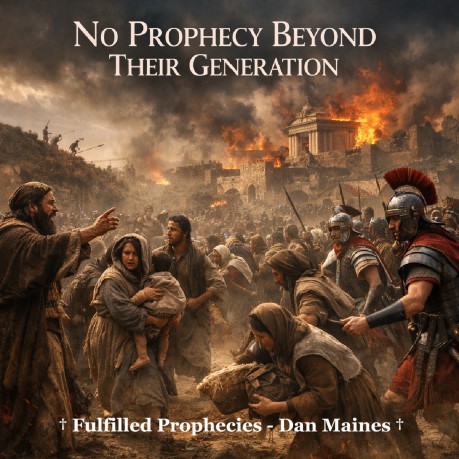
No Prophecy Beyond Their
Generation Introduction † The claim has been made that no prophecy of
the Bible has anything at all to do with the future of us who are
living in the years 2026 and beyond, not one. (Luke 21:22) † Others respond that Jesus spoke of people
outside the first century, some that are not of this fold, and that
His kingdom must extend prophetically into our future. (John 10:16) † We're going to let Scripture speak plainly,
and we're going to deal honestly with what Jesus actually said to His
apostles, to their faces, in their lifetime. (Matthew 24:34)
Remember Jesus is NOT talking to you. Matthew 16:27-28 For the Son of Man is going to come in the glory of His Father
with His angels, and WILL THEN REPAY EVERY MAN ACCORDING TO HIS
DEEDS. Truly I say to you, there are some of those who are standing
here who will not taste death until they see the Son of Man coming in
His kingdom. † Jesus tied His coming and judgment to some
standing there not tasting death, that is a built in time limit.
(Matthew 24:34) † He didn't say a distant generation thousands
of years later would witness it, He said some standing here. (Luke
9:27) † If some standing there lived to see it, then
it cannot be pushed into 2026 and beyond. (Hebrews 10:37) Luke 21:20-23 But when you see Jerusalem surrounded by armies, then recognize
that her desolation is near. Then those who are in Judea must flee to
the mountains, and those who are in the midst of the city must leave,
and those who are in the country must not enter the city, because
these are days of vengeance, so that all things which are written
will be fulfilled. Woe to those who are pregnant and to those who are
nursing babies in those days, for there will be great distress upon
the land and wrath to this people. † Jesus gave them the sign, Jerusalem
surrounded by armies, and told them what to do, flee Judea, that is
geographic, local, and time bound. (Matthew 24:16) † He called it days of vengeance so that all
things which are written will be fulfilled, that is total fulfillment
language. (Daniel 9:26-27) † He said wrath to this people and distress
upon the land, that is covenant judgment language. (1 Thessalonians
2:14-16) † If all things which are written were
fulfilled in those days of vengeance, then prophecy is not waiting on
2026 and beyond. (Matthew 5:17-18) John 10:16 I have other sheep, which are not of this fold, I must bring them
also, and they will hear My voice, and they will become one flock
with one shepherd. † The other sheep were Gentiles being brought
into the one flock under one Shepherd. (Ephesians 2:11-13) † Jesus said they will hear My voice, and that
happened through apostolic preaching. (Colossians 1:5-6) † This does not create a new prophetic timeline
beyond their generation, it describes the expansion of the already
established kingdom. (Acts 1:8) Ephesians 2:14-16 For He Himself is our peace, who made both groups into one and
broke down the barrier of the dividing wall, by abolishing in His
flesh the enmity, which is the Law of commandments contained in
ordinances, so that in Himself He might make the two into one new
man, thus establishing peace, and might reconcile them both in one
body to God through the cross, by it having put to death the enmity. † Paul speaks in completed language, made,
broke down, abolished, establishing, reconcile, put to death, that is
fulfillment language. (Colossians 2:14) † The dividing wall between Jew and Gentile was
removed in the first century through the cross. (Galatians 3:28) † The one new man was already being formed in
Paul's day, proving the other sheep were being gathered then. (Romans
10:12-13) Matthew 24:34 Truly I say to you, this generation will not pass away until all
these things take place. † This generation refers to the generation He
was speaking to. (Matthew 23:36) † All these things includes the coming,
judgment, tribulation, and fulfillment statements. (Luke 21:22) † If all these things took place before that
generation passed, then prophecy did not extend into 2026 and beyond.
(Hebrews 8:13) Matthew 23:36 Truly I say to you, all these things will come upon this
generation. † Jesus repeated the time limit clearly, all
these things upon this generation. (Matthew 24:34) † The judgment He described was directed at His
contemporaries. (1 Thessalonians 2:14-16) † This reinforces that prophetic fulfillment
was confined to that era. (Luke 21:20) Luke 21:32 Truly I say to you, this generation will not pass away until all
things take place. † Luke confirms the same time statement
independently. (Matthew 24:34) † All things means the events of the discourse,
including desolation and vengeance. (Luke 21:22) † The repetition removes any excuse to stretch
fulfillment into distant centuries. Hebrews 10:37 For yet in a very little while, He who is coming will come, and
will not delay. † The writer says in a very little while, not
in thousands of years. (James 5:8) † Will not delay contradicts the idea of a two
thousand year postponement. † This confirms the nearness of the coming in
their lifetime. Hebrews 8:13 When He said, A new covenant, He has made the first obsolete. But
whatever is becoming obsolete and growing old is ready to disappear. † The old covenant was already becoming
obsolete in their generation. † Ready to disappear shows the covenant system
was about to vanish. (Luke 21:22) † That disappearance occurred in AD 70 with the
destruction of Jerusalem. 1 Corinthians 15:24-26 then comes the end, when He hands over the kingdom to the God and
Father, when He has abolished all rule and all authority and power.
For He must reign until He has put all His enemies under His feet.
The last enemy that will be abolished is death. † He must reign until shows He was already
reigning in Paul's day. (Acts 2:30-36) † The end follows the abolition of enemies, not
a future earthly millennium. † The reign is ongoing, but the prophetic
transition occurred in their generation. Historical References † Eusebius records that believers fled
Jerusalem before its destruction, fulfilling Luke 21 literally.
(Ecclesiastical History 3.5) † Josephus documented the siege, famine, and
devastation exactly as Jesus described. (Wars of the Jews 6.9.3) † Irenaeus connected the Lord's warnings with
the destruction that came upon Jerusalem. (Against Heresies 5.25) † Early Christian writers consistently treated
the fall of Jerusalem as fulfillment, not as unfinished prophecy. How It Applies To Us Today † We are not waiting for prophecy to complete
itself, we are living in the reality of a fulfilled kingdom. (Hebrews
12:28) † Christ reigns now because He was seated on
David's throne in the first century. (Acts 2:30-36) † The kingdom shall never end because His
dominion is everlasting. (Daniel 7:14) † Our confidence rests in completed redemption,
not postponed expectation. (John 19:30) † We live under a kingdom that cannot be
shaken, not one that is still waiting to arrive. (Hebrews 12:28) † We are not standing on the edge of wrath, we
are standing in grace because the covenant judgment has already
fallen. (Romans 5:1-2) † The fear driven timelines of modern futurism
collapse when we accept that the days of vengeance already occurred.
(Luke 21:22) † Our mission is not to predict prophetic
countdowns, it is to proclaim a finished work. (John 19:30) † The gospel we preach is not a warning that
destruction is about to come upon Jerusalem, it is the announcement
that Christ reigns. (Acts 17:31) † Because the old covenant passed away, we do
not live under shadows, types, and temple systems, we live in the
reality of the new covenant. (2 Corinthians 3:11) † The kingdom advancing today is not prophetic
fulfillment unfolding, it is the ongoing expansion of a kingdom
already established. (Colossians 1:13) † We do not wait for Jesus to take His throne,
He already has, and we serve under His present authority. (Matthew
28:18) † Confidence replaces confusion when we
understand that all things which are written were fulfilled in their
time. (Luke 21:22) † The stability of our faith rests in fulfilled
prophecy, not postponed expectation. (2 Peter 1:19) Q and A Appendix Q If all prophecy was fulfilled, does that mean
Christ is not reigning now? A No. Acts 2:30-36 shows He was seated on David's
throne in the first century, and Daniel 7:14 declares His dominion is
everlasting. Q What about some that are not of this fold? A John 10:16 refers to Gentile inclusion, and
Ephesians 2:14-16 shows that unity was established in the apostolic
age. Q Does Revelation speak about our future? A Revelation 1:1 and 1:3 state the events must
soon take place and the time is near. Q Are there any prophecies left for 2026 and
beyond? A Matthew 24:34, Matthew 23:36, and Luke 21:32
state that all these things would take place before that generation
passed away. Q If Jesus already came in judgment in that
generation, what are we waiting for now? A We’re not waiting for prophetic fulfillment.
We’re living in the ongoing reign of Christ. Hebrews 12:28 says we
receive a kingdom which cannot be shaken. Q What about the Great Commission, does that mean
prophecy continues? A The Great Commission is mission, not prophecy.
Matthew 28:18-20 shows Christ already had all authority. The command
to disciple the nations flows from fulfillment, not future
prediction. Q If Revelation was fulfilled, why does evil
still exist? A Revelation addresses covenant judgment and the
fall of the old order, not the immediate removal of all sin from the
earth. 1 Corinthians 15:25 says He must reign until He has put all
His enemies under His feet, showing an ongoing reign after
fulfillment. Q What about the resurrection, hasn't that
already happened in your view? A 2 Timothy 2:17-18 warns about those who
misunderstood the resurrection timing. The resurrection connected to
the end of the age and covenant transition occurred as Scripture said
within that generation, 1 Corinthians 15:23-24. Q If all prophecy was fulfilled, does that mean
there is no future judgment for individuals? A Individual judgment is consistent throughout
Scripture. Hebrews 9:27 says it is appointed for men to die once and
after this comes judgment. That is not a postponed covenant event,
that is personal accountability. Q Why does the New Testament repeatedly say soon
and near if it really meant thousands of years? A It doesn't mean thousands of years. Revelation
1:1 and Revelation 22:10 both state the events must soon take place
and the time is near. The plain meaning supports first century
fulfillment. Q Doesn't the kingdom continuing into future
generations prove prophecy is ongoing? A No. Daniel 7:14 says His dominion is
everlasting. The reign continues, but the prophetic transition into
that reign occurred in their generation. Q Are you saying there is no future hope? A Our hope is not in postponed prophecy, it is in
a reigning King and an unshakable kingdom. Colossians 1:13 says we
have been transferred into the kingdom of His beloved Son. † This is the fulfilled perspective we proclaim at
Fulfilled Prophecies † Source Index † Matthew 16:27-28; Luke 21:20-23; John 10:16;
Ephesians 2:14-16; Matthew 24:34; Matthew 23:36; Luke 21:32; Hebrews
10:37; Hebrews 8:13; 1 Corinthians 15:24-26; Acts 2:30-36; Daniel
7:14; Hebrews 12:28; John 19:30 † Eusebius, Ecclesiastical History 3.5;
Josephus, Wars of the Jews 6.9.3; Irenaeus, Against Heresies 5.25
By Dan Maines
© Fulfilled Prophecies - Dan
Maines.
Links