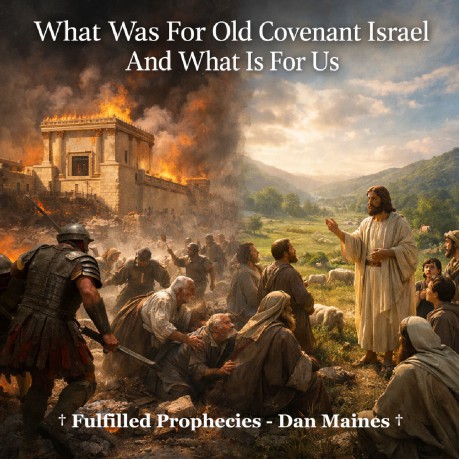
What Was For Old Covenant
Israel And What Is For Us Introduction † A lot of confusion in the church comes from
not knowing what belonged to Old Covenant Israel and what belongs to
us in the fulfilled kingdom today. (Hebrews 8:13) Matthew 25:31-34, 41 When the Son of Man comes in His glory, and all the angels with
Him, then He will sit on His glorious throne. † This passage is part of the Olivet Discourse,
and Jesus already said all these things would happen in that
generation, not thousands of years later. (Matthew 24:34) Matthew 24:34 Truly I say to you, this generation will not pass away until all
these things take place. † Jesus didn't say some of these things. He
didn't say most of these things. He said all these things. (Matthew
16:27-28, Mark 13:30, Luke 21:32) Matthew 23:36-38 Truly I say to you, all these things will come upon this
generation. † Jesus tied covenant judgment directly to that
generation. (Matthew 24:34) Romans 9:6 But it is not as though the word of God has failed. For they are
not all Israel who are descended from Israel; † Even in the first century, there was a
division within Israel. (Romans 2:28-29) What Was For Old Covenant Israel † The destruction of the Temple. (Matthew
24:1-2) Hebrews 8:13 When He said, A new covenant, He has made the first obsolete. But
whatever is becoming obsolete and growing old is ready to disappear. † The Old Covenant was ready to disappear in
the first century. (Hebrews 9:9-10) What Is For Us † We live in the fulfilled kingdom. (Colossians
1:13) 2 Corinthians 5:18-19 Now all these things are from God, who reconciled us to Himself
through Christ and gave us the ministry of reconciliation, † Our commission isn't to warn about an
impending AD 70 judgment. (Matthew 28:18-20) Historical References † Eusebius recorded that the Christians fled
Jerusalem before its destruction, recognizing Jesus' warnings.
(Ecclesiastical History 3.5) How It Applies To Us Today † We don't live under impending covenant wrath.
(Romans 8:1) Q & A Appendix Q If the sheep and goats judgment already
happened, why do people still die? Q Wasn't that a final judgment of all humanity? Q Are there any future covenant judgments
coming? Q If the sheep and goats was only for Old
Covenant Israel, does that mean God no longer judges anyone? Q What about Matthew 24:35 where Jesus says
heaven and earth will pass away? Q If the tribulation was limited to Judea, why
does it sound so global? Q Does this mean there is no future second
coming? Q Why does Revelation speak in such dramatic
imagery if it was fulfilled in the first century? Q If the Law was abolished, what guides believers
today? Q Are we living in the kingdom now or waiting for
it? † This is the fulfilled perspective we proclaim at
Fulfilled Prophecies † © Fulfilled Prophecies - Dan Maines. Source Index † Matthew 25:31-34, 41; Matthew 24:34; Matthew
23:36-38; Romans 9:6; Hebrews 8:13; 2 Corinthians 5:18-19; Hebrews
12:26-28; Colossians 1:13; Ephesians 2:14-16; Matthew 24:16; Matthew
10:5-6; Matthew 15:24; Isaiah 66:24; Daniel 12:2; Romans 11:5;
Hebrews 10:9; Romans 8:1 † Eusebius, Ecclesiastical History 3.5;
Josephus, Wars of the Jews, Book 6; Irenaeus, Against Heresies 5.25
By Dan Maines
†
If we don't divide covenantal context correctly, we'll misapply
judgment texts, time statements, and promises that were never written
to us. (Matthew 24:34; Matthew 23:36)
† The
sheep and the goats judgment is one of the clearest examples of
something that was for first century Old Covenant Israel. (Matthew
25:31-46)
† When we let Jesus define His own
time frame, everything lines up without forcing future speculation.
(Luke 21:32)
All the nations
will be gathered before Him, and He will separate them from one
another, as the shepherd separates the sheep from the goats;
and
He will put the sheep on His right, and the goats on the left.
Then
the King will say to those on His right, Come, you who are blessed of
My Father, inherit the kingdom prepared for you from the foundation
of the world.
Then He will also say to those on His left, Depart
from Me, accursed ones, into the eternal fire which has been prepared
for the devil and his angels.
†
The throne judgment language is covenantal, not a modern courtroom
scene at the end of human history. (Matthew 23:36-38)
†
The word nations here is ethnos, meaning tribes or covenant groups,
and in context it's dealing with how people treated Christ's brethren
during the tribulation leading up to AD 70. (Matthew 10:40-42)
†
Jesus' earthly mission focus was Old Covenant Israel first, not
modern nation-states. (Matthew 10:5-6; Matthew 15:24)
†
The judgment fell when Jerusalem fell, because that was the climax of
the age Jesus was ending. (Luke 21:20-22)
†
The coming tribulation was geographically limited to Judea, not the
globe. (Matthew 24:16)
† Eternal fire
language reflects covenant judgment imagery used by the prophets.
(Isaiah 66:24; Daniel 12:2)
† The sheep
and goats judgment was part of all these things. (Matthew 25:31-46)
†
If that generation passed, and it did, then the judgment occurred
within their lifetime. (Matthew 23:36)
Behold, your house is being left to you desolate!
† He wasn't
talking about a future race thousands of years removed from His
audience. (Luke 17:25)
† The house left
desolate was the Temple, and that happened in AD 70. (Luke 21:20)
†
The sheep and goats separation is covenant separation between
faithful and apostate Israel. (Romans 9:6)
†
That desolation fulfilled the covenant warnings spoken long before.
(Daniel 9:26-27)
†
True Israel consisted of believing Jews and Gentiles united in
Christ. (Galatians 3:28-29)
† The goats were
apostate covenant breakers. (Acts 2:36-40)
†
The sheep were those who received Christ and endured through the
tribulation. (Matthew 24:13)
† The remnant
principle was already active in that generation. (Romans 11:5)
† The end of the Old Covenant age.
(Hebrews 8:13)
† The tribulation tied to
Judea and Jerusalem. (Matthew 24:16)
† The
judgment upon that generation. (Matthew 23:36)
†
The passing away of heaven and earth, meaning the covenant world of
Israel. (Hebrews 12:26-28)
† The shaking
removed what belonged to that covenant order so that what cannot be
shaken would remain. (Hebrews 12:27-28)
†
Those events were never about modern geopolitics. (John 18:36)
†
They were about God closing one covenant and establishing another.
(Ephesians 2:14-16)
† The Law of commandments
contained in ordinances was abolished in His flesh. (Ephesians 2:15)
† It did
disappear in AD 70. (Hebrews 12:27)
† That
transition was for them. (Matthew 23:36)
†
We're not waiting for that to happen. (Hebrews 12:28)
† We're not awaiting national judgment.
(Romans 8:1)
† We're not bracing for covenant
wrath. (1 Thessalonians 5:9)
† We're living
in reconciliation. (2 Corinthians 5:18-19)
†
We have received a kingdom which cannot be shaken. (Hebrews 12:28)
namely,
that God was in Christ reconciling the world to Himself, not counting
their trespasses against them, and He has committed to us the word of
reconciliation.
†
That judgment is past. (Matthew 24:34)
† Our
mission is reconciliation, not speculation. (2 Corinthians 5:20)
†
The kingdom has been inherited, not postponed. (Hebrews 12:28)
†
There is now no condemnation for those who are in Christ Jesus.
(Romans 8:1)
† Josephus
documented the catastrophic fall of Jerusalem exactly within that
generation. (Wars of the Jews, Book 6)
†
Irenaeus testified that the Temple was destroyed in fulfillment of
prophecy. (Against Heresies 5.25)
† Early
Christians understood those warnings as first century realities, not
distant future events. (Matthew 24:34)
† We don't reinterpret Jesus'
time statements to protect a future system. (Matthew 24:34)
†
We live in the finished kingdom. (Hebrews 12:28)
†
We proclaim reconciliation, not fear. (2 Corinthians 5:20)
†
We don't wait for sheep and goats separation, it already happened in
the covenantal transition. (Matthew 25:31-46)
†
Our identity isn't tied to Israel's Old Covenant structure.
(Galatians 4:21-31)
† It's rooted in Christ's
fulfilled work. (Ephesians 1:10)
A Because
that judgment was covenantal, not biological. It was about the end of
the Old Covenant age, not the end of physical death. (Matthew 24:34)
A
No. Jesus limited the timing to that generation and tied it to
Jerusalem's desolation. (Matthew 23:36-38)
A No. Hebrews 8:13 shows the Old
Covenant was ready to disappear in their time, and it did. We now
live in the established New Covenant age. (Hebrews 12:28)
A
No. It means that specific covenant judgment tied to that generation
has already occurred. Personal accountability before God remains, but
the Old Covenant age judgment of Matthew 25 was fulfilled in their
lifetime. (Matthew 24:34; Hebrews 9:27)
A That refers
to the covenant world of Israel, not the destruction of the physical
universe. Hebrews 12:26-28 explains that what was shaken was removed
so that what cannot be shaken would remain.
A Prophetic language
often uses cosmic imagery to describe covenant collapse. The actual
instructions were local and geographic. Those in Judea were told to
flee. (Matthew 24:16; Luke 21:20-22)
A It means the coming in judgment Jesus
described in the Olivet Discourse happened in that generation. He
came in covenant authority against Jerusalem just as He said He
would. (Matthew 16:27-28; Matthew 24:34)
A
Because it is prophetic apocalyptic language, the same kind used in
Isaiah, Ezekiel, and Daniel when speaking about covenant judgment. It
describes the fall of a covenant world, not the end of planet earth.
(Isaiah 13:10; Ezekiel 32:7-8; Daniel 7:13)
A We are under the law of Christ, not
the Law of Moses. The commandments contained in ordinances were
abolished, but we now walk by the Spirit in the established New
Covenant. (Ephesians 2:15; Galatians 6:2; Romans 8:4)
A We have been transferred into His kingdom
already. It is not future, it is present and unshakable. (Colossians
1:13; Hebrews 12:28)
Links