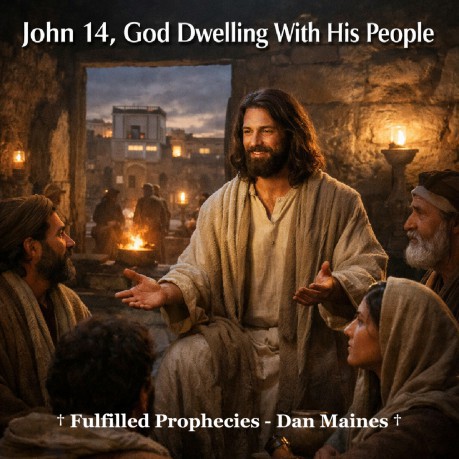
John 14, God Dwelling With
His People Introduction † John 14 isn't about people going to heaven,
it's about Jesus coming to dwell with His people. John 14:2-3 In My Father's house are many dwelling places; if it were
not so, I would have told you; for I go to prepare a place for you.
If I go and prepare a place for you, I will come again and receive
you to Myself, that where I am, there you may be also. † Jesus says He goes to prepare a place and
then comes again to receive them to Himself. John 14:23 Jesus answered and said to him, If anyone loves Me, he
will keep My word; and My Father will love him, and We will come to
him and make Our dwelling with him. † Just a few verses later Jesus explains what
receiving them to Himself actually means. Hebrews 9:8-10 The Holy Spirit is signifying this, that the way into the
holy place has not yet been disclosed while the outer tabernacle is
still standing, which is a symbol for the present time. Accordingly
both gifts and sacrifices are offered which cannot make the worshiper
perfect in conscience, since they relate only to food and drink and
various washings, regulations for the body imposed until a time of
reformation. † The old dwelling system restricted access. Hebrews 10:19-22 Therefore, brethren, since we have confidence to enter the
holy place by the blood of Jesus, by a new and living way which He
inaugurated for us through the veil, that is, His flesh, and since we
have a great priest over the house of God, let us draw near with a
sincere heart in full assurance of faith, having our hearts sprinkled
clean from an evil conscience and our bodies washed with pure water. † Access is opened through Christ, not
relocation. John 4:24 God is spirit, and those who worship Him must worship in
spirit and truth. † God isn't confined to a physical location. Isaiah 66:1 Thus says the Lord, Heaven is My throne and the earth is
My footstool. Where then is a house you could build for Me? And where
is a place that I may rest? † Throne and footstool are authority terms, not
street addresses. 1 Kings 8:27 But will God indeed dwell on the earth? Behold, heaven and
the highest heaven cannot contain You, how much less this house which
I have built! † Solomon already knew God couldn't be
confined. John 14:10 Do you not believe that I am in the Father, and the Father
is in Me? The words that I say to you I do not speak on My own
initiative, but the Father abiding in Me does His works. † Jesus reveals mutual indwelling. Ephesians 2:21-22 In whom the whole building, being fitted together, is
growing into a holy temple in the Lord, in whom you also are being
built together into a dwelling of God in the Spirit. † Paul confirms believers are God's dwelling
place. Jeremiah 23:23-24 Am I a God who is near, declares the Lord, and not a God
far off? Can a man hide himself in hiding places so I do not see him?
declares the Lord. Do I not fill the heavens and the earth? declares
the Lord. † God fills heaven and earth by His presence. Revelation 21:3 And I heard a loud voice from the throne, saying, Behold,
the tabernacle of God is among men, and He will dwell among them, and
they shall be His people, and God Himself will be among them. † Revelation ends exactly where John 14
pointed. Historical References † Irenaeus taught that God's dwelling with
humanity was realized through Christ and the church. How It Applies To Us Today † We don't wait for presence, we live in it. Q & A Appendix Q Is John 14 about going to heaven? Q What does heaven represent in this teaching? Q When was this dwelling reality fully
established? Q If Christ was going to the Father, wouldn't
that mean He was going to heaven? Q When Christ went to prepare a place, did He
bring it back with Him? † This is the fulfilled perspective we proclaim at
Fulfilled Prophecies † Source Index † John 14:2-3; John 14:10; John 14:23; John
4:24; Hebrews 9:8-10; Hebrews 10:19-22; Isaiah 66:1; 1 Kings 8:27;
Ephesians 2:21-22; Jeremiah 23:23-24; Revelation 21:3
By Dan Maines
†
Jesus is explaining covenant transition, not post death relocation.
†
The focus of the chapter is presence, access, and indwelling under
the New Covenant.
† This teaching was given
on the eve of the cross, during the final hours of the Old Covenant
age.
† The audience is the first century
disciples who were about to experience the passing of the old house
and the establishment of the new.
†
The movement is toward the disciples, not away from the earth.
†
The language of house and dwelling places points to covenant space,
not geography.
† The Fathers house is
covenantal, not cosmic.
† This house was
transitioning from the Old Covenant system to the New Covenant
reality.
†
The Father and the Son come to the believer and make their dwelling
with him.
† The direction is clear, God comes
to man, not man going to heaven.
† This
defines the meaning of the promise in verses 2 and 3.
†
Jesus interprets His own words as indwelling, not relocation.
†
The problem was never distance, it was covenant limitation.
†
The transition Jesus spoke of was from the old house to the new.
†
As long as the old tabernacle stood, full access wasn't realized.
†
John 14 anticipates the removal of that barrier.
† Drawing near is covenant
language, not spatial travel.
† The house of
God is now entered through union with Christ.
†
The veil language confirms covenant transition, not a future
departure.
† John 14 and Hebrews are teaching
the same reality.
†
Worship is no longer tied to place, but to covenant reality.
†
This aligns perfectly with Jesus teaching in John 14.
†
Spirit based worship requires indwelling, not distance.
† Heaven and earth describe
God's rule, not His containment.
† This
language rules out the idea of God being locked in a location.
†
The New Covenant reveals where God chooses to dwell.
† Even the highest heaven can't
contain Him.
† This proves dwelling language
is relational and covenantal.
† The temple
was never about housing God, but about access to Him.
†
Presence replaces distance.
† This becomes
the pattern for believers.
† What existed in
Christ is extended to His people.
† The temple is now people, not
stone.
† This fulfills what Jesus promised in
John 14.
† The New Covenant dwelling is
corporate and relational.
†
He rules from heaven in authority.
† He
dwells with His people relationally.
† Heaven
is the realm of His reign, not His confinement.
† God dwelling with man, not man
relocating to find God.
† The New Covenant
reality is His dwelling is with us.
† This
marks the full manifestation of the New Covenant order after the
passing of the old.
†
Tertullian affirmed that the Spirit makes believers the habitation of
God.
† Augustine identified the church as the
city and dwelling of God on earth.
† Early
Christian writers consistently emphasized indwelling over relocation.
†
We don't strive to reach heaven, we walk in union with Christ now.
†
Our confidence rests in access, not distance.
†
Our identity is rooted in being God's dwelling place.
†
Faith is lived from presence, not anticipation of escape.
A
No, it's about Jesus coming to dwell with His people, John 14:23,
Ephesians 2:21-22.
A
Heaven represents God's authority and reign, not a physical address,
Isaiah 66:1, Jeremiah 23:23-24.
A With the passing of the Old
Covenant system and the full establishment of the New Covenant in the
first century, Hebrews 9:8-10, Revelation 21:3.
A Yes, Christ
did go to the Father, but going to the Father speaks of covenant
authority and completion, not abandonment of the earth. Jesus said
the Father dwelled in Him and that He would come again and dwell in
His people, John 14:10, John 14:23.
A Yes, the prepared
dwelling is revealed as the New Covenant body of Christ, where God
now dwells by His Spirit. What was prepared through the cross and
resurrection was manifested as the living temple, Ephesians 2:21-22,
Hebrews 10:19-22.
© Fulfilled Prophecies - Dan
Maines.
†
Irenaeus, Against Heresies; Tertullian, On the Resurrection of the
Flesh; Augustine, City of God
Links