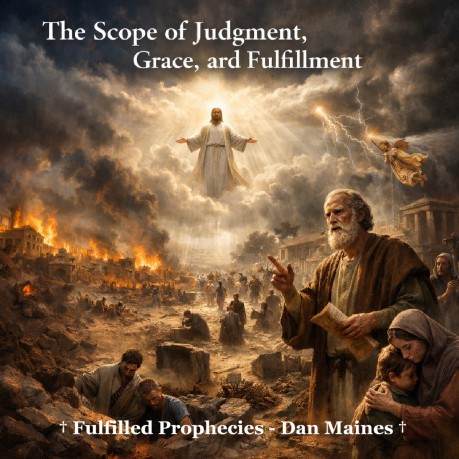
The Scope of Judgment, Grace,
and Fulfillment Introduction † Much confusion exists today because people
blend fulfilled judgment language with ongoing gospel realities,
mixing covenantal judgment with everyday life in the world. (1
Corinthians 14:33) John 5:28-29 Do not marvel at this; for an hour is coming, in which all who are
in the tombs will hear His voice, and will come forth; those who did
the good deeds to a resurrection of life, those who committed the
evil deeds to a resurrection of judgment. † Jesus speaks of an hour, not a timeless
process, pointing to a defined period of judgment. (Daniel 12:1-2) 1 Thessalonians 4:16-17 For the Lord Himself will descend from heaven with a shout, with
the voice of the archangel and with the trumpet of God, and the dead
in Christ will rise first. Then we who are alive and remain will be
caught up together with them in the clouds to meet the Lord in the
air, and so we shall always be with the Lord. † Paul addresses first century believers
grieving fellow saints, not distant generations. (1 Thessalonians
4:13) 1 Peter 5:8 Be sober, be vigilant; because your adversary the devil, as a
roaring lion, walketh about, seeking whom he may devour. † Peter writes after the cross, proving Satan
wasn't eliminated in the sense futurists claim. (Acts 5:3) Hebrews 4:16 Therefore let us draw near with confidence to the throne of grace,
so that we may receive mercy and find grace to help in time of need. † The throne of grace remains open, directly
contradicting claims of total closure. (Romans 5:2) Revelation 15:8 And the temple was filled with smoke from the glory of God and
from His power; and no one was able to enter the temple until the
seven plagues of the seven angels were finished. † This closure is temporary and covenantal, not
eternal. (Isaiah 6:4) Revelation 22:11 Let the one who does wrong still do wrong, and the one who is
filthy still be filthy; and let the one who is righteous still
practice righteousness, and the one who is holy still keep himself
holy. † This reflects fixed covenant standing at the
close of the age. (Daniel 12:10) Revelation 22:12 Behold, I am coming quickly, and My reward is with Me, to render
to every man according to what he has done. Revelation 11:18-19 And the nations were enraged, and Your wrath came, and the time
came for the dead to be judged, and the time to reward Your
bond-servants the prophets and the saints and those who fear Your
name, the small and the great, and to destroy those who destroy the
earth. And the temple of God which is in heaven was opened; and the
ark of His covenant appeared in His temple, and there were flashes of
lightning and sounds and peals of thunder and an earthquake and a
great hailstorm. † These passages describe covenant judgment
against Jerusalem and the persecuting powers. (Matthew 23:36) Revelation 16 † The seven plagues parallel the Exodus
plagues, showing covenantal pattern judgment. (Exodus 7-12) Revelation 21:8 But for the cowardly and unbelieving and abominable and murderers
and immoral persons and sorcerers and idolaters and all liars, their
part will be in the lake that burns with fire and brimstone, which is
the second death. † The second death represents covenantal
separation and judgment, not biological extinction. (Isaiah 66:24) Genesis 3:16-19 † Pain in childbirth and labor continue,
proving the Genesis curse wasn't removed at the cross. (Romans
8:20-22) John 1:18 No one has seen God at any time; the only begotten God who is in
the bosom of the Father, He has explained Him. † God remains unseen in essence, though known
through Christ. (Colossians 1:15) Historical References † Josephus describes the destruction of
Jerusalem as covenantal judgment. (Wars of the Jews 6) How It Applies To Us Today † We live under grace, not awaiting wrath.
(Romans 8:1) Q & A Appendix Q Are the graves empty of the dead to be judged
at Jesus second coming? Q Are prison cells empty of criminals? Q Were Satan and his 1/3 completely eliminated at
the cross? Q Is the throne of grace now closed? Q Has the Holy Spirit been withdrawn? Q Has final judgment begun? Q How about the seven plagues in Revelation 16? Q How about the second death in Revelation
21:8? Q Have the curses of childbirth pain and labor
ceased? Q Have you seen God? Q Does fulfilled judgment mean God no longer
judges sin today? † This is the fulfilled perspective we proclaim at
Fulfilled Prophecies † Source Index † John 5:28-29; 1 Thessalonians 4:16-17; 1
Peter 5:8; Hebrews 4:16; Revelation 15:8; Revelation 22:11-12;
Revelation 11:18-19; Revelation 16; Revelation 21:8; Genesis 3:16-19;
John 1:18
By Dan Maines
This
post is a response to questions raised from a futurist.
† Scripture must be
allowed to define its own categories, especially when it speaks of
resurrection, judgment, wrath, grace, and restoration within a
redemptive framework. (Isaiah 28:10)
† From
the fulfilled perspective, Revelation and related passages describe
covenantal judgment and transition, not the annihilation of humanity,
society, or daily life. (Matthew 24:34)
† The
controlling question in every judgment text is not modern
speculation, but who Jesus said these things were coming upon and
when. (Matthew 24:34)
†
Resurrection language here is judicial and covenantal, consistent
with Daniel 12:2, addressing Israel under the Law. (Ezekiel
37:12-14)
† The graves aren't physically
emptied worldwide, showing the passage concerns authority,
vindication, and judgment rather than biological reversal. (Hosea
6:1-2)
† The imagery draws from Old Testament
theophanic language where God comes in judgment, not literal
atmospheric travel. (Isaiah 19:1)
† The
continued presence of physical death proves this wasn't a global
bodily evacuation. (Hebrews 9:27)
†
Satan's activity is restrained, not eradicated, consistent with
Revelation 20:1-3. (Luke 10:18)
† The cross
defeated Satan's authority over the Law and death, not his influence
in the world. (Colossians 2:14-15)
†
Believers are invited continually, showing access didn't end with
covenant judgment. (Ephesians 2:18)
†
Judgment on Jerusalem didn't cancel grace toward the faithful.
(Romans 11:22)
† The imagery mirrors
Old Testament judgment scenes against nations and Israel. (Exodus
40:34-35)
† It refers to the Old Covenant
temple system, not heaven itself. (Hebrews 9:24)
† It doesn't
indicate the Holy Spirit's withdrawal from the world. (John 14:16)
†
Gospel transformation continues, proving the Spirit remains active.
(2 Corinthians 3:17-18)
†
The language is judicial and symbolic, rooted in Old Testament
prophetic imagery. (Isaiah 13:9-10)
† Final
judgment in this context is covenantal, not the end of human history.
(Luke 21:22)
† Scripture defines this
judgment as imminent to its original audience, not delayed thousands
of years. (Revelation 1:1; Revelation 22:6)
†
They target a specific rebellious system, not the entire globe.
(Revelation 1:1)
† History records the
destruction of Jerusalem as the fulfillment of these warnings. (Luke
19:43-44)
†
It parallels Old Testament death language for exile and rejection.
(Jeremiah 51:57)
† Life continues, but
covenant standing is lost. (Matthew 8:12)
† Redemption addresses sin and
death, not the structure of physical existence. (John 3:16)
†
Scripture never teaches these conditions would cease in this age.
(Ecclesiastes 3:1-2)
† Seeing
God in Revelation is covenantal language for access and relationship.
(Matthew 5:8)
† Faith, not physical sight,
defines the believer's walk. (2 Corinthians 5:7)
†
Eusebius confirms fulfillment within that generation. (Ecclesiastical
History 3)
† Clement of Alexandria taught
realized judgment and mature faith. (Stromata)
†
Tacitus records the catastrophic judgment upon Jerusalem recognized
even by Rome. (Histories 5)
† Christ reigns now, not after a
future catastrophe. (Ephesians 1:20-22)
†
Believers walk in confidence, vigilance, and faithfulness. (Hebrews
12:28)
† Fulfillment shifts believers from
fear-based expectation to faith-driven obedience and gratitude.
(Colossians 2:6-7)
A No. Judgment and
resurrection language were fulfilled covenantally in their appointed
hour, not by emptying physical graves worldwide. (John 5:28-29;
Daniel 12:2; 1 Thessalonians 4:16-17)
A
No. Scripture never teaches covenant judgment removes civil order or
human society. (Romans 13:1-4)
A No. Satan's authority was judged,
but his activity continues in a restrained role. (1 Peter 5:8;
Colossians 2:15)
A
No. Believers are still commanded to draw near with confidence.
(Hebrews 4:16; Romans 5:2)
A
No. The Spirit remains active in righteousness and transformation.
(Revelation 22:11; John 14:16)
A
Yes, covenantal judgment came upon that generation as promised.
(Revelation 22:12; Revelation 11:18-19; Matthew 24:34)
A
They were covenant judgments patterned after Exodus, fulfilled in the
fall of Jerusalem. (Revelation 16; Luke 21:20-22)
A It represents covenantal exclusion and
loss of standing, not physical annihilation. (Revelation 21:8; Isaiah
66:24)
A No. These conditions continue,
proving redemption isn't the removal of physical reality. (Genesis
3:16-19; Romans 8:22)
A No.
God is known through Christ, not physical sight. (John 1:18; 2
Corinthians 5:7)
A No. God continues to judge
righteously and discipline His people, but not through
covenant-ending wrath. (Hebrews 12:6; Romans 2:5-6)
© Fulfilled Prophecies - Dan
Maines.
† Josephus, Wars of the Jews Book
6; Eusebius, Ecclesiastical History Book 3; Clement of Alexandria,
Stromata; Tacitus, Histories 5
Links