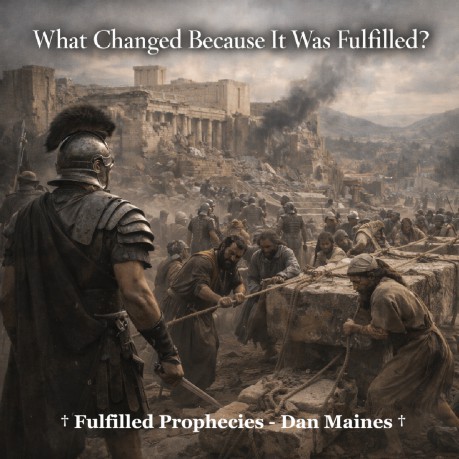
What Changed Because It Was
Fulfilled? Introduction † This sermon isn't about proving fulfillment,
it's about celebrating what fulfillment actually gave us. John 19:30 † Jesus spoke of completing the work the Father
gave Him, not merely ending His suffering (John 4:34). Hebrews 9:26 † The consummation of the ages refers to
covenantal ages, not the end of the physical world (1 Corinthians
10:11). Hebrews 10:12-14 † A seated priest signifies completed
sacrificial work, even while covenantal transition was still underway
(Hebrews 1:3). Matthew 24:34 † Jesus anchored covenantal judgment to His own
generation, not a distant future (Matthew 23:36). Hebrews 12:26-28 † Shaking language refers to covenantal
removal, not physical destruction (Haggai 2:6). Colossians 1:13-14 † The transfer into the kingdom occurred during
the covenant transition period (Ephesians 2:6). Romans 8:1 † No condemnation is possible only because
covenant judgment has already occurred (John 5:24). Hebrews 10:19-22 † Confidence replaces distance because the
temple barrier has been removed (Matthew 27:51). 2 Corinthians 5:17 † Old things passing away refers to covenantal
realities tied to the Law (Hebrews 8:13). Joy That Flows From Fulfillment John 15:11 † Full joy assumes nothing remains unfinished
(John 17:13). Identity After Fulfillment Ephesians 2:19-22 † Identity after AD 70 isn't tied to temple or
nation (Acts 17:24). Historical References † Josephus recorded the destruction of
Jerusalem and the temple in AD 70. How It Applies To Us Today † We live free from fear because covenant
judgment is past. Q & A Appendix Q What changed because it was fulfilled? Q When did the old covenant end? Q What did the cross accomplish? Q If fulfillment happened in AD 70, what are we
living in now? Q Does fulfilled prophecy mean God is finished
working in our lives? Q Why do many Christians still live in fear if
judgment is past? Q Did AD 70 change God's nature or His love? Q What replaces end times fear after
fulfillment? Q Are believers missing anything promised in
Scripture today? Q How should fulfilled believers view the
future? Q What does fulfillment change about how we live
daily? † This is the fulfilled perspective we proclaim at
Fulfilled Prophecies † Source Index † John 19:30; Hebrews 9:26; Hebrews 10:12-14;
Matthew 24:34; Hebrews 12:26-28; Colossians 1:13-14; Romans 8:1;
Hebrews 10:19-22; 2 Corinthians 5:17; John 15:11; Ephesians 2:19-22
By Dan Maines
†
Most sermons answer the question, what happened, but this one answers
the question, so what.
† Fulfillment isn't
just a doctrine to defend, it's a reality to live in, and when it's
understood, it brings peace, joy, and rest instead of fear and
anxiety.
Therefore when Jesus had received
the sour wine, He said, It is finished! And He bowed His head and
gave up His spirit.
†
Finished means it was brought to its intended goal, leaving nothing
unfinished (John 17:4).
† The cross
accomplished the redemptive work that would be fully applied and
closed with the removal of the old covenant system in AD 70 (Hebrews
8:13).
Otherwise, He would have needed
to suffer often since the foundation of the world, but now once at
the consummation of the ages He has been manifested to put away sin
by the sacrifice of Himself.
† Sin being put away describes the
completed sacrificial basis, not the immediate disappearance of the
temple system (Hebrews 8:13).
† The removal
of the old covenant world culminated in the judgment of Jerusalem in
AD 70 (Matthew 24:34).
But He, having offered one
sacrifice for sins for all time, sat down at the right hand of God,
waiting from that time onward until His enemies be made a footstool
for His feet. For by one offering He has perfected for all time those
who are sanctified.
† Perfected for all time
speaks to standing in Christ, not the immediate end of the temple
order (Hebrews 8:13).
† Fulfillment produces
confidence because the old covenant condemnation was removed in its
appointed time (Romans 8:1).
Truly I say to you, this
generation will not pass away until all these things take place.
†
The destruction He described occurred exactly as stated in AD 70
(Luke 21:20-22).
† What was impending for
them is settled history for us (Hebrews 12:27).
And His voice shook the
earth then, but now He has promised, saying, Yet once more I will
shake not only the earth, but also the heaven. This expression, Yet
once more, denotes the removing of those things which can be shaken,
as of created things, so that those things which cannot be shaken may
remain. Therefore, since we receive a kingdom which cannot be shaken,
let us show gratitude, by which we may offer to God an acceptable
service with reverence and awe.
†
The things that were shaken were removed in the first century
judgment (AD 70).
† What remains is the
unshakable kingdom believers now live in (Hebrews 12:28).
For He rescued us from
the domain of darkness, and transferred us to the kingdom of His
beloved Son, in whom we have redemption, the forgiveness of sins.
†
Kingdom life isn't future relocation, it's present participation
(Luke 17:21).
† Redemption was secured at the
cross and realized fully with the end of the old covenant world
(Hebrews 9:15).
Therefore there is now no
condemnation for those who are in Christ Jesus.
†
Fear driven religion belonged to the pre AD 70 transition period
(Hebrews 10:27).
† Fulfillment establishes
assurance, not anticipation (Romans 8:33).
Therefore, brethren, since
we have confidence to enter the holy place by the blood of Jesus, by
a new and living way which He inaugurated for us through the veil,
that is, His flesh, and since we have a great priest over the house
of God, let us draw near with a sincere heart in full assurance of
faith, having our hearts sprinkled clean from an evil conscience and
our bodies washed with pure water.
†
Access was fully realized once the old system was judged and removed
(Hebrews 9:8).
† Fulfillment establishes
permanent nearness to God (Ephesians 2:18).
Therefore if anyone is in
Christ, he is a new creature, the old things passed away, behold, new
things have come.
†
New creation life stands on the far side of AD 70 (Galatians 6:15).
†
Fulfillment means believers live in the completed new covenant world.
These things I have spoken to you
so that My joy may be in you, and that your joy may be made full.
† Joy is grounded in
completion, not expectation (Hebrews 4:3).
†
Fulfillment turns joy into a settled condition.
So then you are no longer
strangers and aliens, but you are fellow citizens with the saints,
and are of Gods household, having been built on the foundation of the
apostles and prophets, Christ Jesus Himself being the corner stone,
in whom the whole building, being fitted together, is growing into a
holy temple in the Lord, in whom you also are being built together
into a dwelling of God in the Spirit.
† God now dwells in His
people, not in a physical structure (1 Corinthians 3:16).
†
Fulfillment establishes believers as the dwelling place.
† Eusebius
affirmed Jesus judgment prophecies were fulfilled in that
generation.
† Clement of Alexandria taught
the Law reached its goal in Christ.
†
Irenaeus wrote of the summing up of the ages in Christ.
† We serve God from rest,
not anticipation.
† Joy flows naturally from
fulfillment.
A
We now live on the far side of covenant judgment (Matthew 24:34).
A
It ended historically with the destruction of Jerusalem in AD 70
(Hebrews 8:13).
A
The cross secured redemption that was fully applied when the old
covenant world ended (Hebrews 9:15).
A We're living in the unshakable
kingdom that already replaced the old covenant world (Hebrews 12:28).
A No, it means God is no
longer working through shadows but through realized life in Christ
(Galatians 2:20).
A Because fear remains where
fulfillment isn't understood or trusted (1 John 4:18).
A
No, it revealed His faithfulness to keep His word exactly as spoken
(Matthew 5:18).
A Confidence, assurance, and peace
in Christ (Romans 5:1).
A No, all things necessary for
life and godliness have already been given (2 Peter 1:3).
A With hope, not fear, knowing our life
is secure in Christ (Colossians 3:3).
A It frees us to live from love instead
of obligation (2 Corinthians 5:14).
© Fulfilled Prophecies - Dan
Maines.
†
Josephus, Wars of the Jews; Eusebius, Ecclesiastical History; Clement
of Alexandria, Stromata; Irenaeus, Against Heresies
Links