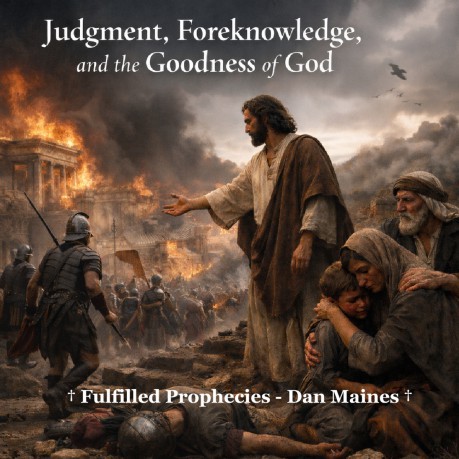
Judgment, Foreknowledge, and
the Goodness of God Introduction † Scripture consistently reveals God as good,
purposeful, and redemptive, not cruel or arbitrary (Psalm 145:8-9). Lamentations 3:31-33 † God plainly states that affliction is not His
desire or disposition (Ezekiel 18:23). Romans 6:23 † Scripture defines the consequence of sin as
death, not eternal torment (James 1:15). Matthew 23:33-38 † Jesus explicitly locates this judgment in
Jerusalem and the temple system, not in the afterlife (Luke
13:34-35). Matthew 24:1-3 † Jesus immediately ties judgment to the
destruction of the temple and the end of the age (Matthew 24:1-3). Matthew 24:34 † Jesus anchors judgment to that living
generation, eliminating the idea of endless delay (Luke 21:32). Isaiah 46:10 † Foreknowledge refers to God's governance of
redemptive history, not predestined damnation (Acts 2:23). Ezekiel 18:23 † God explicitly denies delight in destruction
(Ezekiel 18:23). 1 Timothy 2:4 † God's salvific desire is universal in scope
(Titus 2:11). 2 Corinthians 5:18-19 † God is the initiator of reconciliation, not
the enemy Christ saves us from (Romans 5:8). Hebrews 12:6-11 † Discipline is an expression of love, not
cruelty (Proverbs 3:11-12). 1 Corinthians 15:26 † Death is the enemy to be destroyed, not
humanity (2 Timothy 1:10). Romans 8:1 † Condemnation is removed in Christ, not
postponed (John 5:24). Historical References † Josephus records Jerusalem's fall as
catastrophic covenant judgment, not eternal punishment. How It Applies To Us Today † We are freed from fear based religion rooted
in eternal torment (1 John 4:18). Q & A Appendix Q Does rejecting eternal conscious torment deny
judgment? Q Does foreknowledge mean God creates people
condemned? Q Did Jesus die to save us from the Father? Q If judgment was fulfilled in history, does that
mean God no longer judges at all? Q What about passages that speak of fire and
destruction? Q Does rejecting eternal conscious torment
diminish God's holiness? Q If God is love, why was judgment necessary at
all? Q How should believers talk about hell and
judgment today? Q I was raised in fear of hell and eternal
punishment. How do I move forward without that fear controlling my
faith? † This is the fulfilled perspective we proclaim at
Fulfilled Prophecies † Source Index † Lamentations 3:31-33; Romans 6:23; Matthew
23:33-38; Matthew 24:1-3; Matthew 24:34; Isaiah 46:10; Ezekiel 18:23;
Ezekiel 33:11; 1 Timothy 2:4; 2 Corinthians 5:18-19; Hebrews 12:6-11;
1 Corinthians 15:26; Romans 8:1
By Dan Maines
†
Confusion about hell and judgment comes from later traditions imposed
on Scripture rather than letting Scripture define itself (Colossians
2:8).
† From the fulfilled perspective,
judgment, foreknowledge, love, and redemption must be understood
covenantally and historically, not as eternal conscious torture
(Matthew 23:36; Matthew 24:34).
For the Lord will not
reject forever,
For if He causes grief,
Then He will have
compassion
According to His abundant lovingkindness.
For He
does not afflict willingly
Or grieve the sons of men.
†
Judgment is limited and governed by compassion, not cruelty (Isaiah
57:16).
† Scripture denies the idea of God
taking pleasure in prolonged suffering (Ezekiel 33:11).
For the wages of sin is death,
but the free gift of God is eternal life in Christ Jesus our Lord.
†
Death is the covenant penalty under the law, not metaphysical torture
(Ezekiel 18:4).
† Eternal life is presented
as union with Christ, not rescue from a wrathful Father (John
3:16-17).
You serpents, you brood of
vipers, how will you escape the sentence of hell?
Therefore,
behold, I am sending you prophets and wise men and scribes, some of
whom you will kill and crucify, and some you will scourge in your
synagogues, and persecute from city to city,
so that upon you
may fall the guilt of all the righteous blood shed on earth, from the
blood of righteous Abel to the blood of Zechariah, the son of
Berechiah, whom you murdered between the temple and the altar.
Truly
I say to you, all these things will come upon this
generation.
Jerusalem, Jerusalem, who kills the prophets and
stones those who are sent to her, how often I wanted to gather your
children together, the way a hen gathers her chicks under her wings,
and you were unwilling.
Behold, your house
is being left to you desolate.
† The phrase your house refers to
the covenant house of Israel, centered in the temple (Matthew
21:13).
† This judgment is covenantal,
generational, and historical, not eternal torture (Matthew 23:36).
Jesus came out from the
temple and was going away when His disciples came up to point out the
temple buildings to Him.
And He said to them, Do you not see all
these things? Truly I say to you, not one stone here will be left
upon another, which will not be torn down.
As He was sitting on
the Mount of Olives, the disciples came to Him privately, saying,
Tell us, when will these things happen, and what will be the sign of
Your coming, and of the end of the age?
†
The disciples ask about timing, not eternal destiny, showing the
covenant focus of the discourse (Mark 13:4).
†
This confirms Gehenna language belongs to historical judgment on
Jerusalem (Jeremiah 7:31-34).
Truly I say to you, this
generation will not pass away until all these things take place.
†
Time statements govern interpretation and prevent speculative
afterlife doctrines (Habakkuk 2:3).
†
Fulfillment preserves God's justice and integrity (Joshua 21:45).
Declaring the end from the
beginning,
And from ancient times things which have not been
done,
Saying, My purpose will be established,
And I will
accomplish all My good pleasure.
†
God's pleasure is fulfillment of His purpose, not eternal suffering
(Psalm 100:5).
† Scripture never equates
foreknowledge with creating beings already condemned (Ezekiel 18:23).
Do I have any pleasure in the
death of the wicked, declares the Lord God, rather than that he
should turn from his ways and live?
† Judgment serves repentance
and life, not endless torment (Hosea 6:1-2).
†
Eternal conscious torment contradicts God's stated desire (Ezekiel
33:11).
Who desires all men to be
saved and to come to the knowledge of the truth.
† This desire cannot coexist
with the creation of beings for inevitable torture (Psalm 145:8-9).
†
Salvation is tied to knowledge of truth, not escape from torment
(John 17:3).
Now all these things
are from God, who reconciled us to Himself through Christ and gave us
the ministry of reconciliation,
namely, that God was in Christ
reconciling the world to Himself, not counting their trespasses
against them, and He has committed to us the word of reconciliation.
†
The Father and Son act in unity, not opposition (John 10:30).
†
Non imputation of sin contradicts eternal punishment theology (Psalm
103:10-12).
For those whom the Lord
loves He disciplines,
And He scourges every son whom He
receives.
It is for discipline that you endure, God deals with
you as with sons, for what son is there whom his father does not
discipline?
But if you are without discipline, of which all have
become partakers, then you are illegitimate children and not
sons.
Furthermore, we had earthly fathers to discipline us, and
we respected them, shall we not much rather be subject to the Father
of spirits, and live?
For they disciplined us for a short time
as seemed best to them, but He disciplines us for our good, so that
we may share His holiness.
All discipline for the moment seems
not to be joyful, but sorrowful, yet to those who have been trained
by it, afterwards it yields the peaceful fruit of righteousness.
† God's
correction has purpose and produces fruit (James 1:12).
†
This framework rules out endless punitive torment.
The last enemy that will
be abolished is death.
† Eternal
conscious torment requires death to remain forever (Revelation
21:4).
† Scripture declares death abolished,
not eternalized.
Therefore there is now no
condemnation for those who are in Christ Jesus.
† The gospel replaces
fear with assurance (1 John 4:18).
† This
verdict is present and covenantal.
†
Eusebius identified the destruction of Jerusalem as fulfillment of
Jesus' warnings.
† Clement of Alexandria
described divine punishment as corrective rather than vindictive.
†
Justin Martyr spoke of judgment in terms of accountability and
restoration, not endless torture.
†
Lactantius emphasized God's justice as measured and purposeful.
† We
proclaim a God whose judgments are just, measured, and fulfilled
(Psalm 89:14).
† We live reconciled lives
grounded in love, not terror (2 Corinthians 5:19).
†
Faith becomes relational trust, not survival from punishment.
†
God's wrath is disciplinary, corrective,
measured, and motivated by love
(Hebrews 12:6; Hebrews 12:10-11; Lamentations 3:31-33; Isaiah 54:7-8;
Isaiah 57:16; Ezekiel 18:23; Hosea 11:8-9; Romans 2:4; Revelation
3:19; Psalm 89:14).
A No. Scripture affirms judgment with
purpose and restoration in view (Matthew 23:36; Hebrews 12:6).
A No. God governs history while
desiring repentance and life (Isaiah 46:10; Ezekiel 18:23).
A
No. God was in Christ reconciling the world to Himself (2 Corinthians
5:19).
A No.
Scripture shows God judges righteously within history, but judgment
is not eternal torture. God still disciplines, corrects, and holds
people accountable, but always in line with His goodness and purpose
(Hebrews 12:6; Romans 2:6).
A Fire language in Scripture
consistently represents judgment, purification, and covenant removal,
not endless torment. Jerusalem's destruction is described this way,
and it resulted in desolation, not eternal suffering (Matthew
3:10-12; Jeremiah 7:31-34).
A No. God's holiness
is upheld by righteous, measured judgment, not by infinite punishment
for finite sin. Scripture says righteousness and justice are the
foundation of His throne, and mercy triumphs over judgment (Psalm
89:14; James 2:13).
A Judgment was necessary to deal with
covenant unfaithfulness, injustice, and bloodguilt, especially under
the old covenant system. Judgment cleared the way for reconciliation
and restoration in Christ (Matthew 23:35-36; Hebrews 9:15).
A Believers should speak
biblically, covenantally, and truthfully, pointing people to Christ's
finished work rather than using fear as a tool. The gospel is
reconciliation, not terror (2 Corinthians 5:18-20; Romans 8:15).
A Scripture says perfect love drives out
fear, because fear involves punishment. In Christ, punishment has
been dealt with and reconciliation has been accomplished. Growth
comes from renewing the mind with truth, learning to trust God's
character, and resting in the finished work of Christ rather than
living under threat (1 John 4:18; Romans 8:15; 2 Corinthians 5:19).
© Fulfilled Prophecies - Dan
Maines.
† Josephus,
Wars of the Jews, Book 6; Eusebius, Ecclesiastical History, Book 3;
Clement of Alexandria, Stromata; Justin Martyr, First Apology;
Lactantius, Divine Institutes
Links