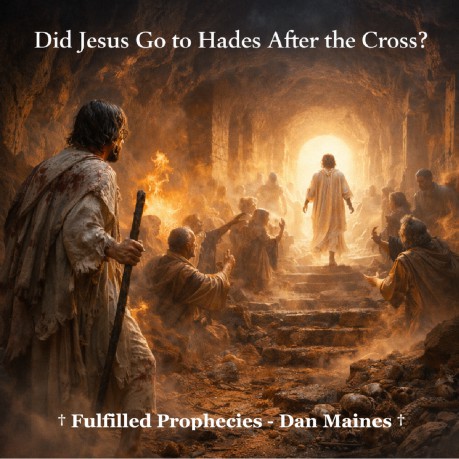
Did Jesus Go to Hades After
the Cross Introduction † In the Bible, Hades is the realm of the dead,
not a place of torment for the righteous. (Ecclesiastes 9:10) Psalm 16:10 † This Psalm defines Sheol as the realm of the
dead, not a place of punishment. (Ecclesiastes 9:10) Acts 2:27 † Scripture shows that Jesus truly entered
death. (Romans 6:9) Matthew 12:40 † The heart of the earth is Jewish language
describing death and the realm of the dead. (Genesis 37:35) Ecclesiastes 9:10 † Sheol is described as the state of death, not
conscious torment. (Psalm 6:5) John 19:30 † What did He do there, He did not suffer
torment, the suffering was finished on the cross. (Isaiah 53:5) Ephesians 4:8-10 † Instead of suffering, He entered death as a
victor. (Colossians 2:15) Revelation 1:18 † Revelation confirms the result of His
descent, He was dead, and now He lives forevermore. (Romans 6:9) Hosea 13:14 † This prophecy anticipated the Messiah's
victory over death and Sheol. (1 Corinthians 15:54-55) 1 Corinthians 15:54-55 † Paul declares Hosea's prophecy fulfilled.
(Hosea 13:14) Luke 16:31 † This passage is often misused to define
Hades, but it is a parable spoken before the cross. (Luke 16:19-31) Revelation 20:14 † Death and Hades are conditions, not people.
(1 Corinthians 15:26) Historical References † Josephus describes Sheol as the realm of the
dead, the unseen state of death. How It Applies To Us Today † Jesus went to Hades in the sense that He
truly died and entered the realm of the dead. John 5:24 † This passage defines the believer's present
reality. (Ephesians 2:5-6) Q and A Appendix Q Did Jesus go to Hades after He died? Q Did Jesus suffer in Hades? Q Why did Jesus enter Hades at all? Q Do believers go to Hades today? Q Did Jesus preach in Hades? Q What about torment being in Abraham's bosom? Q How do we explain Luke 16:23 where it says the
rich man was in torment and saw Abraham far away with Lazarus in his
bosom? † This is the fulfilled perspective we proclaim at
Fulfilled Prophecies † Source Index † Psalm 16:10; Acts 2:27; Matthew 12:40;
Ecclesiastes 9:10; John 19:30; Ephesians 4:8-10; Revelation 1:18;
Hosea 13:14; 1 Corinthians 15:54-55; Luke 16:31; Revelation 20:14;
John 5:24
By Dan Maines
†
In the Old Testament, this same realm is called Sheol, the grave, the
unseen state of the dead. (Psalm 16:10)
†
Much confusion exists because later tradition redefined Hades into
something Scripture never taught. (Colossians 2:8)
†
To understand what happened after the cross, we must let Scripture
define Hades and death. (Acts 17:11)
For You will not abandon my soul
to Sheol,
Nor will You allow Your Holy One to undergo decay.
†
Peter later applies this directly to Jesus, proving this was always
messianic. (Acts 2:31)
† Sheol is shown as
temporary and defeatable, not eternal. (Hosea 13:14)
You will not abandon my soul to
Hades,
Nor allow Your Holy One to undergo decay.
† Peter is clear that
Jesus was in Hades, but He was not left there. (Acts 2:31)
†
Hades here corresponds to Sheol, the realm of the dead, not a place
of torment for the righteous. (Psalm 16:10)
for just as Jonah was three
days and three nights in the belly of the sea monster, so will the
Son of Man be three days and three nights in the heart of the earth.
†
This is not language for fiery torment or punishment. (Ecclesiastes
9:10)
† Jesus did not bypass death, He
entered it fully. (Hebrews 2:14)
Whatever your hand finds
to do, do it with all your might, for there is no activity or
planning or knowledge or wisdom in Sheol where you are going.
† This
reinforces the biblical definition of the realm of the dead. (Job
14:10-12)
† This is the condition Jesus
entered when He died. (Romans 6:9)
Therefore when Jesus had received
the sour wine, He said, It is finished. And He bowed His head and
gave up His spirit.
†
There was no remaining punishment left to complete after this.
(Hebrews 10:12)
† Any teaching that places
suffering after this moment denies Christ's finished work. (Hebrews
9:28)
Therefore it says,
When
He ascended on high,
He led captive a host of captives,
And
He gave gifts to men.
Now this expression, He ascended, what
does it mean except that He also had descended into the lower parts
of the earth?
He who descended is Himself also He who ascended
far above all the heavens, so that He might fill all things.
† He descended into
the realm of death to break its power. (Hebrews 2:14)
†
Death held captives under the Law, and Christ led that captivity
captive. (Galatians 3:13)
and the living One, and I
was dead, and behold, I am alive forevermore, and I have the keys of
death and of Hades.
†
Keys represent authority and ownership. (Matthew 16:19)
†
Jesus stripped death and Hades of their authority. (2 Timothy 1:10)
Shall I ransom them from the
power of Sheol?
Shall I redeem them from death?
O Death,
where are your thorns?
O Sheol, where is your sting?
†
Death is revealed as a covenant enemy, not merely a biological event.
(Romans 5:20-21)
† Redemption from death was
always part of God's plan. (Isaiah 25:8)
But when this
perishable will have put on the imperishable, and this mortal will
have put on immortality, then will come about the saying that is
written,
Death is swallowed up in victory.
O death, where
is your victory?
O death, where is your sting?
† The sting of death was the
Law, not the grave. (1 Corinthians 15:56)
†
When the Old Covenant passed, death lost its covenantal authority.
(Hebrews 8:13)
If they do not listen to Moses
and the Prophets, they will not be persuaded even if someone rises
from the dead.
†
Parables illustrate covenant truth, they do not map afterlife
geography. (Matthew 13:34)
† It cannot
override clear teaching given after the resurrection. (Acts 2:31)
Then death and Hades were
thrown into the lake of fire. This is the second death.
† This imagery shows
the removal of their authority. (2 Timothy 1:10)
†
From the fulfilled perspective, this occurred at the judgment of that
age. (Matthew 24:34)
† Irenaeus
taught that Christ descended to the realm of the dead in victory, not
torment.
† Tertullian affirmed Christ's
victory over death, not post cross suffering.
†
He did not remain there, He was not punished there, and He emerged
victorious.
† Believers do not go to Hades
now because we are already in Christ. (John 5:24)
†
Eternal life is a present possession, not a post death reward. (1
John 5:12)
Truly, truly, I say to you, he who
hears My word, and believes Him who sent Me, has eternal life, and
does not come into judgment, but has passed out of death into life.
† We have passed
from death into life. (1 John 3:14)
† Death
no longer has authority over us. (Romans 8:1)
A
Yes. He truly entered death and the realm of the dead, but He was not
left there (Acts 2:31).
A
No. The suffering was finished on the cross (John 19:30).
A
To truly die, fulfill Scripture, and break the power of death from
within (Hebrews 2:14).
A
No. Believers have already passed from death into life (John 5:24).
A
Scripture does not teach that Jesus preached the gospel to dead
humans in Hades. Passages like 1 Peter 3:19 speak of proclamation of
victory, not evangelism, and they refer to Christ declaring His
triumph, not offering salvation after death (Colossians 2:15).
A
Torment is never said to be in Abraham's bosom. Abraham's bosom
appears only in a parable spoken before the cross (Luke 16:19-31),
and parables use imagery to teach covenant truth, not map the
afterlife. Abraham's bosom represents covenant fellowship with
Abraham, not a compartment of Hades, and it cannot override clear
post cross teaching about Christ's victory over death.
A Luke 16 is a parable spoken to the
Pharisees about covenant reversal, not a literal description of the
afterlife. The torment is never said to be in Abraham's bosom.
Abraham's bosom is described as far away, showing two opposite
covenant conditions. Abraham's bosom represents covenant fellowship
with Abraham and the promises, while the torment represents covenant
judgment and anguish for those who trusted wealth, status, and
lineage. This parable was spoken before the cross and cannot override
clear post resurrection teaching about Christ's victory over death
and Hades. If taken literally, it creates contradictions such as
bodily features and conversations after death. The parable's point is
belief in Moses and the Prophets, not mapping Hades or teaching post
death torment.
© Fulfilled Prophecies - Dan
Maines.
† Josephus, Antiquities of the
Jews; Irenaeus; Tertullian
Links