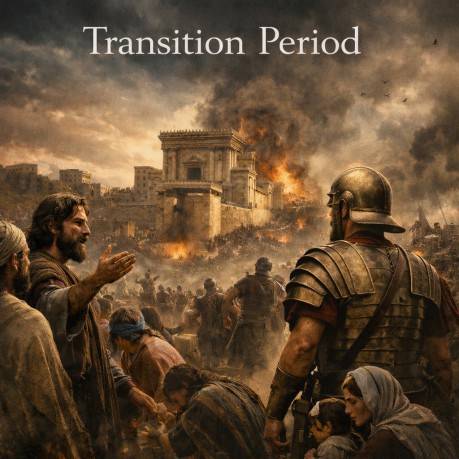
Transition Period Introduction † The Bible doesn't jump from Old Covenant to
New Covenant in a single moment, it unfolds through a God ordained
Transition Period where fulfillment replaces shadow and maturity
replaces infancy (Hebrews 8:13). The Transition Period † The Transition Period began on Pentecost in
AD 30 with the birth of the Church and ended with the destruction of
Jerusalem and the Temple in AD 70, bringing the Old Covenant age to
its close (Acts 2:1-4; Luke 21:20-24). † A spiritual house was being built, not made
with hands, in which God would permanently dwell (1 Peter 2:5;
Ephesians 2:21-22). † This change of the ages did not happen
overnight, it unfolded across forty years (Numbers 14:33-34; Matthew
23:36). Acts 2:16-17 But this is what was spoken of through the prophet Joel: † Pentecost marks the opening of the Transition
Period and the beginning of the last days of the Old Covenant age
(Hebrews 1:1-2). Matthew 12:32 Whoever speaks a word against the Son of Man, it shall be forgiven
him, but whoever speaks against the Holy Spirit, it shall not be
forgiven him, either in this age or in the age to come. † Jesus plainly identified two covenantal ages
relevant to His first century audience (Matthew 24:3). † Jewish theology already divided time into
olam hazeh and olam haba, confirming Jesus spoke within an understood
framework (Hebrews 6:5). Ephesians 1:21 Far above all rule and authority and power and dominion, and every
name that is named, not only in this age but also in the one to come. † Paul confirms the same two age framework
taught by Jesus (Romans 12:2). † This shows the New Covenant wasn't
theoretical, it was approaching fulfillment (Colossians 1:13). 1 Corinthians 10:11 Now these things happened to them as an example, and they were
written for our instruction, upon whom the ends of the ages have
come. † Paul clearly states the ends of the ages were
coming upon the first century saints (Romans 13:11-12). † The Transition Period explains why some
instructions were temporary and others permanent (Galatians
3:24-25). Hebrews 8:13 When He said, A new covenant, He has made the first obsolete. But
whatever is becoming obsolete and growing old is ready to disappear. † The Old Covenant was not merely old, it was
in the process of vanishing (Hebrews 10:9). Matthew 24:2 And He said to them, Do you not see all these things? Truly I say
to you, not one stone here will be left upon another, which will not
be torn down. † Jesus tied the end of the age to the
destruction of the Temple (Matthew 24:3). Historical References † Josephus documents the fall of Jerusalem and
the destruction of the Temple as the end of the Jewish age (Wars of
the Jews 6.4). How It Applies To Us Today † We're not waiting for a new age, we're living
in it (Hebrews 12:28). † Understanding the Transition Period protects
us from misapplied warnings (Colossians 2:16-17). Q & A Appendix Q Were the apostles mistaken when they said the
end of the ages was near? Q Does the age to come refer to heaven? Q Why do some New Testament instructions not
apply today? Q What marked the official end of the Transition
Period? Q Why did miraculous gifts operate during the
Transition Period? Q Were believers fully under the New Covenant
before AD 70? Q Why does the New Testament sometimes sound
urgent and time sensitive? Q Did the Law continue to function during the
Transition Period? Q Is the age to come still future for us today? Q Why do some passages speak of waiting while
others speak of fulfillment? Q Does recognizing the Transition Period diminish
Christ's finished work? † This is the fulfilled perspective we proclaim at
Fulfilled Prophecies † Source Index † Acts 2:16-17; Matthew 12:32; Ephesians 1:21;
1 Corinthians 10:11; Hebrews 8:13; Matthew 24:2; Hebrews 9:26
By Dan Maines
† This
period explains why the New Testament contains both fading elements
and established realities existing side by side (2 Corinthians
3:7-11).
† Understanding this Transition
Period keeps Scripture consistent, honors audience relevance, and
preserves the integrity of fulfilled prophecy (Matthew 24:34).
†
During this time the Church was growing from infancy to maturity,
moving toward the fullness promised in Christ (Ephesians 4:11-13).
†
God worked in the growing Church through miraculous gifts and
prophetic revelation to bring His people to maturity (1 Corinthians
13:8-10).
† This was a season of
transformation from the Old to the New, not confusion or
contradiction (Hebrews 12:26-28).
† The old
things of Judaism faded slowly, while the New Covenant realities
steadily took their place (2 Corinthians 5:17).
† During this time, this age was
passing away and the age to come was developing (Hebrews 9:26).
†
The New Testament writers lived and wrote within this transition
(James 5:8-9).
And
it shall be in the last days, God says,
That I will pour forth
of My Spirit on all mankind.
† Peter didn't say this
would happen later, he declared fulfillment had begun (Acts 2:33).
†
The outpouring of the Spirit signaled that the New Covenant age was
breaking in (Galatians 4:4-6).
†
This age referred to the Mosaic Covenant world then present (Luke
16:16).
† The age to come referred to the
incoming Messianic age (Mark 1:15).
† The Messiah was
expected to bring about a new world order, not delay it indefinitely
(Isaiah 65:17).
† Jesus confirmed that the
transition between these ages was already underway (Luke 17:20-21).
† Christ's
authority extended across both ages, proving His reign wasn't
postponed (Matthew 28:18).
† The age to come
was near from Paul's perspective, not distant or symbolic only
(Philippians 4:5).
†
Authority was transferring from the Old Covenant structures to Christ
alone (Hebrews 7:12).
† The language reflects
covenantal change, not physical relocation (Isaiah 51:15-16).
†
This can't be shifted to a future generation without changing Paul's
audience (1 Corinthians 1:2).
† More than one
age was ending, confirming a covenantal transition (Hebrews 9:26).
† It explains why miraculous signs
functioned during this period of establishment (Hebrews 2:3-4).
†
Paul wrote to believers living inside the transition, not beyond it
(1 Thessalonians 4:15).
†
This language describes an active Transition Period, not an instant
replacement (2 Corinthians 3:13).
† The
Temple's destruction finalized what Hebrews declared was already
happening (Luke 23:45).
†
This prophecy was fulfilled in AD 70, closing the Old Covenant world
(Luke 19:43-44).
† The Transition Period
reached its completion exactly as Jesus foretold (Matthew 24:34).
† Eusebius records that
Christians fled Jerusalem, recognizing Jesus' warnings as fulfilled
(Ecclesiastical History 3.5).
† Clement of
Alexandria taught that the Law reached fulfillment in Christ
(Stromata 6).
† Irenaeus affirmed covenant
fulfillment through Christ's work (Against Heresies 4.34).
†
Tertullian described the Old Covenant system as obsolete after
Jerusalem's fall (Apology 21).
† We don't read
Scripture through fear of unfinished prophecy (Luke 21:22).
†
We stand in the confidence of fulfilled promises (2 Corinthians
1:20).
†
It keeps us grounded in Christ's completed work (Hebrews 10:14).
†
It reminds us that the Church today is mature, established, and
lacking nothing (Ephesians 1:22-23).
A No, they spoke
truthfully to their audience, as confirmed in 1 Corinthians
10:11 and Hebrews 9:26.
A
No, it refers to the New Covenant age established through Christ, as
shown in Ephesians 1:21.
A Because they were written to
believers living during the Transition Period, as explained in
Hebrews 8:13.
A The destruction of Jerusalem and the
Temple in AD 70, which Jesus identified as the sign that all things
He spoke of were fulfilled (Matthew 24:2; Luke 21:20-22).
A They functioned as
confirming signs while the New Covenant was being established and
until maturity was reached (Hebrews 2:3-4; 1 Corinthians 13:8-10).
A They were participants in the
New Covenant while the Old Covenant was still passing away (Hebrews
8:13; Galatians 4:4-6).
A Because the
writers lived at the close of the Old Covenant age and expected its
imminent end (Romans 13:11-12; James 5:8-9).
A Yes, it remained in effect
until its fulfillment and removal at the end of the age (Matthew
5:17-18; Colossians 2:14).
A
No, we now live in what the apostles called the age to come, the
fully established New Covenant age (Hebrews 12:28; Ephesians 3:21).
A Because the
writers were living inside the Transition Period where fulfillment
was unfolding in real time (Hebrews 10:36-37).
A No, it magnifies it
by showing His work was completed exactly as promised and on time
(John 19:30; 2 Corinthians 1:20).
© Fulfilled Prophecies - Dan
Maines.
†
Josephus, Wars of the Jews; Eusebius, Ecclesiastical History; Clement
of Alexandria, Stromata; Irenaeus, Against Heresies; Tertullian,
Apology
Links