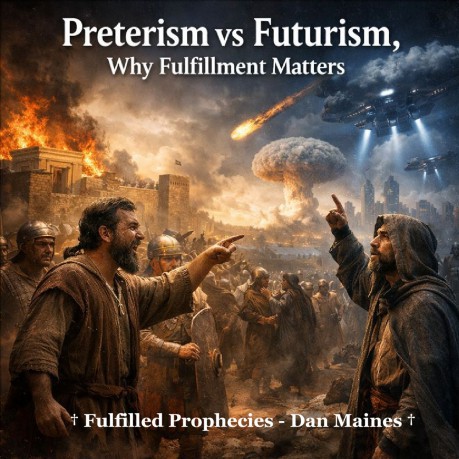
Preterism vs Futurism, Why
Fulfillment Matters Introduction † This post is written to compare two
approaches to Bible prophecy, futurism and preterism, and to show why
the fulfilled perspective honors the words of Jesus, the time
statements of Scripture, and the testimony of history. Matthew 24:34 † Jesus directly tied the fulfillment of all He
described to the generation standing before Him, not to a future
audience thousands of years removed. (Matthew 24:34) Matthew 16:27-28 † Jesus again anchored His coming to the
lifetime of some standing there, leaving no room for a distant future
fulfillment. (Matthew 16:28) Luke 21:32 † Luke records the same time marker as Matthew,
confirming this was not symbolic language but a fixed expectation.
(Luke 21:32) Hebrews 8:13 † The writer of Hebrews said the old covenant
was in the process of vanishing at the time of writing, not thousands
of years later. (Hebrews 8:13) Historical References † Eusebius recorded that Jesus warnings were
fulfilled in the destruction of Jerusalem, confirming early Christian
understanding was not futurist. (Ecclesiastical History, Book 3) How It Applies To Us Today † Preterism frees believers from fear driven
prophecy and replaces it with confidence in a finished work. (Hebrews
12:28) Q & A Appendix Q Did preterism deny the return of Christ Q Why does futurism dominate modern churches Q Does fulfilled prophecy weaken Christian hope Q Does preterism claim nothing is future at all Q Why does futurism require constant
reinterpretation Q Did the apostles expect fulfillment in their
lifetime Q Does preterism undermine the authority of
Scripture Q Why does futurism emphasize fear and
speculation Q What advantage does preterism give the believer
today Q If prophecy is fulfilled, what is our focus
now † This is the fulfilled perspective we proclaim at
Fulfilled Prophecies † Source Index † Matthew 24:34; Matthew 16:27-28; Luke 21:32;
Hebrews 8:13
By Dan Maines
†
The issue is not optimism versus pessimism, but faithfulness versus
delay. One view takes Jesus at His word, the other continually
postpones fulfillment.
† Scripture itself
tells us which approach is faithful, because God anchored prophecy to
real people, real places, and real generations.
Truly I say to you, this
generation will not pass away until all these things take place.
†
Futurism must redefine generation to mean something other than what
it means everywhere else in Scripture in order to survive. (Matthew
23:36; Luke 11:50-51)
† Preterism accepts
Jesus meant exactly what He said, which preserves His credibility and
authority. (John 7:16)
For the Son of Man is going
to come in the glory of His Father with His angels, and will then
repay every man according to his deeds.
Truly I say to you,
there are some of those who are standing here who will not taste
death until they see the Son of Man coming in His kingdom.
† Futurism is
forced to separate verse 27 from verse 28 to avoid the timing
statement, something the text itself never does. (Matthew 16:27-28)
†
Preterism keeps the passage unified and consistent, showing Christ
came in judgment and kingdom authority within that generation.
(Daniel 7:13-14)
Truly I say to you, this
generation will not pass away until all things take place.
† Futurism must claim all things
have not happened yet, even though Jesus said they would in that
generation. (Luke 21:22)
† Preterism
recognizes the destruction of Jerusalem as the covenantal fulfillment
Jesus was describing. (Luke 19:41-44)
When He said, A new covenant,
He has made the first obsolete. But whatever is becoming obsolete and
growing old is ready to disappear.
† Futurism
keeps the old covenant shadows alive by pushing fulfillment into the
future. (Galatians 4:21-31)
† Preterism sees
the complete removal of the old covenant system in AD 70 as the final
confirmation of the new covenant. (Hebrews 9:26)
†
Josephus documented the exact signs Jesus described, famine, false
prophets, wars, and the city surrounded by armies. (Wars of the Jews,
Book 6)
† Clement of Alexandria taught that
the end spoken of by Jesus referred to the end of the Jewish age, not
the end of the world. (Stromata)
† It anchors faith in what Christ has
already accomplished rather than what we are told to endlessly wait
for. (Ephesians 1:20-22)
† It restores trust
in Jesus words, because He wasn't mistaken, delayed, or symbolic
about timing. (John 14:29)
A
No, it affirms Christ came in judgment and kingdom authority exactly
when He said He would. Matthew 16:27-28; Matthew 24:34.
A
Because delayed fulfillment removes accountability and keeps people
dependent on systems of interpretation rather than Scripture itself.
Matthew 24:48; 2 Timothy 4:3.
A
No, it strengthens hope by showing God keeps His word on time.
Hebrews 6:18; Romans 15:13.
A
No. Preterism teaches that Bible prophecy concerning Israel, the Law,
the Temple, and the covenant age reached fulfillment in Christ and in
AD 70. We still live, grow, suffer, and die in history, but
redemptive prophecy has reached its goal. Hebrews 1:1-2; Hebrews
9:26.
A Because the time statements
given by Jesus and the apostles keep expiring. To survive, futurism
must redefine generation, near, shortly, and at hand into meanings
they never have elsewhere in Scripture. Matthew 24:34; Revelation
1:1; Revelation 22:6.
A Yes. They spoke of the end as near,
at hand, and about to happen, and they warned first century believers
to prepare for it. Romans 13:11-12; James 5:8-9; 1 Peter 4:7.
A No, it strengthens it. Preterism
takes Scripture at face value and refuses to override clear timing
statements with theological systems. John 14:29; Numbers 23:19.
A Because unresolved prophecy
creates uncertainty. When fulfillment is always future, believers are
kept watching headlines instead of trusting finished promises. Luke
21:28; Hebrews 10:23.
A It gives assurance. Christ reigns now,
the kingdom is established, sin has been judged, and believers live
in the fullness of the new covenant without waiting for validation.
Colossians 1:13; Hebrews 12:28.
A Faithfulness, maturity, and walking in
the reality of what Christ has already accomplished, not waiting for
what He already completed. Ephesians 4:13; Galatians 2:20.
© Fulfilled Prophecies - Dan
Maines.
† Josephus, Wars of the Jews,
Book 6; Eusebius, Ecclesiastical History, Book 3; Clement of
Alexandria, Stromata
Links