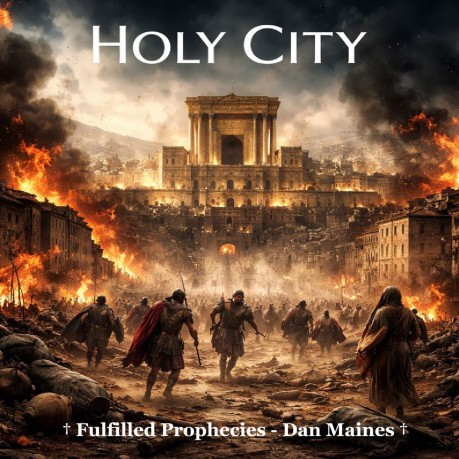
Holy City Introduction † The identity of Revelation's Harlot City
isn't a mystery created by speculation, it's established by Scripture
interpreting Scripture. (2 Peter 1:20-21) Holy City Revelation 11:2-8 But leave out the courtyard which is outside the temple and do not
measure it, because it has been given to the nations, and they will
trample the holy city for forty-two months. † Revelation identifies the Holy City as the
place where the Lord was crucified, which can only be Jerusalem.
(John 19:16-20) Nehemiah 11:1 Now the leaders of the people lived in Jerusalem, but the rest of
the people cast lots to bring one out of ten to live in Jerusalem,
the holy city, while nine-tenths remained in the other cities. † Jerusalem is explicitly titled the Holy City
in Scripture. (Nehemiah 11:18) Isaiah 52:1 Awake, awake, clothe yourself in your strength, O Zion, clothe
yourself in your beautiful garments, O Jerusalem, the holy city, for
the uncircumcised and the unclean will no longer come into you. † Zion and Jerusalem are directly named as the
Holy City. (Isaiah 48:2) Matthew 27:53 and coming out of the tombs after His resurrection they entered
the holy city and appeared to many. † The Gospel writers confirm Jerusalem retained
the Holy City title in the first century. (Matthew 4:5) † ALWAYS and ONLY Jerusalem is titled the Holy
City in Scripture. (Nehemiah 11:1; Isaiah 52:1) Sodom Revelation 11:8 And their dead bodies will lie in the street of the great city
which mystically is called Sodom and Egypt, where also their Lord was
crucified. † Revelation calls the same city Sodom, and
then anchors it to the crucifixion location. (John 19:16-20) Isaiah 1:10 Hear the word of the LORD, You rulers of Sodom; Listen to the
instruction of our God, You people of Gomorrah. † God directly calls Jerusalem's rulers Sodom.
(Isaiah 1:21-23) Jeremiah 23:14 Also among the prophets of Jerusalem I have seen a horrible thing,
the committing of adultery and walking in falsehood; And they
strengthen the hands of evildoers, so that no one has turned back
from his wickedness. All of them have become to Me like Sodom, And
her inhabitants like Gomorrah. † Jeremiah applies Sodom language specifically
to the prophets of Jerusalem. (Jeremiah 23:11) † All titles applied to the Harlot are already
applied to Jerusalem. (Isaiah 1:21; Jeremiah 3:8) Harlot Revelation 17:5 and on her forehead a name was written, a mystery, Babylon the
Great, the Mother of Harlots and of the Abominations of the Earth. † Harlotry in Scripture is covenant adultery,
not paganism. (Jeremiah 3:8-9) Isaiah 1:21 How the faithful city has become a harlot, She who was full of
justice, Righteousness once lodged in her, But now murderers. † Jerusalem is directly called a harlot by God.
(Isaiah 1:10, 21) Jeremiah 3:8 And I saw that for all the adulteries of faithless Israel, I had
sent her away and given her a writ of divorce, yet her treacherous
sister Judah did not fear; but she went and was a harlot also. † God frames Israel and Judah's sin as
adultery, and even uses divorce language. (Jeremiah 3:1) † The harlot imagery is consistent from the
prophets to Revelation. (Ezekiel 16:15; Hosea 1:2) Historical References † Josephus records Jerusalem's blood guilt and
covenant rebellion leading to AD 70 judgment. (Josephus, Wars of the
Jews, Book 5-6) How It Applies To Us Today † God holds His covenant people accountable for
faithfulness, and He doesn't grade on tradition. (James 1:22) Q & A Appendex Q Why can't the Harlot be Rome Q Why does Revelation use Old Testament
language Q Who alone could be guilty of covenant
adultery Q Why does Revelation locate judgment in that
generation Q Why does Revelation call the city Sodom and
Egypt Q Why does Revelation anchor the city to where
the Lord was crucified † This is the fulfilled perspective we proclaim at
Fulfilled Prophecies † Source Index † Revelation 11:2-8; Revelation 11:8;
Revelation 17:5
By Dan Maines
†
When the Bible assigns titles, it does so with consistency, not
ambiguity. (Isaiah 28:10)
† The question
isn't what city fits our theology, it's which city already bears
these titles in Scripture. (Romans 3:4)
†
When every title applied to Revelation's Harlot already belongs to
Jerusalem, the conclusion becomes unavoidable. (Luke 21:20-22)
And I will grant
authority to my two witnesses, and they will prophesy for twelve
hundred and sixty days, clothed in sackcloth.
These are the two
olive trees and the two lampstands that stand before the Lord of the
earth.
And if anyone wants to harm them, fire flows out of their
mouth and devours their enemies, so if anyone wants to harm them, he
must be killed in this way.
These have the power to shut up the
sky, so that rain will not fall during the days of their prophesying,
and they have power over the waters to turn them into blood, and to
strike the earth with every plague, as often as they want.
When
they have finished their testimony, the beast that comes up out of
the abyss will make war with them, and overcome them and kill
them.
And their dead bodies will lie in the street of the great
city which mystically is called Sodom and Egypt, where also their
Lord was crucified.
† The forty-two months fits a
bounded covenant judgment window, not an open-ended future. (Daniel
12:7)
† Revelation itself ties the city to
the crucifixion location, so it can't be Rome. (Luke 23:33)
† This title
isn't symbolic guesswork, it's a stated biblical designation. (Isaiah
52:1)
† So when Revelation uses Holy City,
it's using Jerusalem's covenant title. (Daniel 9:24)
† Scripture doesn't
spread this title across the nations, it anchors it to Jerusalem.
(Nehemiah 11:1)
† That means Revelation's
Holy City language is covenantally located, not globalized. (Luke
21:24)
†
That puts the term in the exact time frame Revelation addresses.
(Revelation 1:1-3)
† This is why Holy City in
Revelation can't be reassigned without breaking Scripture's own
usage. (Romans 3:4)
†
The Holy City in Revelation must therefore be Jerusalem. (Revelation
11:2)
† The correspondence is exact, not
symbolic or transferable. (Isaiah 28:10)
†
The prophets already used Sodom as a covenant judgment name for
Jerusalem. (Isaiah 1:10)
† So Revelation
isn't inventing new labels, it's continuing prophetic courtroom
language. (Hosea 12:10)
† That makes Sodom a
prophetic covenant label, not a geographic claim. (Ezekiel
16:46-49)
† Revelation's mystically called
Sodom fits this established pattern. (Revelation 11:8)
†
That means covenant Jerusalem can be judged under the Sodom title for
corruption. (Lamentations 4:6)
† Revelation's
Sodom label stays inside the same prophetic track. (Revelation 11:8)
†
The language never shifts to Rome or any Gentile city. (Matthew
23:34-36)
† Only a
covenant people can commit adultery against God, because adultery
requires a covenant bond. (Ezekiel 16:15)
†
That covenant category fits Jerusalem, not Rome. (Isaiah 1:21)
† The faithful city
language points to covenant status, not a pagan empire. (Psalm
48:1-2)
† Revelation's harlot imagery matches
this prophetic charge. (Revelation 17:1-6)
†
Revelation's harlot judgment belongs to that same covenant lawsuit
theme. (Hosea 2:2-5)
† This is why the harlot
title belongs to Mosaic Jerusalem in that first century generation.
(Matthew 23:34-36)
†
It never describes Rome, it always describes Jerusalem. (Isaiah 1:21)
† Eusebius confirms the
destruction of Jerusalem as fulfillment of Jesus' warnings.
(Eusebius, Ecclesiastical History, Book 3)
†
Clement of Alexandria identified Jerusalem's fall as divine judgment.
(Clement of Alexandria, Stromata)
†
Titles and warnings in Scripture aren't empty symbols, they're real
judgments with real meaning. (Romans 15:4)
†
Fulfillment confirms God's faithfulness, not His failure, so we can
trust Christ's words fully. (Matthew 24:34-35)
A
Because Rome was never called the Holy City, never accused of
covenant adultery, and never crucified the Lord, Matthew 27:22-25.
A Because Revelation completes the
covenant story already established by the prophets, Isaiah 1:21;
Jeremiah 3:8.
A Only Israel under the Mosaic
Covenant, because adultery requires a covenant relationship, Ezekiel
16:15; Hosea 1:2.
A Because Jesus explicitly tied
covenant judgment to His generation, Matthew 23:34-36; Matthew 24:34.
A Because the prophets already used those
labels for covenant rebellion in Jerusalem, Isaiah 1:10; Jeremiah
23:14.
A Because it identifies
Jerusalem directly, and it blocks any attempt to relocate the passage
to Rome, John 19:16-20; Revelation 11:8.
© Fulfilled Prophecies - Dan
Maines.
† Nehemiah 11:1; Isaiah 52:1;
Matthew 27:53
† Matthew 4:5; Daniel 9:24;
Isaiah 48:2; Isaiah 1:10; Jeremiah 23:14; Isaiah 1:21; Jeremiah 3:8
†
Josephus, Wars of the Jews, Book 5-6; Eusebius, Ecclesiastical
History, Book 3; Clement of Alexandria, Stromata
Links